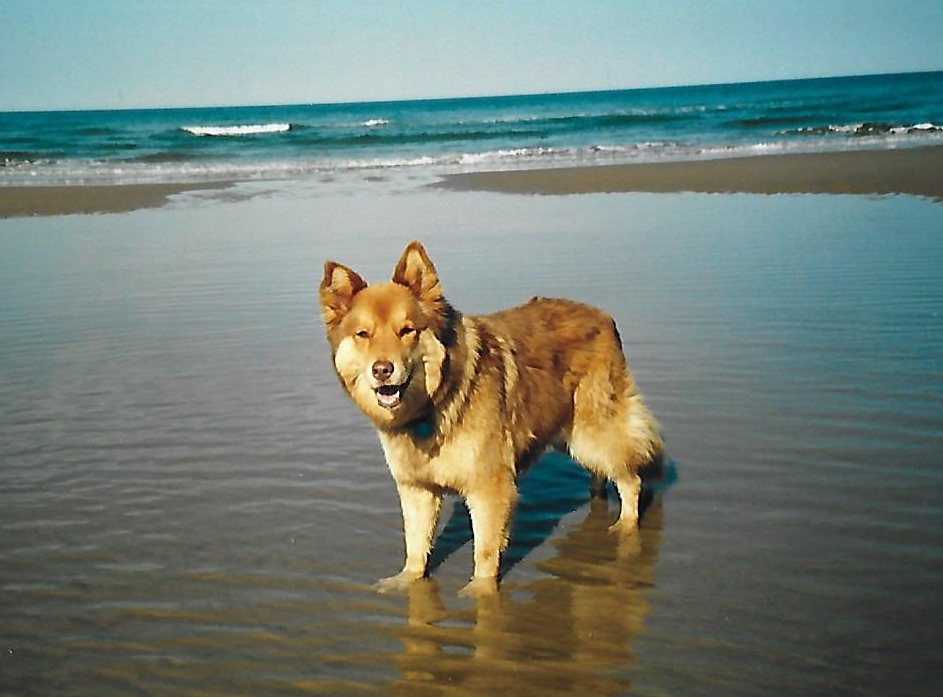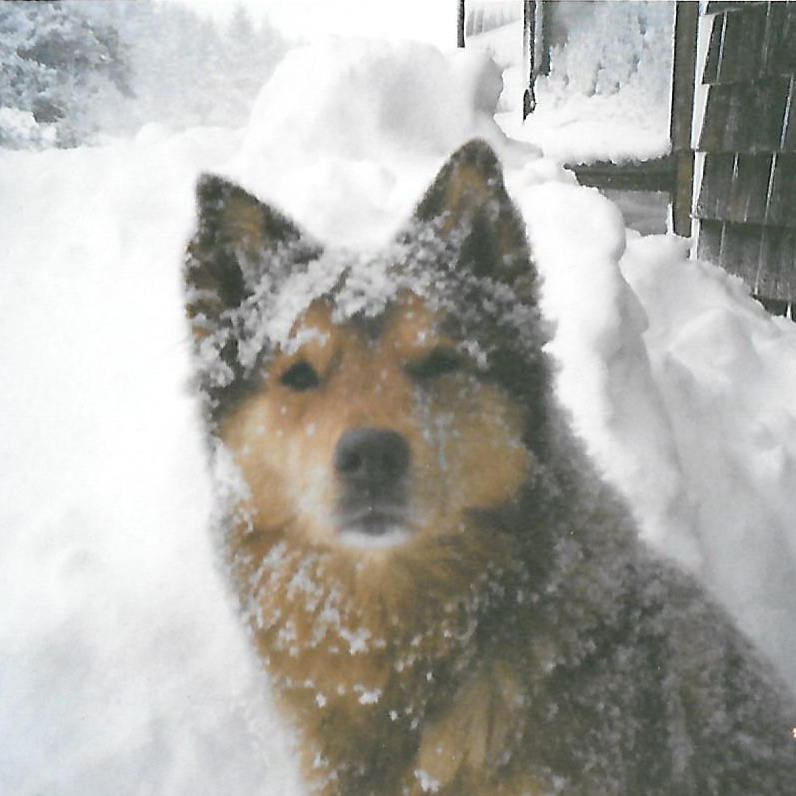
Travels with Tundra and Spot

This year, 2025, marks twenty years since I was back on the road with Tundra, driving from my new Cape Breton home to Calgary and back again. I’d already done that road trip five times, so I was an old hand at long days on the road, finding free overnight stops, and the best backroads. My first big cross-country trip was in 2001, when I spent a year on the road with Tundra. We visited all ten provinces and Yukon territory, but Cape Breton captured my heart.

I moved to Cape Breton in 2004, with my travel trailer in tow and Tundra riding shotgun, as described in Twenty Years in the Holler. But I still had one foot – and a house – in Alberta. It was time to head back to wrap up loose ends and cut ties with my home province. I had a house to empty out and sell up, and family and friends to visit. So in August of 2005 I drove back to Alberta, Tundra by my side, to complete the relocation from Calgary to Cape Breton.
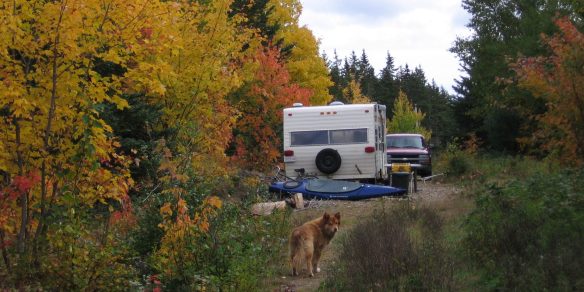
Settled in our new home in Cape Breton and lovin’ it!

I’d rented my Calgary house out in 2001, the year of the big road trip. Now my tenants had given notice and it seemed best to just sell up. But first I had to empty the place out. Most of the furniture had to go, and my son and I had to sort through piles of stuff we’d accumulated over the years.

It just so happened that my son and his partner were renting a place three doors down, so we had a fun summer being neighbours. I could walk over in my slippers to enjoy a BBQ on their balcony; my son could drop Tundra off on his way to work. Meanwhile, we picked away at the pile of stuff. It was a bit of a job, with a lot of memories to sort through.

My son donated his stash of childhood action figures to charity. Who knew they would turn into valuable collectors’ items? But it also turns out there’s a whole lot of stuff you can’t give away – no one wants it. In the end, I had to hire a one-ton truck to haul a load of rubbish to the dump, which deeply pained my frugal soul.

Speaking of frugal, I decided to try selling the house online myself to save thousands in real-estate agent fees. It was a small bungalow, built on a hillside above the Bow River with lots of privacy and a lovely view out back. But the front was below street level and totally lacked curb appeal. I was standing on the road taking a photo when a man pulled up beside me and rolled down his window. Hippie guy, long dark ponytail and beard.

“Hi. Do you know of any houses for sale in this area?” Seriously?
“… Uh … yeah. This one,” I replied.

He and his wife were teachers in the Yukon but were moving to Calgary in a year. He was on a quick trip to buy them a house before prices went up (same reason my tenants had given notice – they bought a house). He liked Montgomery, an old neighbourhood nestled into a meander of the Bow River, so he’d been driving around looking for ‘For Sale’ signs when he happened upon me standing in the road with my camera. What are the odds?

He came inside, took a look around, and asked, ‘How much do you really want for it?’ I liked him, this long-haired teacher from the Yukon, and I opted to be upfront. I named the price I had decided as my bottom price, one that was reasonable at the time. He agreed. I called the lawyer who’d done the paperwork when I bought the house. It was late Friday afternoon, but his office was nearby and he agreed to see us. We scooted over and signed the paperwork. I paid the lawyer and the deal was done – just like that.

And what a deal! Both the buyer and my tenants were a whole lot more savvy than me. Calgary house prices went through the roof the following year and kept on skyrocketing. That little bungalow had almost doubled in price two years after I sold it. C’est la vie.

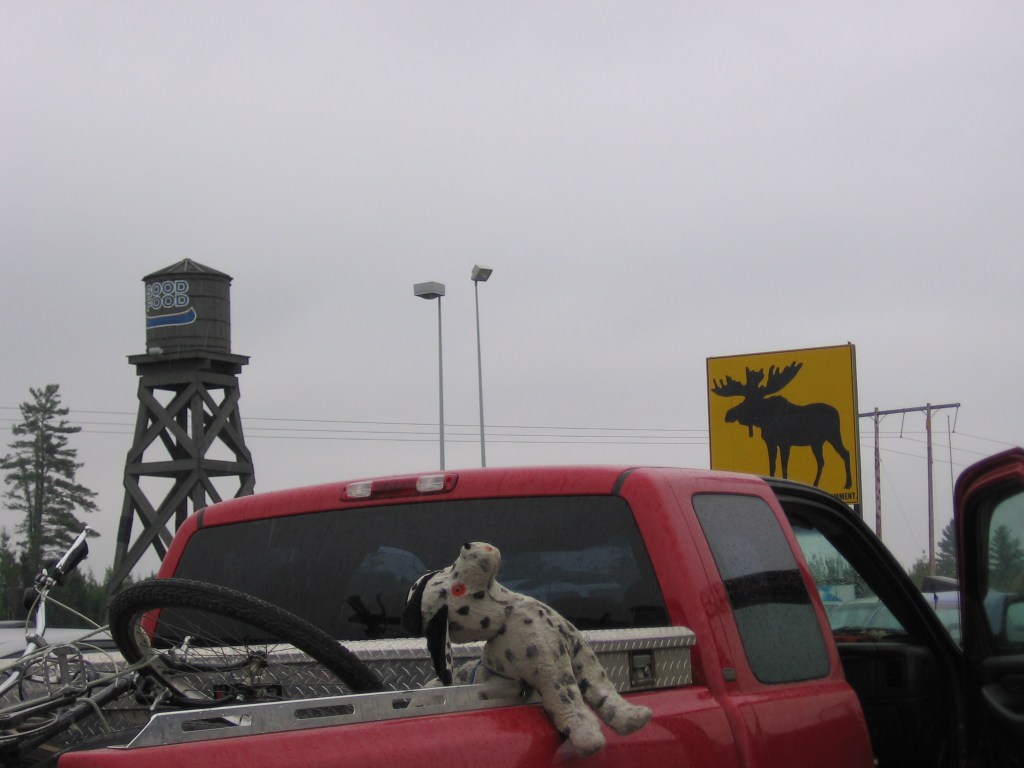
Possession date loomed and I was under the gun to finish purging and packing. I bought a 6’x12′ cargo trailer to haul and store items that made the final cut: tools, camping gear, art work, art supplies, musical instruments, bags of clothes and bins of books, and my beloved rocking chair. I filled the cargo trailer to the roof and piled rubber totes into the truck bed, strapping my trusty bicycle on top. And then I bungeed Spot in.
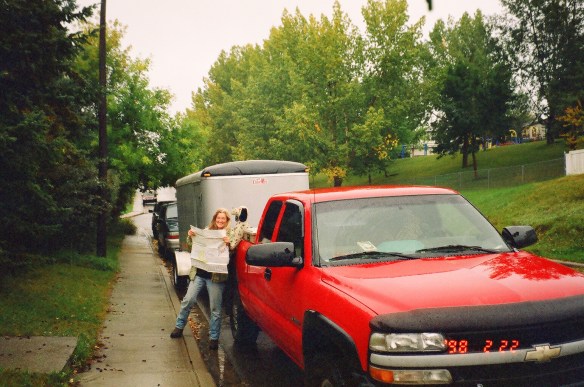
The cargo trailer is hooked up to Roadeo and Spot is ready to roll. Now, which way to Cape Breton?

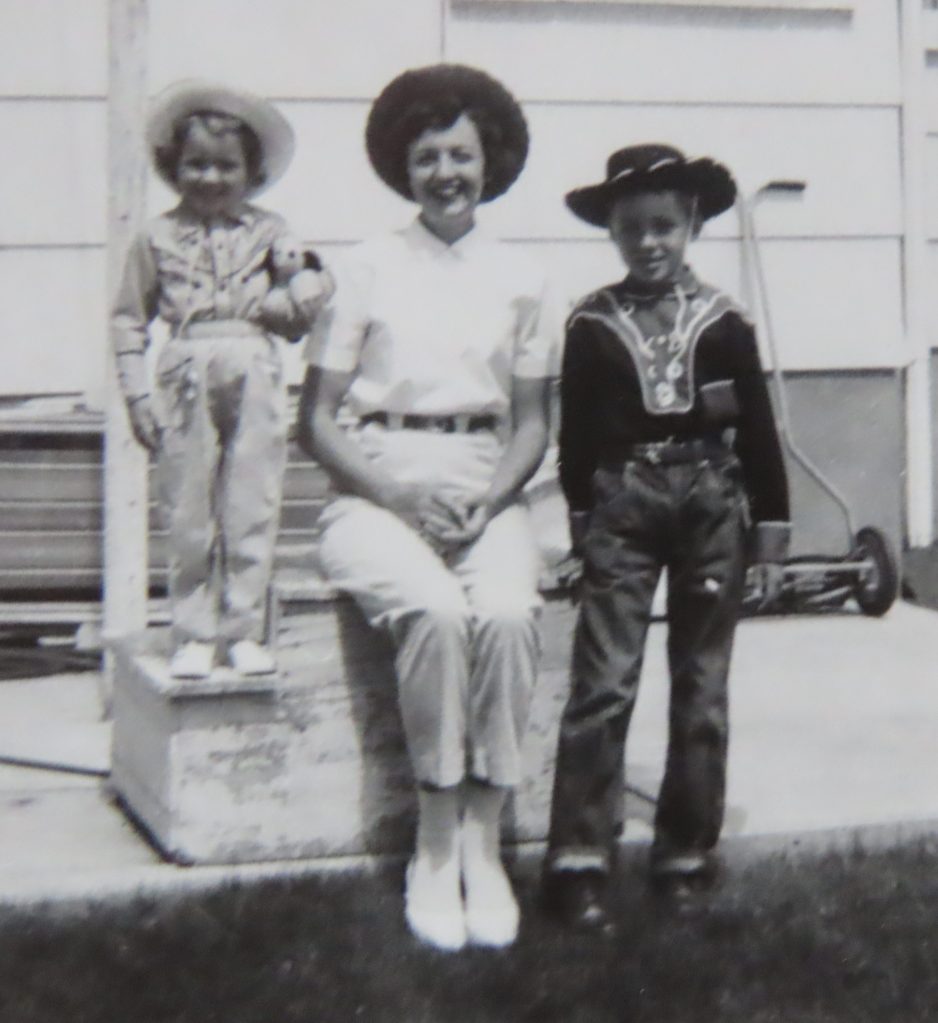
Spot? A very original name for the big stuffed dalmatian that my mum won at the Stampede and gave to my brother and me when we were children. He was life-sized and I adored him. Dolls? Meh, not my thing. But I loved Spot and all my other stuffies. To me they were alive, my beloved friends and playmates. And there I was, 49 years old, and faced with letting them go. Too old and grubby to donate, too precious to trash.

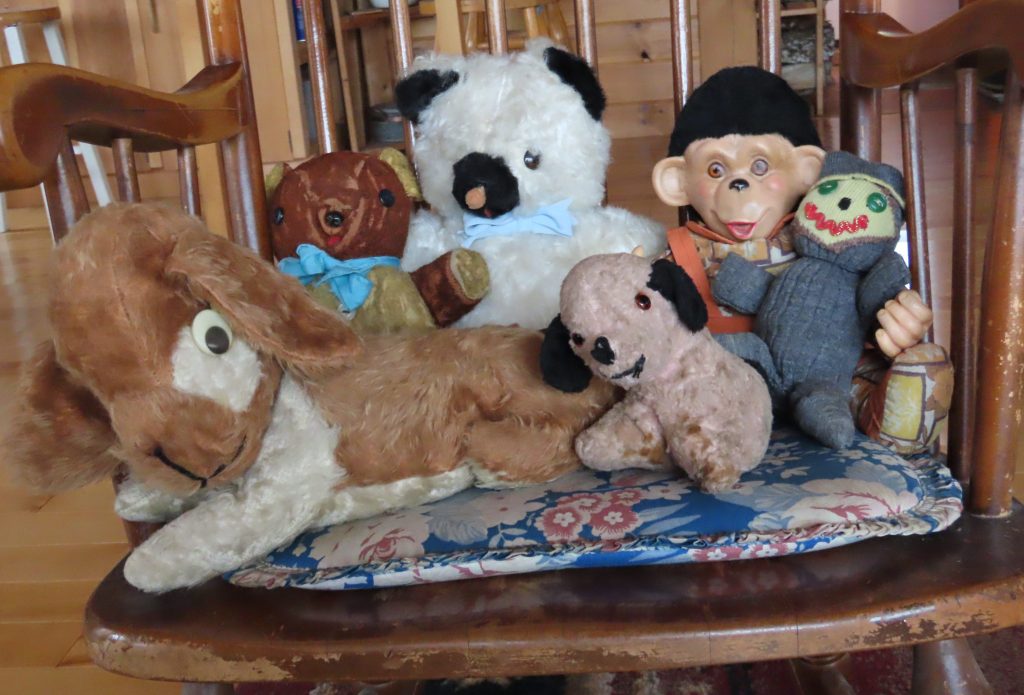
Survivors of the purge, including Shaggy and Pinky, in my old rocking chair.

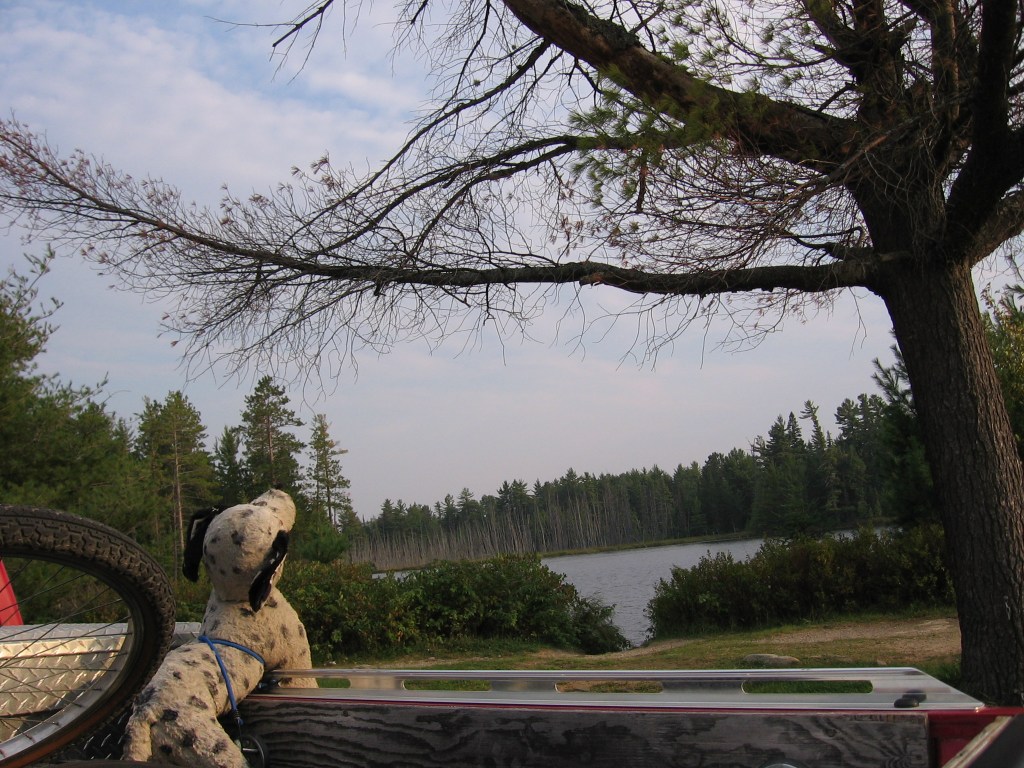
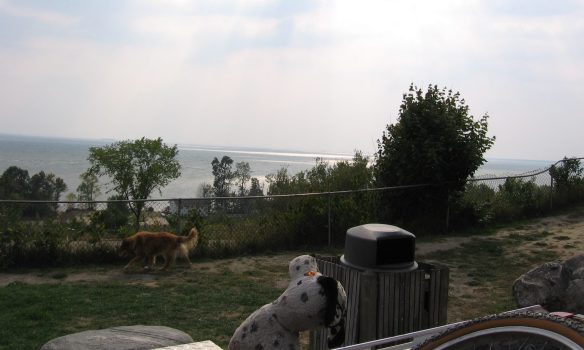
I picked the oldest and dearest and packed them in the cargo trailer, but Spot rode where all dogs used to ride, in the back of my pickup truck. Tundra lounged in the lap of luxury, on the bench seat beside me.

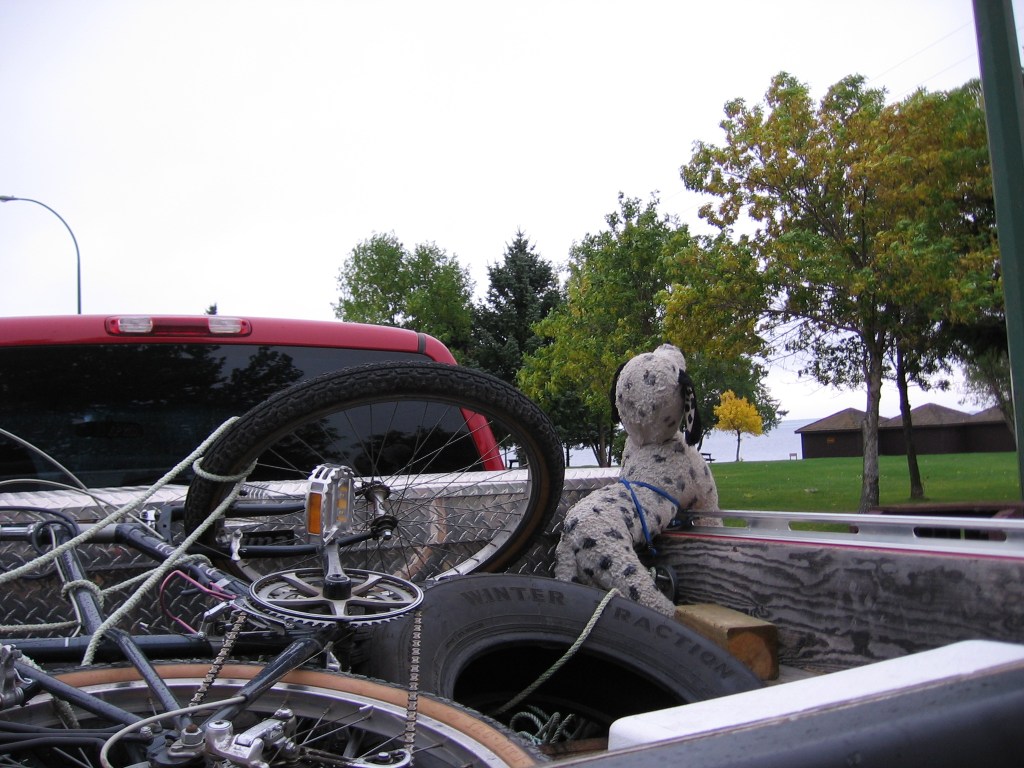
I left Calgary on September 9th, 2005, four years and one day after I left on my epic 2001 trip. As always, I lined up Truckin’ by the Grateful Dead on the tape deck, and, as always, I took the prairie backroads, which, according to my journal, varied between ‘the good, the bad, and the ugly.‘ It was getting dark when I stopped in some small prairie town for ice. I’d just passed an older fellow with a long white beard on a bicycle, and now he passed me and called out, “I like your dog!” “Thanks!” I called back, confused. Tundra was curled up on the passenger seat – no way he could have seen her. Then I realized he meant Spot. Cool.

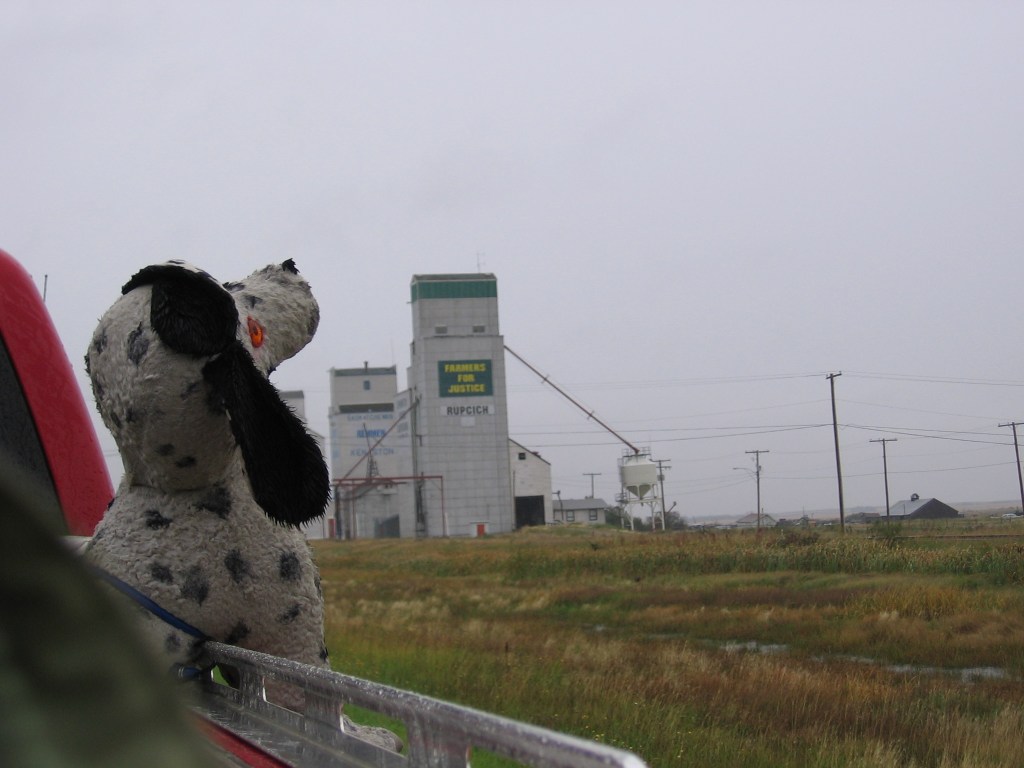
We rode out a wicked scary thunderstorm overnight in the Qu’Appelle Valley in Saskatchewan. The next day I had to pull over when we hit a black wall of rain so thick I couldn’t see a thing. It finally cleared and I stopped at a little cafe in a small town, well off the beaten track. All the regular fellas sitting at the formica counter turned to stare. I ordered a grilled cheese sandwich and the guy behind the counter got it started on the grill. Then he leaned back and looked at me.

“So what the hell are you doing in Punnichy anyhow?” he asked.
I laughed. Good question.
“Driving to Nova Scotia,” I replied. I mean, why else would I be driving along some lonely gravel road 120 kms north of the TransCanada Highway? I guess they don’t get a lot of strangers in Punnichy. And that’s what I love about taking the backroads.
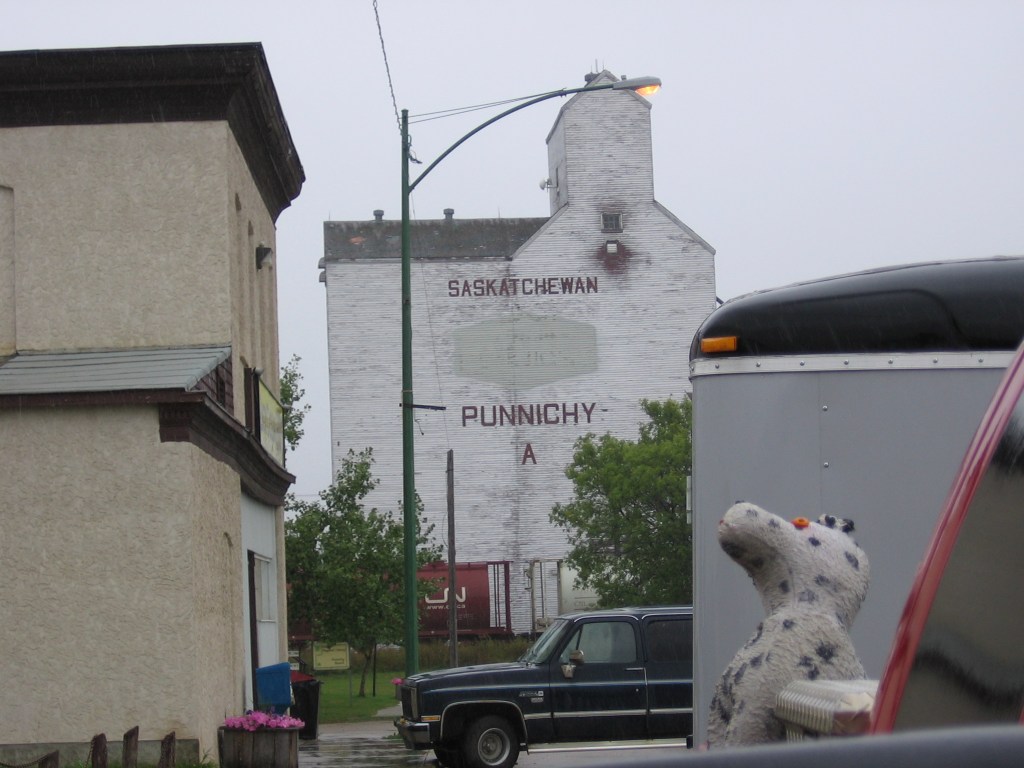
Punnichy – stop here if you want a good grilled cheese sandwich at the local cafe.

The other great thing about the prairies are the skyscapes. Land of Living Skies is an apt license plate for Saskatchewan and is true of all the prairies. But the most stunning skyscape happened on the second night of our journey east, just past Winnipeg. I’ve seen the northern lights quite a few times, but nothing like these. I found a turnout and pulled over. Here’s what my journal has to say about what happened after I stepped out of my truck.

Aaaaahhh! I scream – in surprise and delight and astonishment at the heavenly dance overhead. Then – aaahhh! – red and blue and white shards of light splinter dance swirl – I am in a magic world both ecstatic and a bit frightening in its intensity, its beauty. It’s awesome – in the the true sense.

True awe. It’s not just a sense of wonder, but wonder tinged with fear, with a feeling of being overwhelmed. Of being very tiny in the vastness of the universe. I can understand why indigenous people have a spiritual connection to the aurora borealis. It’s so much more than a celestial light show.

We spent the night in the parking lot of the Welcome Centre at the Manitoba/Ontario border. The next day I drove off to the music of Little Feat, feeling infused with spectral energy. When I stopped for gas, a woman came up to the pumps, laughing. I’d forgotten about Spot.
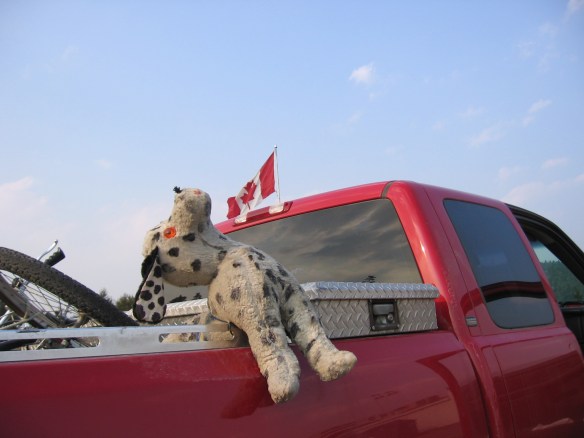
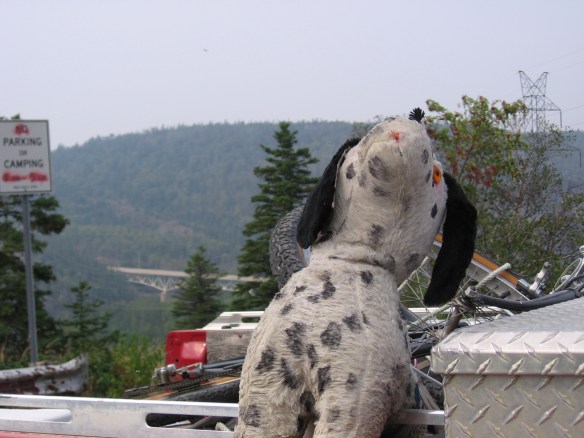
People warned me, the first time I set off to drive across the country, that I would spent half my trip driving though Ontario. They weren’t wrong. Unlike the east/west roads of the prairies, there is a lot of driving northeast then southeast, rounding the Great Lakes. Every sign says the next city is 600 kms away. It’s beautiful country around Lake Superior, but on this trip the skies were hazy all the way. Plus it was much too hot for September.

Sault Ste. Marie is the half-way point between Calgary and Cape Breton. I called my son from a pay phone and greeted him by saying, “This is Sue, calling from the Soo.” After a nice chat I kept on driving. And driving. There were way too many big trucks after dark so I opted to stop for the night. My journal laments the unseasonable warmth.

“I duck into a picnic spot and try to sleep in the godawful heat – sweating in the stuffy back seat – no breeze – in mid Sept!! I hate Ont., I’m thinking as I lay there. Finally, 3ish, I sleep until 8ish then up and off in the haze and it’s warm already.”

Well. So much for the joys of being on the road again. It ain’t all roses.

Finally out of the haze, as glorious ‘God rays’ shine on Lake Nippising. Tundra is by the fence.

My favourite road song is ‘Truckin’ by the Grateful Dead. I think of the chorus as a refection on life, but on this road trip these lyrics were literally true.

Sometimes the light’s all shinin’ on me …
Other times I can barely see …
Lately it occurs to me –
What a long, strange trip it’s been.

If Ontario was long (and hot and hazy), Montreal was terrifying. I hear there’s a ring road now – not to mention GPS if one has a smart phone – but back then I was driving a big pickup and hauling a trailer while trying to navigate roads and construction detours, surrounded on all sides by insane Quebecois driving as if they’re racing in the Grand Prix. No matter my careful plans, my attempts to memorize the simplest route, it was always a nightmare and 2005 was no exception. I decided to go at night – less traffic. It turns out that’s when they do even more construction so it was ALL detours. I got totally lost and discombobulated. Arghhh!

But somehow we made it through intact and I pulled into the first rest stop. I’d never see one so crammed with big rigs. I figured they all went through Montreal at night and then rested. I slept in the back seat, relieved to have the worst behind me. The next day we took a peaceful road that parallels the highway along the St. Lawrence. We stopped in the beautiful village of Kamouraska, made famous by the Quebec writer Anne Hebert.
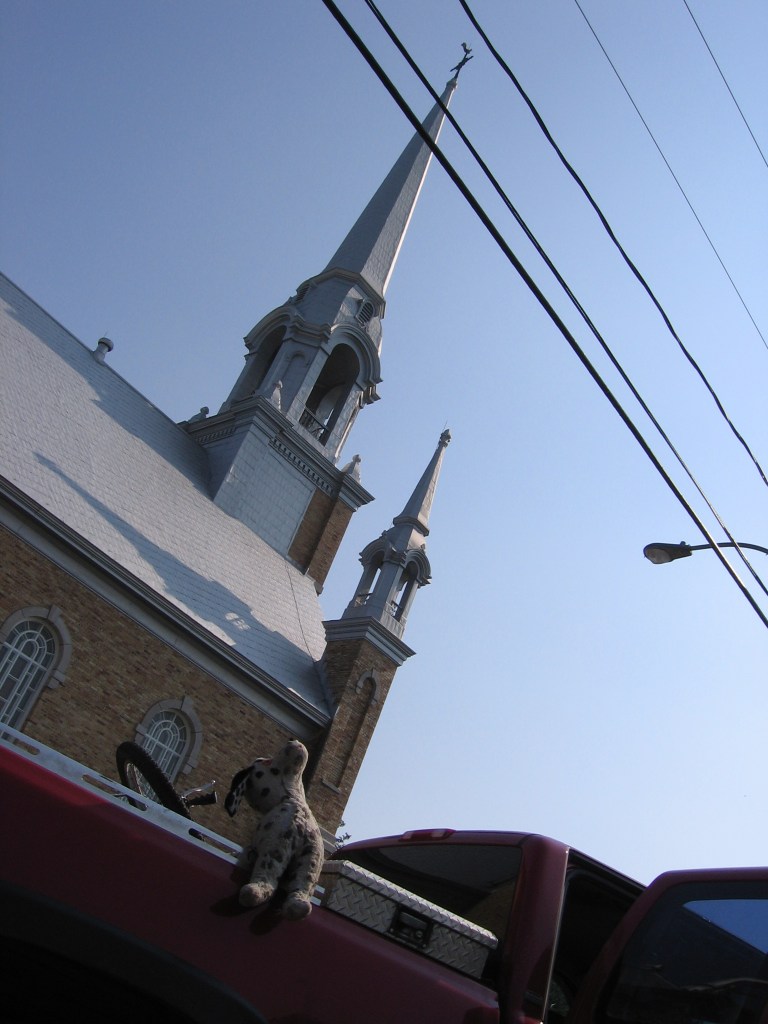
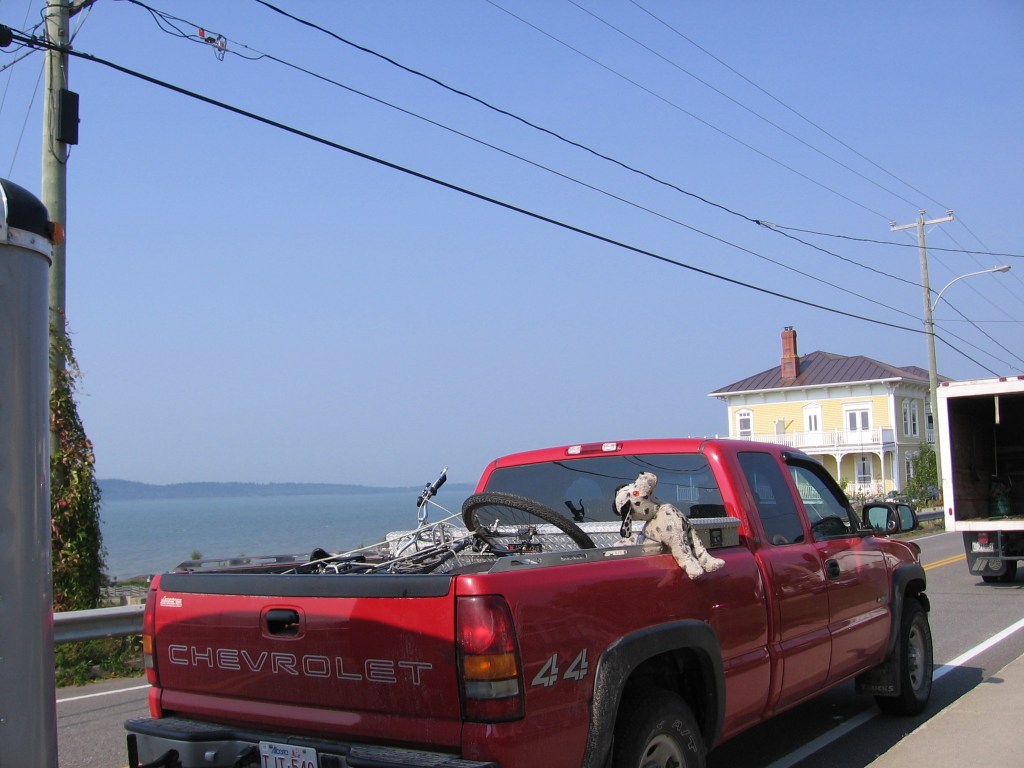
I turned off at Riviere du Loup, saving the rest of the Gaspe for another day. Then across country to New Brunswick. Six days on the road and we’re finally in the Maritimes – ‘yahoo!‘ my journal says. But it still wasn’t a cakewalk. I ended up driving at night, worrying about bright headlights and dumb moose, then almost ran out of gas and had a hard time finding an all-night gas station. Near Fredericton I forked out $65 for the luxury of a good night’s sleep in a motel.
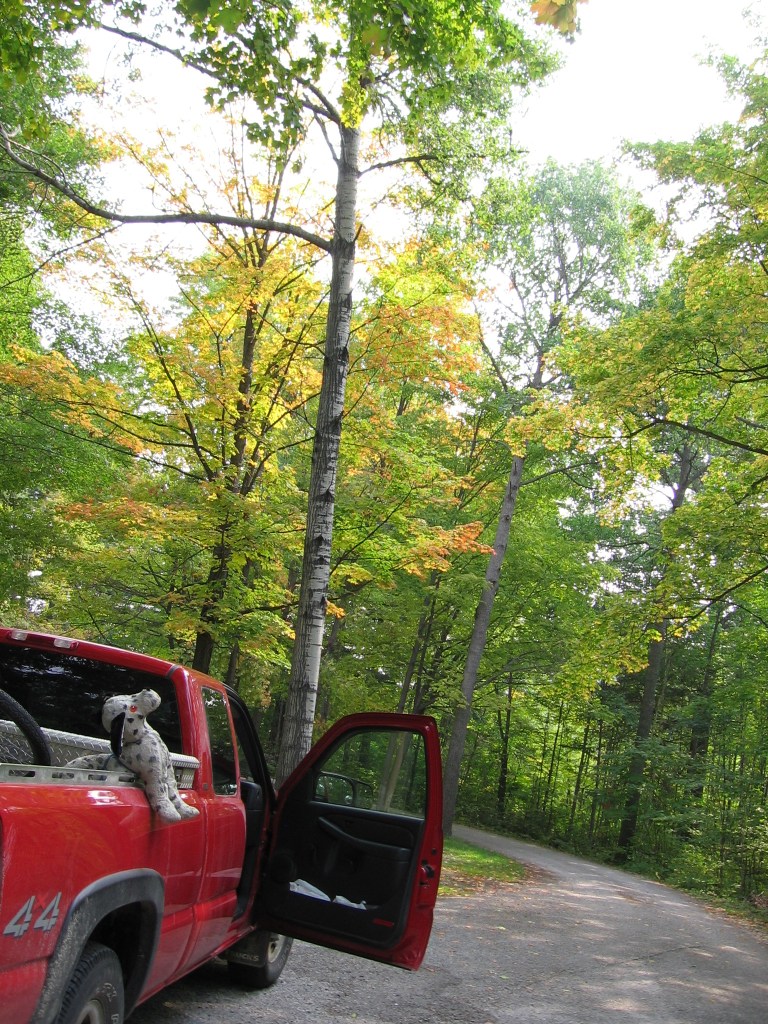
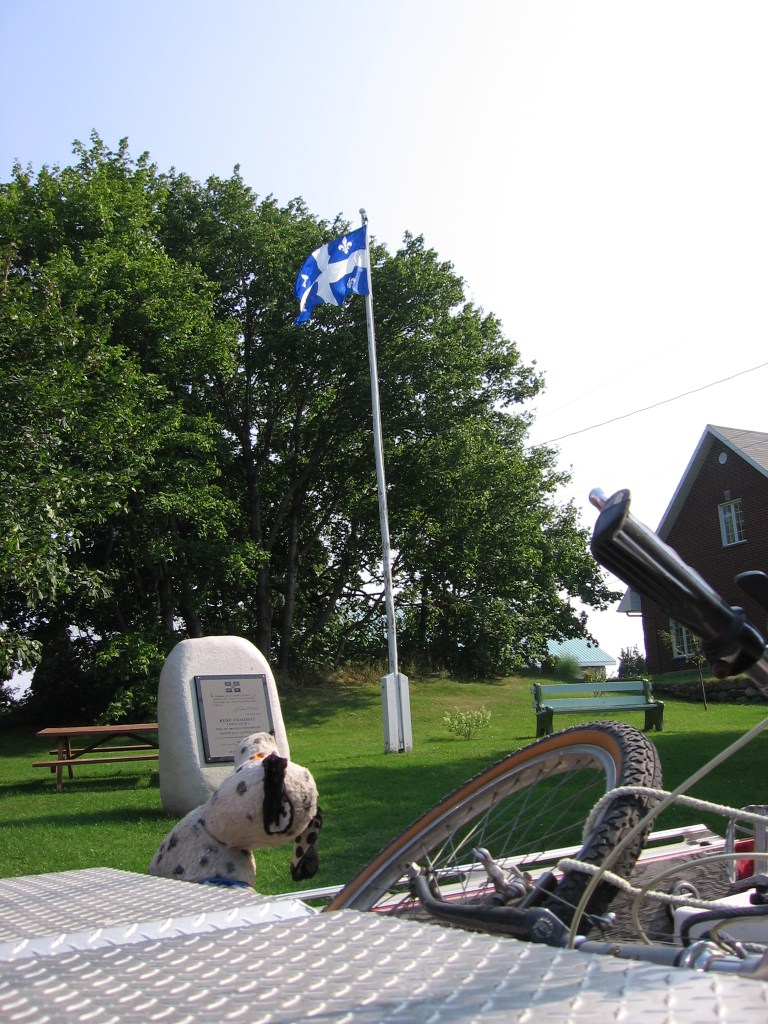
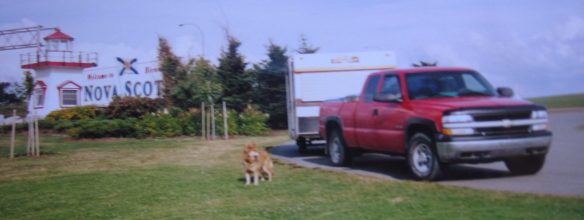
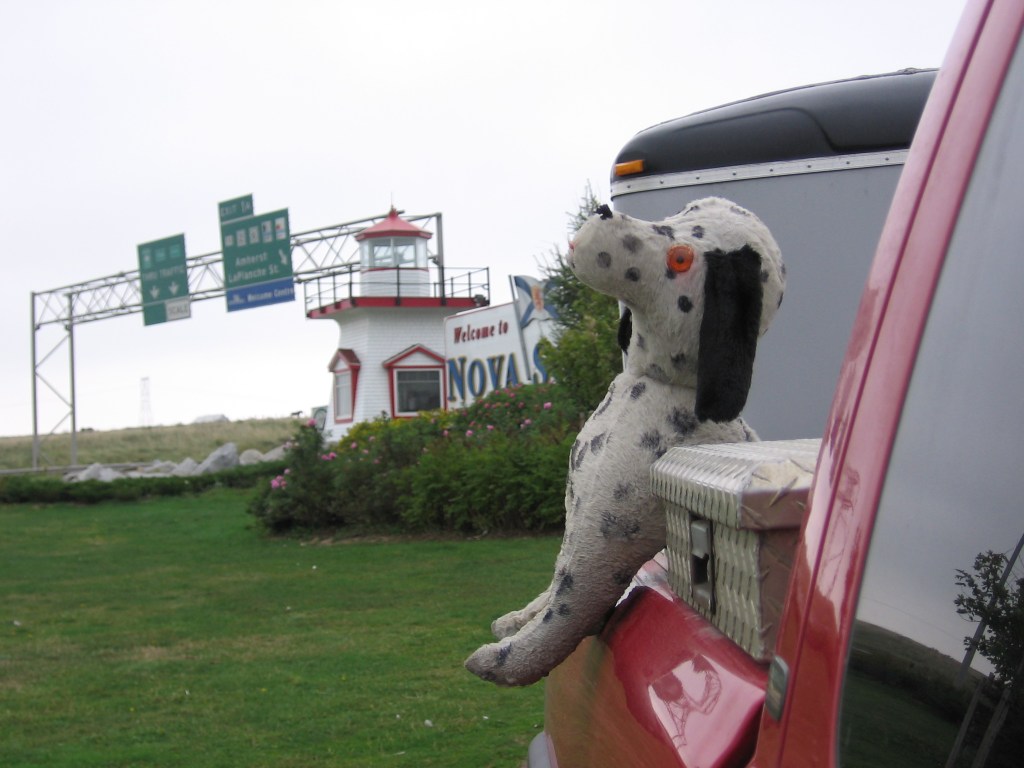
After all that heat and haze in central Canada it was wet and rainy in the Maritimes. We scooted through New Brunswick and made it to Nova Scotia. That got an all-caps YAHOO! in my journal. Had to stop for the obligatory photo at the lighthouse sign to add to my collection from previous trips. It was ‘very cold and windy‘ and I got my photo and got back into the truck just as the heavy rain started. Spot got soaked, but at least he didn’t get that wet dog smell.
Tundra stretches her legs in 2004. Roadeo hauling the travel trailer out to the new land.

It was dark when I crossed the Canso Causeway and I wanted to arrive back in the Holler in the daylight. So I splurged on another night in a motel. My journal has a page of complaints about the woman who tried to overcharge me the next morning and spoiled my happy Cape Breton vibe. But now, twenty years later, I’m over it. In fact, I’d forgotten all about it, so I’ll spare you the details.

I drove past the beautiful Bras D’Or Lakes, blue under a blue sky, and my angry frown flipped into a smile. Stopped at the Gaelic College CAP site to check emails and visited the William Rogers art gallery, then around the loop, “lovely and me happy and feeling good.” Stopped at Piper’s campground for ice (the CAP site, the art gallery, and Piper’s are all gone now). And then … home to the Holler.

Spot gets his first view of Highland Holler, his new home.

I unlocked the gate and “All is well, gate in place, no fires in the firepit since mine, everything is just as I left it.” I pulled into a turnaround to park and unhook the cargo trailer, then went across to the neighbours’, where I’d left my travel trailer, and received a warm welcome. I hooked up my travel trailer, hauled it back, got it turned around and maneuvered into place and unhitched it from the truck. “Roadeo is free again!” I wrote.

I was all set up and ready for the remnants of Hurricane Ophelia to welcome me home. “I felt so happy and content to be home,” my journal says. “Gotta get used to saying that – home.” It’s been twenty years since I wrote that. And I am still ‘happy and content’ and very used to calling Highland Holler home.

Sue McKay Miller
December 28, 2025

One Too Many

No, not that type of one too many. One too many drinks or donuts is never a good thing and usually fits under the category ‘it seemed like a good idea at the time’. No, I mean pushing a season just a bit past its best-before date. In my case, going out just one more time after that perfect hike, swim, or snowshoe at the end of the season.

Snowshoe Season

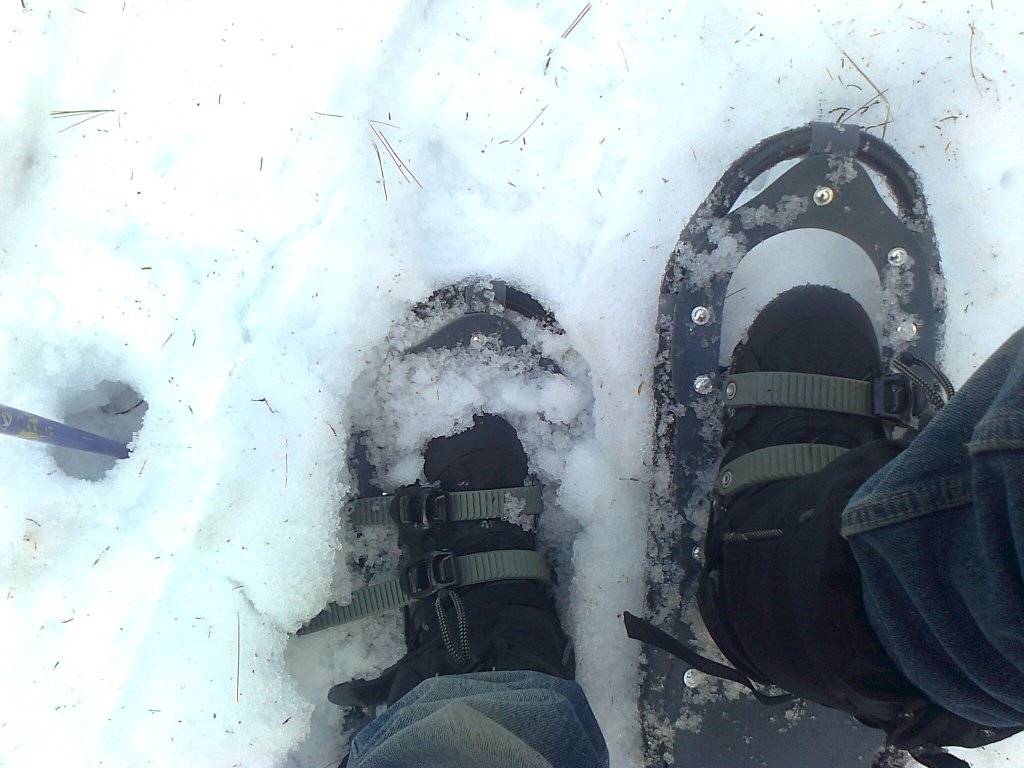
We haven’t had much snow this year, but as I wrote in The Secret Lives of Animals, my winter joy is strapping on my snowshoes and following animal tracks. With warm weather on the way I took advantage of a sunny afternoon in mid-March and went snowshoeing up the hill behind my house along an old wood road. I hadn’t gone far when I saw fresh tracks – first a pair of coyotes, then a moose. I followed the tracks up until they all fed into a narrow trail I’d cut through new growth blocking the road. I was pretty chuffed that the critters were using my trail, but it was too narrow for snowshoes, so I headed back down, past some grouse tracks. (These photos were taken a couple of days later, hence not-so-fresh or clear, and with human tracks alongside. They’re a bit better full size.)

Ruffed grouse (aka partridge) tracks in the snow.

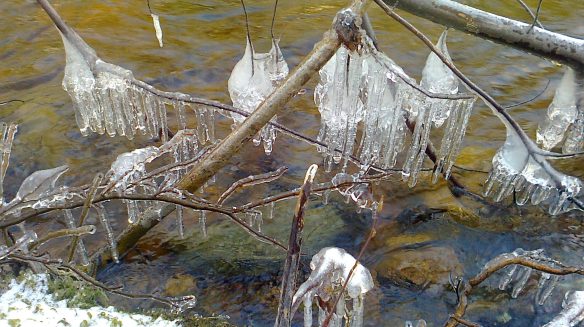
I crossed the slope over to a trail, then went down, down, down to Little River. The river was beautiful. The boulders wore icy skullcaps and stranded branches were festooned with fairy goblets and lacy necklaces of glittering ice. I paused to admire Winter’s Art Gallery, then snowshoed downstream. Before long I spotted small tracks emerging from the open water, up a steep slope, and along the riverbank. It was a mink, I think. Next came the tracks of a coyote who’d crossed the river, and, farther along, a second coyote who’d crossed over.

By chance I found myself following in the footsteps, so to speak, of these two coyotes on my way back home. We all took the same route away from the river and through the woods, but I parted ways when their tracks went straight up a very steep slope. I was almost home when I crossed their paths again. The coyote tracks went up the hill through the forest – and then out onto the old wood road above my house. This was the same coyote pair I’d started tracking when I first set out. I’d come full circle. Perfect! It was the best snowshoe I’d had in a couple of winters.

Little River ice art.

One Too Many Snowshoes

What a great way to finish up the season, right? Wrong. Of course I had to try to squeeze in just one more snowshoe before the snow disappeared. A couple of days later I set off with hope in my heart, detouring to take the track photos before heading off in the opposite direction, away from the river. It wasn’t a complete loss. I did see the tracks of a mother moose with her yearling, and a depression left by a sleeping moose. But I also had to snowshoe across moss and grass, jump over streams of snow-melt, and detour around puddles to get back onto the icy snow crust. April and the Albedo Effect was in full swing, even though it was only mid-March. It was my one-too-many snowshoe hike.

Dark late-day photo, but Moose had a snooze here.

I’ve done ‘one-too-many’ snowshoe hikes so often that it has become a Rite of Spring. A fantastic snowshoe must be followed by a rotten one. Sometime literally. When deep snow rots from below, I might break through up to my knees, as described in April – Awful or Awesome?

So why do it? Why not end on that perfect note, that ideal snowshoe? I can trace the whole one-too-many business back to 2019. I had a sublime snowshoe one brilliant blue-sky afternoon at the end of March. I’d seen lots of animal signs and enjoyed views of two waterfalls. I paused on a hilltop and looked back across the expanse of pristine white snow, shining under the sun and stretching to the next hill. I felt a deep sense of belonging, of being in the exact right time and place in the universe.

The snow had started to rot in the woods, but I couldn’t resist going again the next day, trying for just one more day of bliss. Hardly bliss. The conditions were atrocious. I tried an old wood road to the ocean, I tried through the woods to the river, but everywhere I went I kept breaking through the rotting snow. It was all frustration and no fun. I cursed myself for not having the sense to finish the season on a high note. But later I realized that ending on a sour note wasn’t all bad. It meant that I had pushed the season to its limit and a bit beyond. There was no second-guessing if I coulda/woulda/shoulda gone out one more time. And the one-too-many didn’t tarnish my memory of that perfect, penultimate snowshoe.

After my one-too-many snowshoe this year, I washed the mud off my snowshoes (no lie!) and stored them away. Why so reluctant to call it quits? Partly because now there is a pause. There is too little snow to snowshoe, but too much to bushwhack through the forest. So now I wait. And wait. Until the snow melts enough to swing into – spring hiking!

Spring Hiking Season

I don’t really ‘hike’ so much as mosey through the forest, bushwhacking up and down the highland slopes. I follow freshets and brooks flowing from the highland plateau, linger in hemlock stands, and watch waterfalls tumble down. I explore new places and revisit to my special spots, as described in The Humbled Hiker.

I head for the hills as soon as the snow melts. I live and play in a mixed forest, so there is a time before the trees leaf out at the end of May that is ideal for exploring. The lack of leaves allows for more open vistas, better ocean views, and easier route-finding. But before the veil of leaves appears, a spring scourge drops the curtain on my spring hikes. I jotted down these notes a few years ago:

One Too Many Spring Hikes

“I went on ‘one too many’ hikes the other day. I realized it as I was beating off black flies during one of my Highland explorations. The black flies won this bout, and even the dreadful DEET didn’t stop their frenzy. The plan had been to climb part way up a ridge to a hemlock stand, and see how far I could traverse along that slope. I aborted my plan once I reached the hemlock stand. I just wasn’t having fun anymore.

I enjoyed the ocean view – briefly – and the towering hemlocks – briefly – and then made my way down slope and out onto the cutline where the gusty southwest winds kept the little buggers at bay. I set out on this walk somewhat tentatively. The flies had exploded a week earlier and were annoying on a couple of previous treks, but not enough to spoil the walk.

In fact, my previous walk to a waterfall had been delightful. There were flies, here and there, and it wasn’t a good time to linger by the water, but it was worthwhile. So why not end on that high note? Because fomo. Fear of missing out on one more wonderful walk in the woods. I didn’t regret my last bushwhack, even though I had to flee from the blackflies. That one-too-many hike confirmed what I had suspected: Time to stash away the hiking gear.”

So there you have it. If a lack of snow marks the end of snowshoe season, an abundance of black flies has me fleeing the forest each spring. They breed in fresh running water – abundant on the highland slopes – and usually emerge in mid-May. I find the wee pests so distracting that it’s hard to focus on my footing, which is dangerous as well as frustrating. As my notes suggest, I’d had a wonderful walk to a waterfall that would have made for a grand finale, but I just had to push my luck.

As with the end of snowshoe season, there is a hiatus after spring hiking. The black flies are biting but the ocean is still frigid – and it takes a long, long time to warm up. So I must bide my time before I can dive into …. swim season!

Swim Season

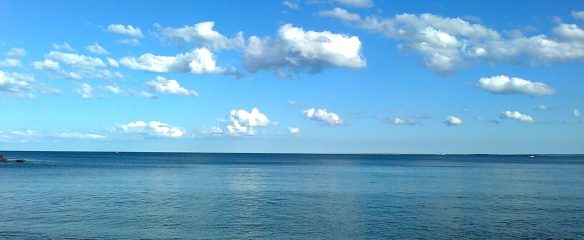
Ah, summer in Cape Breton. We are blessed with an abundance of places to swim: lakes, rivers, and ponds galore – including my own L’il Pond (Swimming with Frogs). But my favourite place to swim is the ocean. And by ‘swim’ I mean being immersed in water. I might swim a few strokes, then roll over and float on my back and gaze at the clouds bobbing by above. Or I might do a little bobbing myself, gently rocked by the waves while I watch the terns and gulls and gannets. I’m a prairie girl who fell in love with the ocean and I feel happiest when I’m held in her briny embrace.

Dive into blue bliss!

Summer is sun, suds, sand, swimming in the salty sea, and a smiling Sue. The perfect beach day is hanging out with friends, going for a swim, drying off in the hot sun with a cold drink, then diving back into water. Repeat.

One Too Many Swims

Unlike snowshoeing or hiking, there can be one-too-many swims in a single day as well as a season. The water is so tempting and the air so warm, but that last swim of the day can be a bit risky. The air temperature drops abruptly when the sun drops behind the highlands. One swim too many and I might get … the dreaded chill. Cold that gets so deep into my bones that there’s only one cure. I have to go home and get immersed again – in a nice hot bath.

Swim season in Cape Breton is sweet but vanishingly short, which is why I try to get in the water every day that the weather allows. That’s also why I push the season and end up diving in one-too-many (or even two-too-many or three-too-many) times, because it’s a long while before beach season rolls back around. Here’s a (lightly-edited) passage from my diary dated Sept. 15th, 2023. (Mervi is my beach buddy (pictured above) who is a glass blower, which is very hot work.)

“Went for a beach walk and to see waves ahead of (tropical storm) Lee. Wore tights and a cotton shirt but threw in my swimsuit and towel in at last minute. After walking in the tidal wash I felt quite warm and a couple of tourists were in the waves. It was cloudy but warm and humid. Tourists said they felt fine getting out, so after they left I put on my swimsuit – still damp from previous swim – and immediately felt chilly. Considered putting clothes back on but opted to wait for Mervi. She was hot from glass blowing and went right in. I waded out but a biggish wave soaked me almost to my neck so, after hesitating, I dove under and floated a bit cuz probably final swim.

Got out and brrr – cold. Needed to get out of wet swimsuit. Tried to wrap a towel around and change back into dry clothes but skin so clammy I couldn’t really get really dry … everything sticking and icky … I felt all chilly and clammy and sticky. Yuck! Wished I hadn’t gone in. But it was okay, I told Mervi, because this had been my one-too-many swim.”

Swim season is the hardest one of all for me to let go. And sometimes we do get a surprise blast of heat late in the season. But there comes a time when the heat has gone out of the air and the ocean is cooling down. A time to rinse out of all my beach gear and store it away, to accept that swim season is over for another year.

Just as a day at the beach must end, so swim season must come to an end.

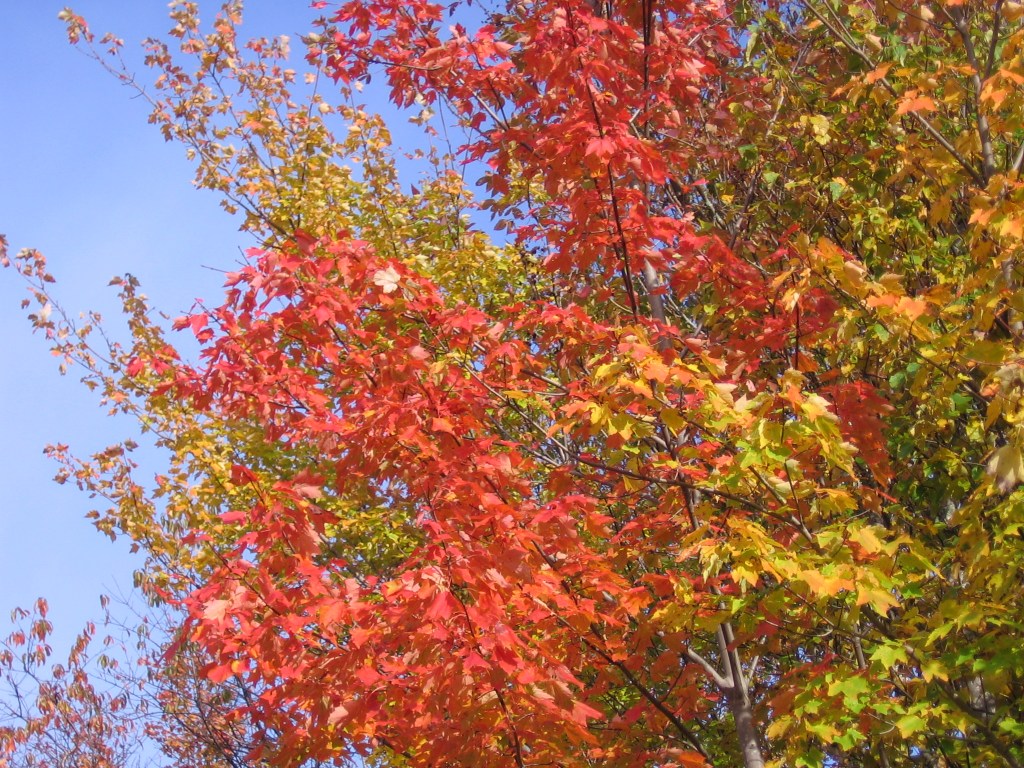
The consolation is that there isn’t any waiting around for the next fun activity to begin. Just as the ocean turns grey and cold, the forest begins to glow with red, gold, yellow, and orange. The autumn woods are warm and welcoming, blazing with colour and fecund with fungi. Fall hiking season begins when swim season ends, and carries on through November, as I wrote in my very first (and very short) blog Bared Trees and Barred Owls. But one day the snow will fall and stay put, hiding all the hazards underfoot. Then it’s that in-between time again – too much snow to bushwhack but not enough to form a good base for snowshoeing. It’s time to wait for more snow so the seasonal cycle can start all over again.

One Too Many and Me

This one-too-many thing is a sign of my reluctance to switch gears. Even if that means shifting into neutral and idling until I can start my next fun outdoor activity. But doing something one-too-many times is also a strategy of sorts. It’s a way of forcing me to face the facts, ma’am – this season is over.

If the ideal snowshoe, hike, or beach day is a perfectly-crafted sentence, the one-too-many day is the period that ends the sentence and closes out that chapter. For me, one too many is just about right. Happy April everyone!

Sue McKay Miller
April 6th, 2025

Winter Wonderland in April. We’ve had three-too-many of these this past week!

Twenty Years in the Holler

It was twenty years ago today
That I moved onto this land to stay

Ahem … my apologies to the Beatles. It was actually twenty years ago this year that I moved onto this land to stay. In 2004 I drove from Calgary to Cape Breton with an old travel trailer in tow and Tundra riding shotgun. I’d quit my job in April, but a car accident and subsequent complications delayed our departure. I finally hit the road in August and left the bright lights of the big city behind, driving over 5000 kms to the new land.

It was a big move: from Calgary to Cape Breton, from west to east, from city to country, from my old familiar hometown to my brand new land. So I’m going to do something a bit different with this blog and celebrate this anniversary with an overview of my first twenty years here in Highland Holler. It was so long ago that some of these photos are photos of snapshots, so please excuse the fuzzies. And click on the small pics to see full size.

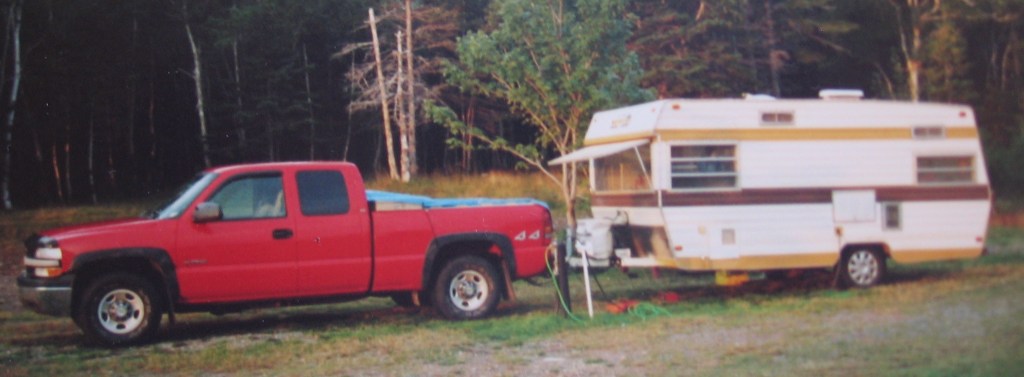
My Chevy Silverado ‘Roadeo’ and the travel trailer I hauled from Calgary to Cape Breton.

Tundra and I made our first home in the 15′ foot travel trailer I’d hauled out from Calgary. It was small but cozy and portable. The new land was on a back road with easy access to a gated field, so that’s where I first set up camp. My neighbours were kind and welcoming, but curious as to why I locked the field gate behind me every time I went anywhere. It took a while for this city kid a while to realize I could leave that gate wide open.

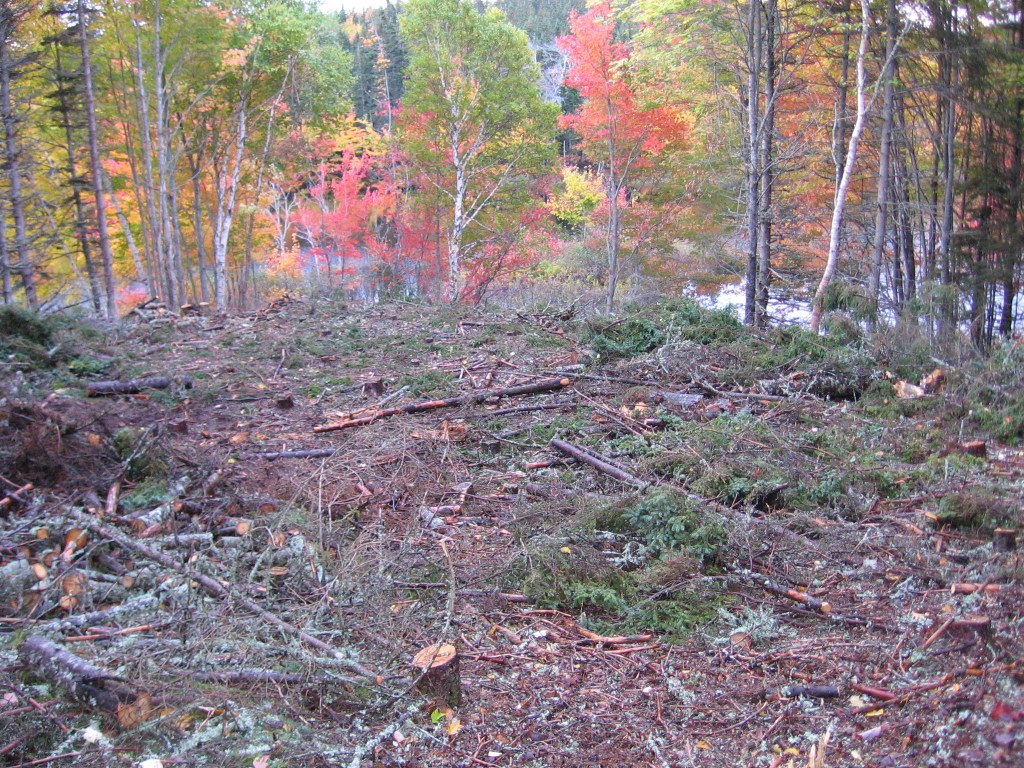
I bought myself a chainsaw and – very slowly but without losing any limbs – opened up a wood road blocked by piles of felled spruce meant to keep vehicles out. Then I shifted my trailer onto that road, moving deeper into the woods and closer to the pond.

Our travel trailer home after I moved it onto the old wood road. That’s my blue kayak in front.

It was a bit scary, giving up my comfortable, secure life to move so far away and into the unknown, but I recall some of the magic moments while we lived in that trailer. The thrill of seeing a young bull moose amble past my truck, or of glimpsing a coyote race past the trailer and, seconds later, a second coyote in hot pursuit. Of sitting out by my campfire and realizing that what sounded like a steady stream of traffic in the distance was actually the roll of the ocean, a mile away. Another night I was sitting outside after Tundra had gone to bed when I heard something large moving around in the forest right behind me. Yikes! I made a quick retreat into the trailer – visions of bears and bull moose prowling in my head.

Looking west to the highlands, where Tundra and I loved to explore.

When it rained for two days and two nights I sat at the table in the trailer and painted beach rocks – before that was a thing. The rain finally stopped and I emerged into a world transformed. The pond had risen into a vast lake and water was pouring in from a myriad of streams and freshets. This transformation has never ceased to thrill and amaze me.

The trailer wasn’t winterized, so come November 2004 I hooked it back up to Roadeo and Tundra and I headed down north, back to the hand-built house where I’d spent the winter of 2001/02 house and dog-sitting. I’d been on a year-long cross-country road trip, visiting all ten provinces and the Yukon. But that winter on Meat Cove Road was transformative. Cape Breton and her people captured my heart and my imagination. After I returned to Calgary I bought the piece of land I’d checked out a few times during my stay here. So while I had another great winter down north, reconnecting with old friends and making new ones, there was a tug on my heartstrings – Highland Holler was calling me.

That winter I spent endless hours sketching house plans: funky off-grid hippie houses with rainwater cisterns and wood-fired saunas. But how big? One story or two? Basement foundation or slab or frost wall or sonotubes? Conventional frame or logs or cob (straw and mud) or cordwood? And where to put it? There was lots of land, plenty of options. In fact, there were altogether too many options. So I began to think about a yurt, a portable tent-like dwelling that would go up quickly and could be moved later if need be. It wouldn’t be cheap, but a yurt would allow me to live full-time on my land sooner rather than later. And it would buy me time to decide what and where to build.

In May 2005 I hitched up the trailer and hauled it back up and over Cape Smokey and parked it in the Holler. That summer I drove back to Calgary with Tundra, sold my house, bought a cargo trailer, and loaded up the last of my stuff. I also spent time with my son and his lady and told them about my plan to live in a yurt. “For how long?” my son asked. “Oh, one to five years,” I said, as if it were a prison sentence. In fact, it would turn out to be eight. Eight years in a yurt.

The truck, the cargo trailer, and ‘Spot’ on board, getting ready to leave Calgary and drive back with the rest of my stuff. ‘Which way is Cape Breton again?’

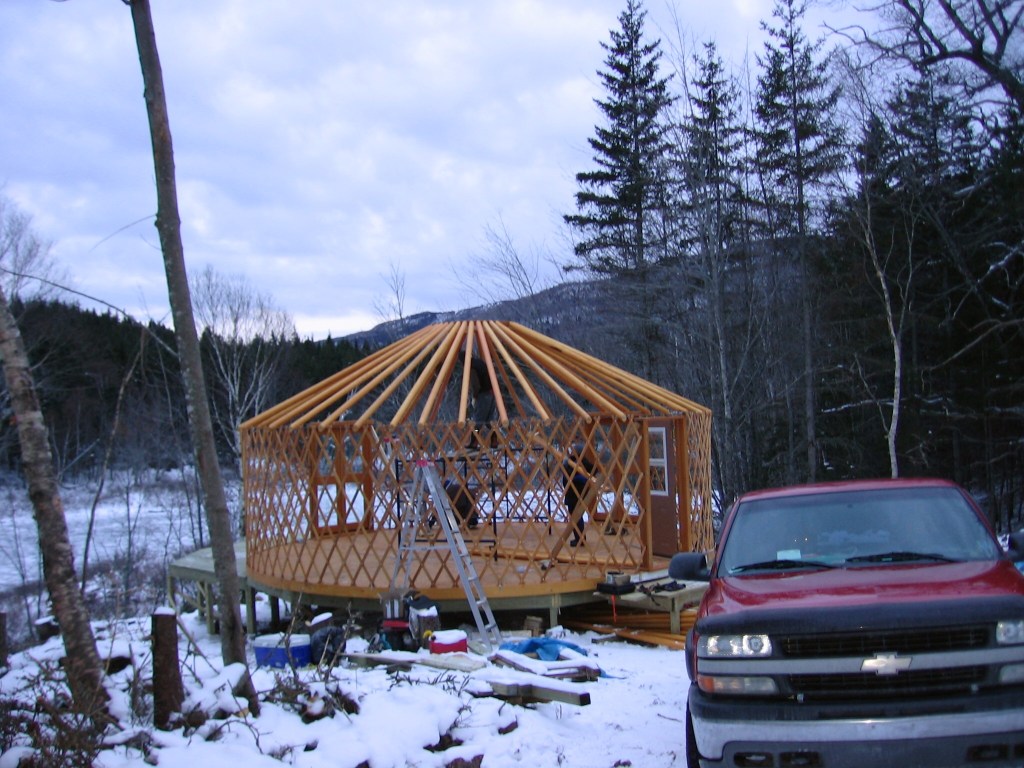
So back we came, Tundra and I, from Calgary to Cape Breton again, this time with a cargo trailer in tow. I shifted our travel trailer home off the driveway and work began. I’d found an ideal site for the yurt but there were trees to be cut and cleared, brush to burn, a platform to build. I hired a local carpenter to build the platform and assisted with my trusty power drill, dreamy visions of yurt life dancing in my head. The yurt kit was due to arrive from Vancouver in September. It did not. The temperatures dropped and I gratefully accepted an offer to housesit down the road while I waited.

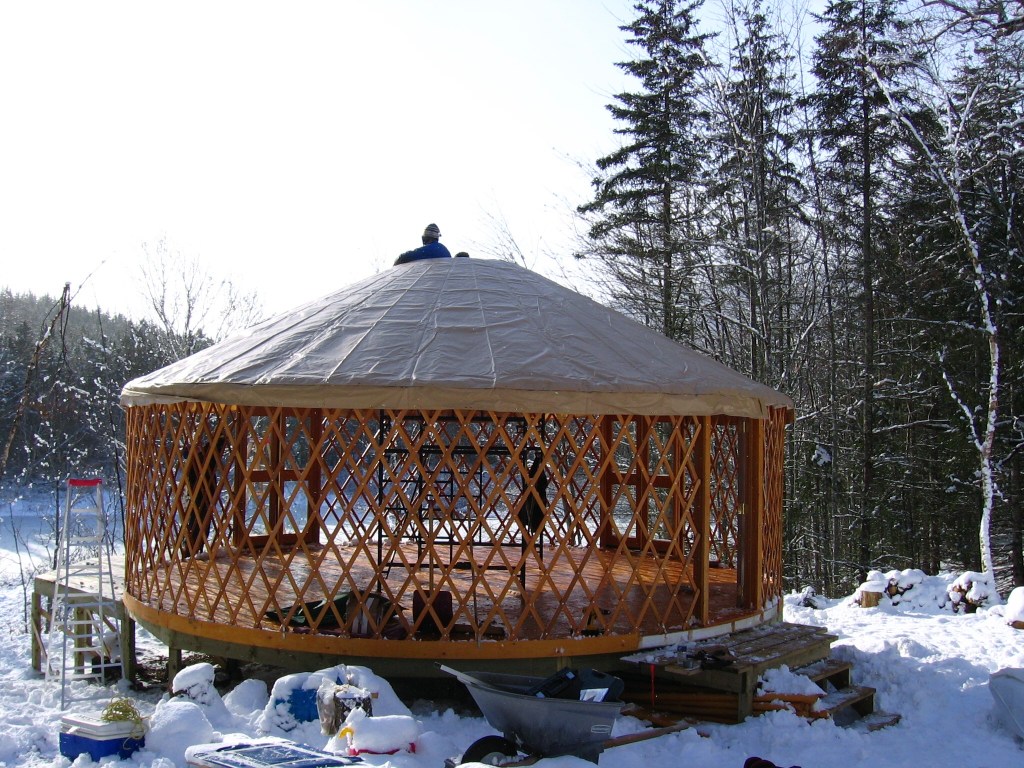
In the end it was snowing and blowing when friends and neighbours joined the carpenter and I in setting up the yurt. It was pretty deluxe – a 24′ diameter yurt with reflective insulation, canvas liner and a polyvinyl covering to keep the rain out. It had a 5′ diameter dome overhead for star gazing, moonbeam bathing, and cloud watching. I bought a wood-cook stove and a clever neighbour figured out how to attach the chimney to the soft-sided, vinyl-walled structure.

Yahoo! Me and Yurtle. Lots left to do but she’s up!

I finally moved in on December 28, 2005 and celebrated my 50th birthday in the yurt a couple of months later. Yurtle would be home for the next eight years, until February 7th, 2014.

Living in the yurt was like camping out in a big, luxurious tent. I was off-grid with no running water. I heated with wood and lit with kerosene lamps. I was too far back from the road to be plowed out, so I snowshoed in and out in winter, hauling in food and water. The yurt was easy enough to heat with the big wood-cook stove; but it didn’t hold the heat so it was bitterly cold on winter mornings. How cold? One morning my bedside water bottle was frozen solid. It was -10C inside. I learned to put the coffee water in the kettle the night before, since the spigot on the water jug would freeze overnight.

Tundra adored the yurt. It was just the right size and only one room so she could always keep an eye on me. It had three doors (the French doors did double-duty as windows) that opened onto a surrounding deck. She liked to ask me to let her out one door, then race around the deck to the door on the opposite side and ask to be let back in. Very funny, Tundra. She swam in the pond, explored the forest with me, romped in the snow, and rode alongside wherever I went. Tundra had a great few years here, but she was getting old and winding down. She died at age 16, a very ripe old age for a dog her size, but a hard loss for me.

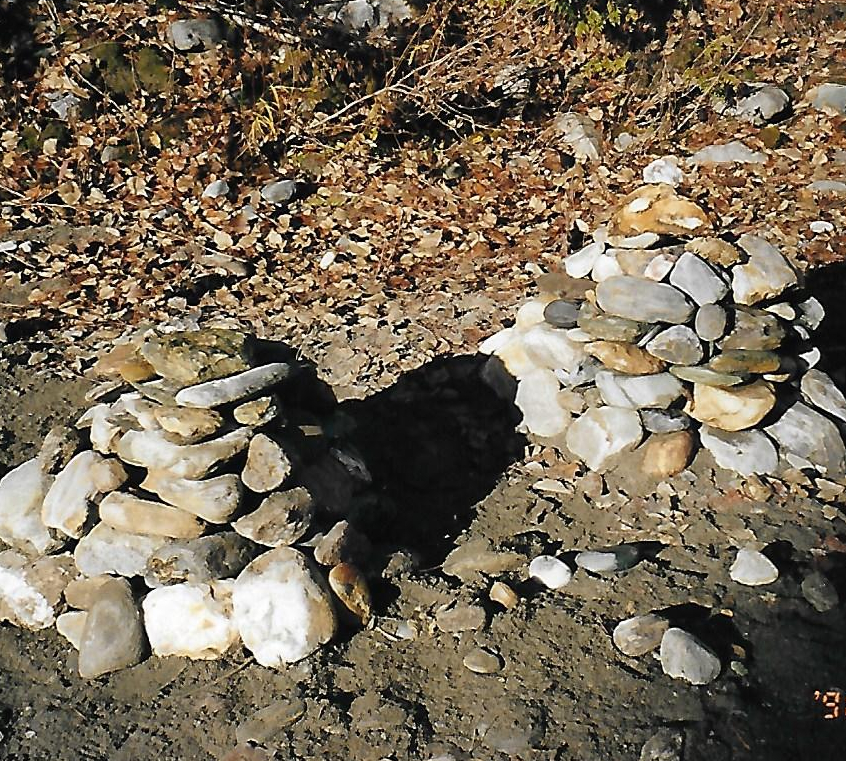
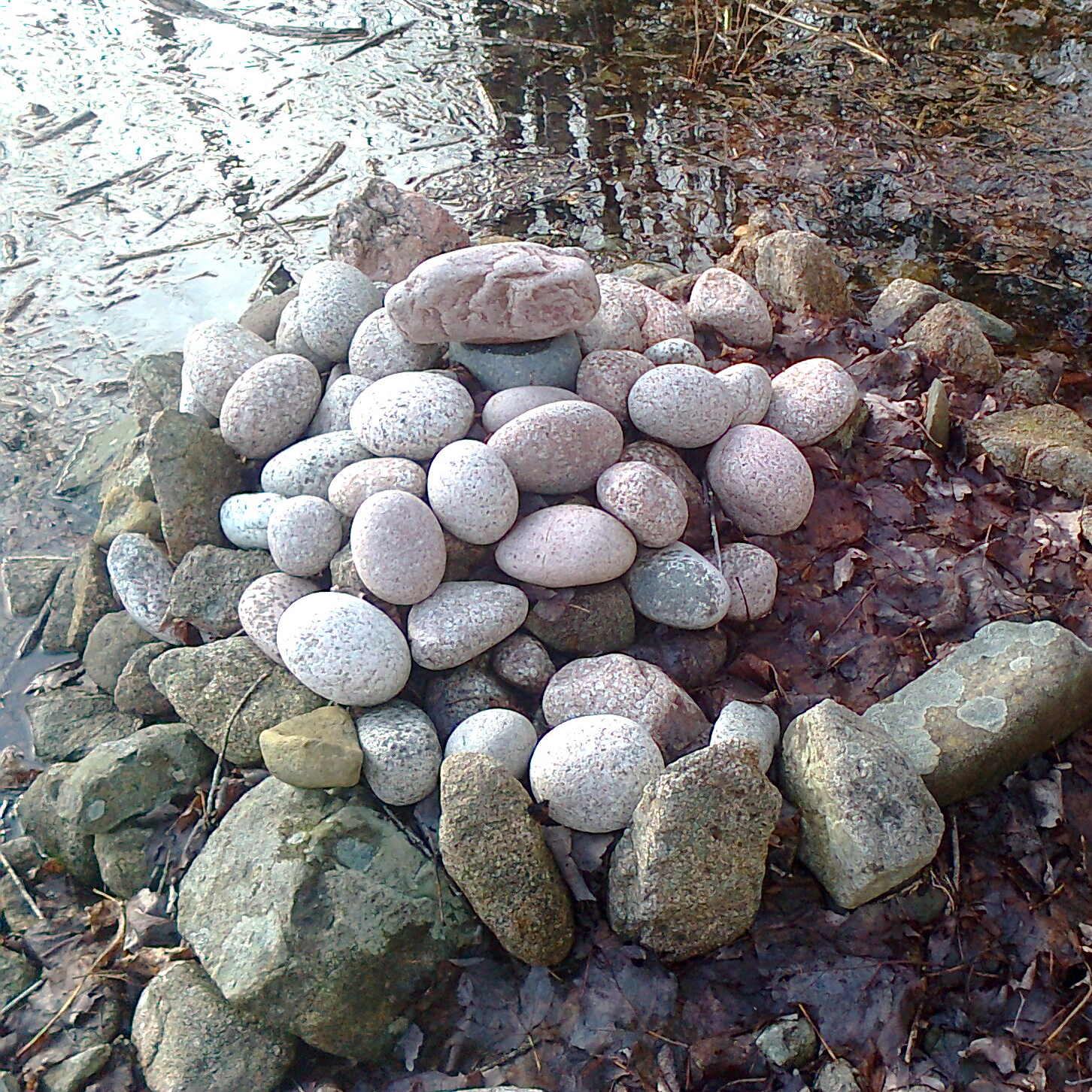
Tundra’s cairn, usually well above the water line, but seen here with the pond in flood.

When I lived in the trailer, I dreamt of living in a yurt. While I lived in the yurt, I began dreaming of living in a cabin. I continued making sketches of my dreamhouse over the years, informed by my experiences in the yurt. The location shifted farther east, bit by bit. The funky hippie houses became more conventional as I accepted my own limitations. To wit, I am entirely useless at building anything. At all. I cannot build a bookshelf, let alone a house. So I would be paying someone else to build my house, and funky costs more.

The trailer, the yurt, a baseball dugout-turned-woodshed – and a whole mess of tarps!

But I knew that I liked one-room living and I loved living by the pond, in spite of the winter inconvenience. I also liked the simplicity of building from a kit, with all the materials and plans included. I finally settled on plan. What to build, where to build it, what material to build it from. A log-cabin kit on a basement foundation, above the high-water mark of the pond, facing south for winter sun, and a stone’s throw from the yurt.

Someone told me it would cost twice as much and take three times as long to build as I expected. ‘Hah! Not for me,’ I scoffed to myself. Well … it cost twice as much and took three times as long as I expected. There were obstacles, there were delays. I made decisions that added to the delays. I almost lost my mind over septic permits. I’d planned to stay off-grid but changed my mind and had to jump through endless hoops to bring power this far back into the woods. I almost froze after my big stove went into the house and my new small stove wasn’t sufficient to heat the yurt. But finally, on Feb. 7, 2014, I moved into my little log home.

The first few months I was startled by loud rifle-cracks in the night as the logs dried and checked (cracked) in the dry heat from the wood stove. For the first few years there were bolts to be tightened as the logs shrunk and settled. There was still lots of work to be done after I moved in, but it got done bit by bit over the years, and now, ten years later, the house is (mostly!) finished. It is a lovely abode in a marvelous location. It took a long time to make all those decisions, but I’m happy with my choices. I feel very lucky to live here, in this home, in this community, on this island.

I finally moved into my Home Sweet Home in Highland Holler!

This year, 2024, marks twenty years since I moved to Cape Breton and ten years since I moved into my log home. It’s been an amazing adventure so far, and now, on the cusp of the new year, I look back over those twenty years with gratitude. I don’t know how many more years I have ahead in this home or in this life, but every day is a gift.

Sue McKay Miller
December 30th, 2024

Happy New Year from Highland Holler!

Can’t See the Forest for the Dead Trees

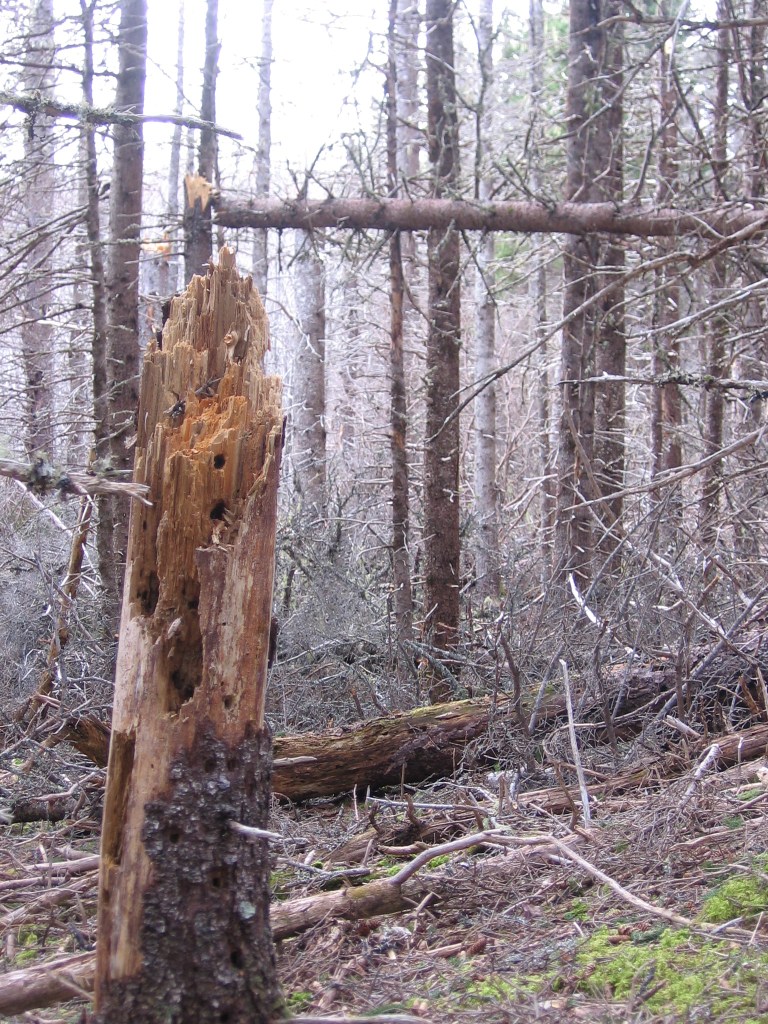
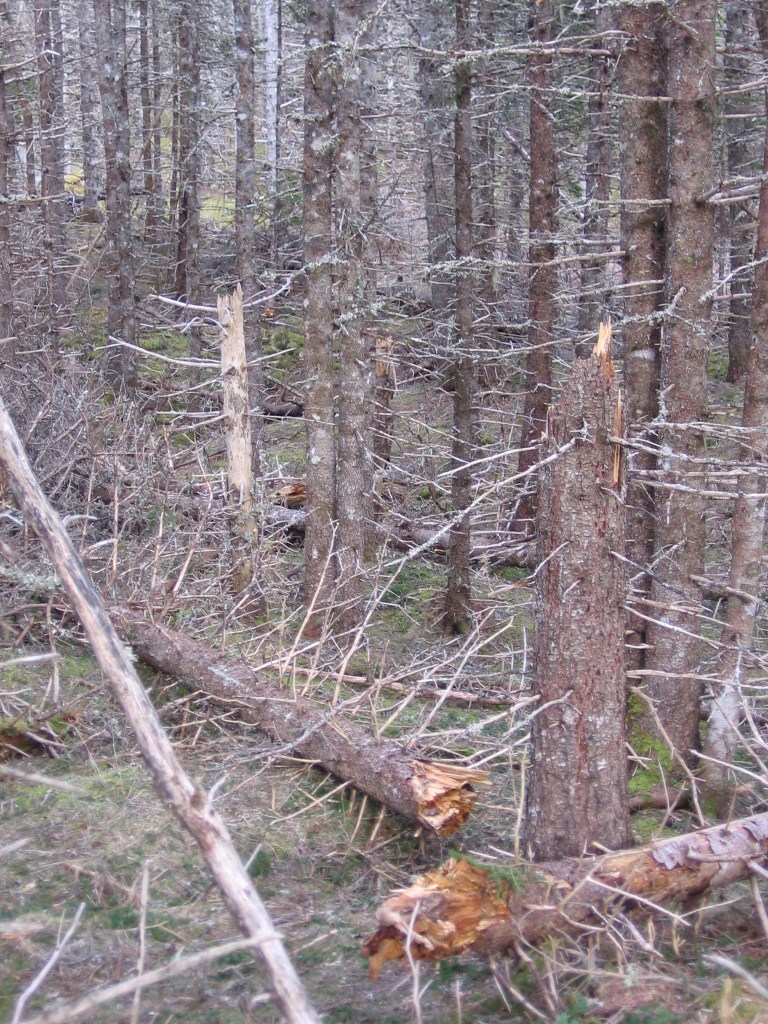
Back In 2013 I entered a ‘CBC Writes’ contest called ‘Hyperlocal’. To enter, contestants had to write a short personal essay on their neighbourhood. Since I live in the woods, I submitted an essay entitled My Dying Neighbourhood. It wasn’t about urban decay or life in a ghost town, but rather the devastating impact of the spruce bark beetle on the surrounding forest and my neighbours, the trees.

I’m revisiting this topic over a decade later because things have changed since then. A forest is a living dynamic ecosystem. It is a place of continual birth, death, transformation, and regeneration. In this blog I revisit my dying neighbourhood and show what has happened since I first penned those words and took those photos. The essay is also posted on my website under Articles and Essays, but I’ve copied it here verbatim, including the preamble, so you don’t have to hop about.


My Dying Neighbourhood

I submitted this essay to the CBC Canada Writes contest called Hyperlocal. It was awarded a gold star as ‘Editors’ Pick’ of the day. In grade 2 I was in fierce competition with Cindy Egbert to get the most gold stars for spelling, so I was rather chuffed.

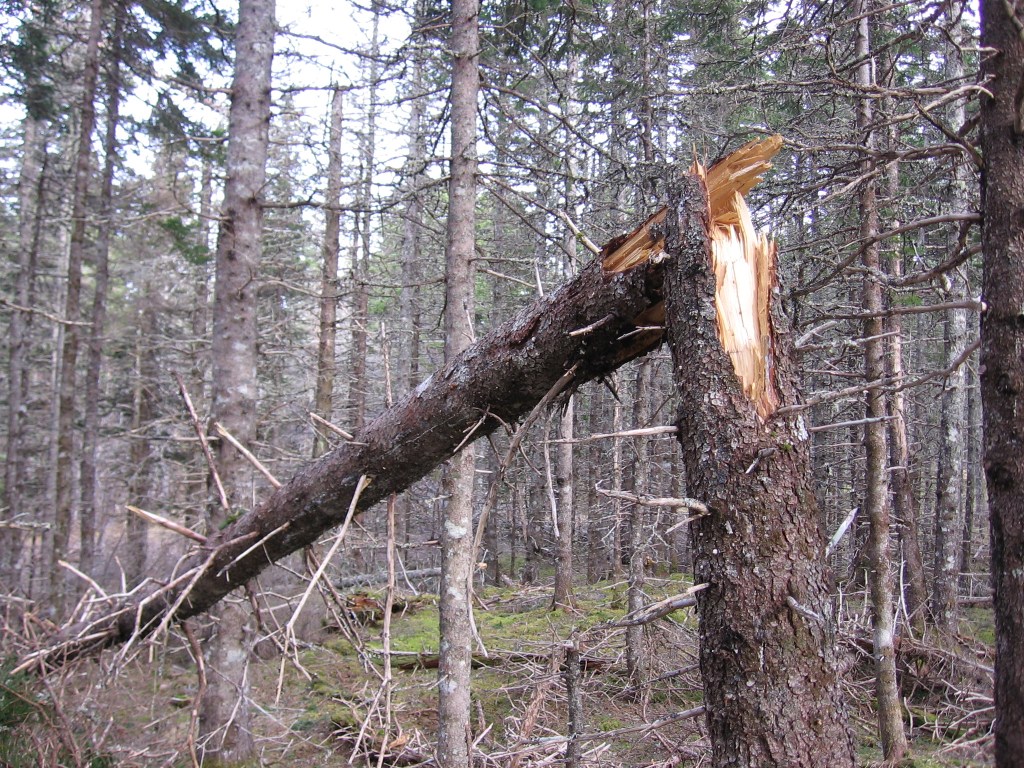
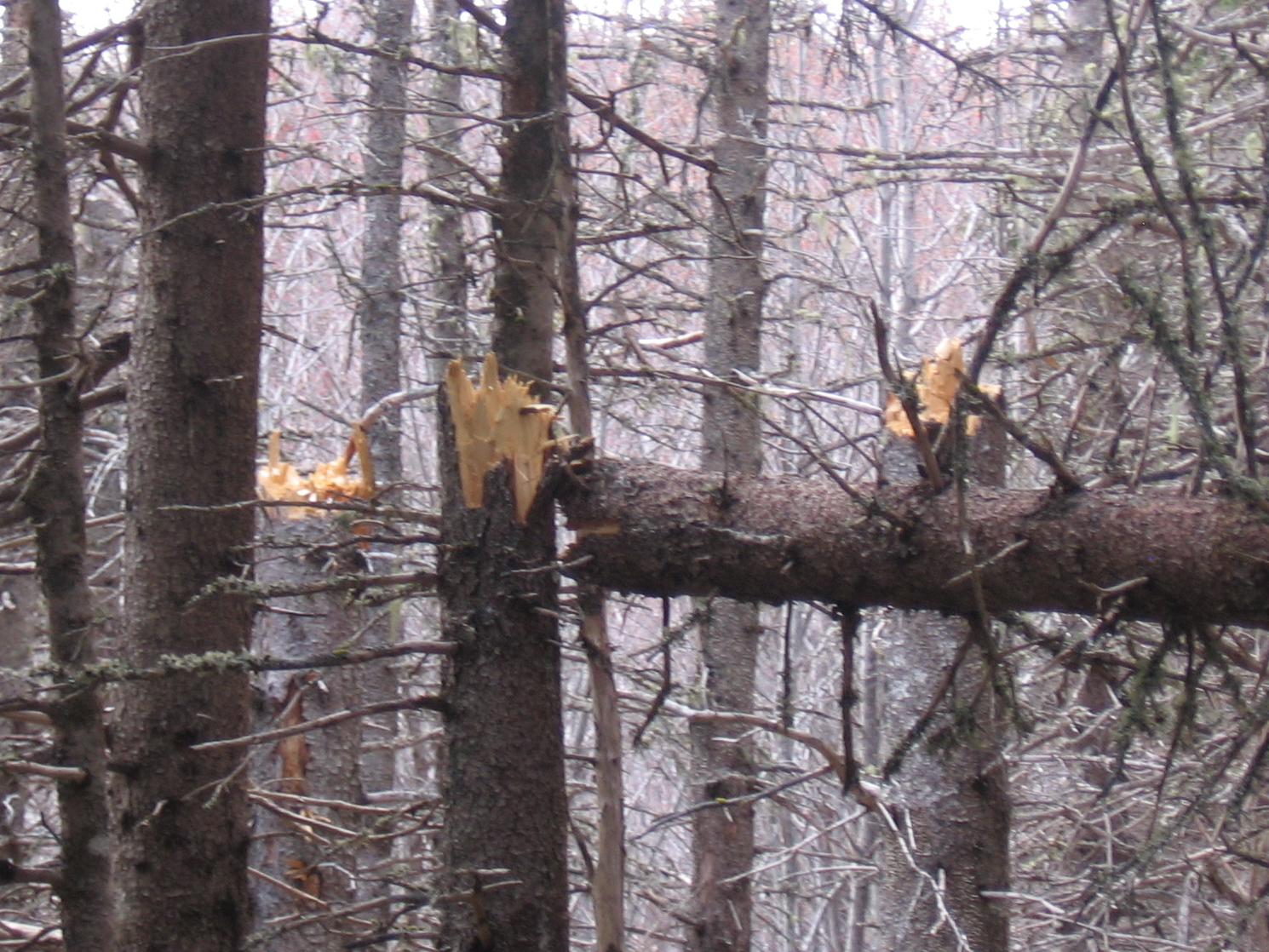
My neighbourhood is a forest on Cape Breton Island, and it is dying. The trees that are my nearest neighbours are dropping dead at an ever faster rate. A walk through the woods reveals the carnage – standing tree trunks ending in exposed jagged shards. The toppled crowns lie strewn on the forest floor or lean against ailing neighbours. When I first walked this trail a dozen years ago, the tall white spruce rising high overhead created a cool shaded passage that felt like a cathedral. Now my cathedral is a graveyard and deadfall blocks the trail used by moose, coyotes, bears and me. Each freshly fractured tree stabs at my heart. And sometimes, when a tree falls in the forest, I hear. A crack like a rifle shot, a thud bouncing off the Highlands and echoing across the pond.

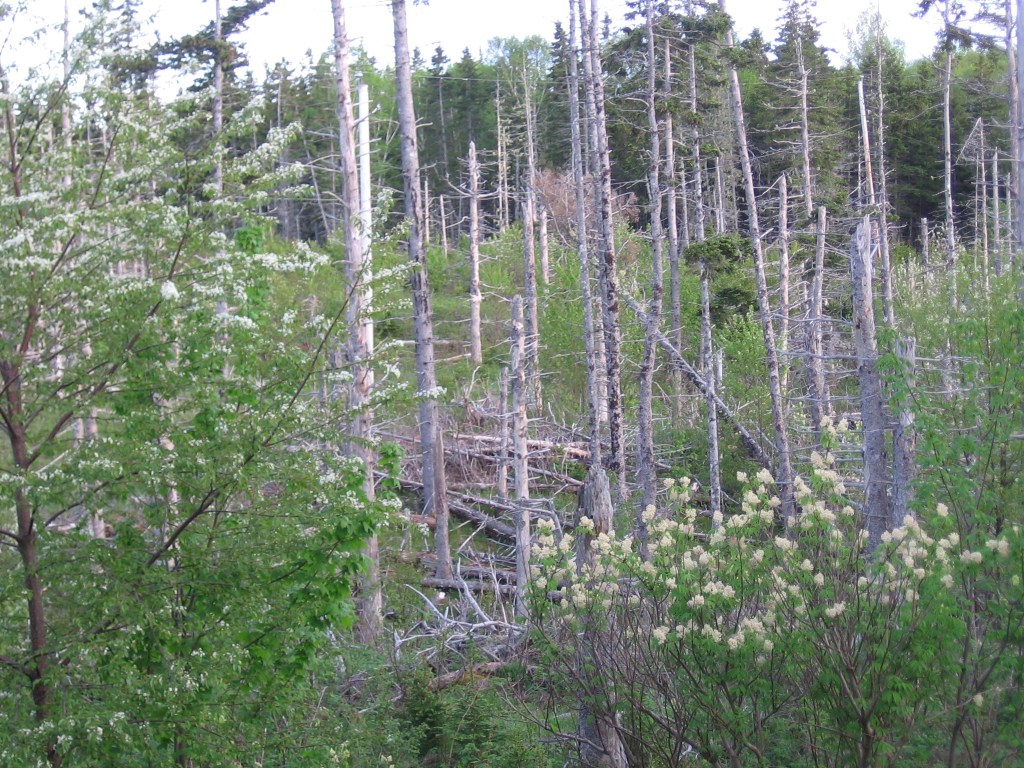
When I look across the pond to the hill, deep conifer green is peppered with the stark grey of the standing dead. The pace of decimation is breathtaking. My towering neighbours are under attack by a bark beetle the size of grain of rice, and they are losing.

This is only the most recent change in my neighbourhood. When this land was reclaimed from the glaciers it gave rise to a mixed Acadian forest of birch and maple, hemlock and pine. Scottish settlers cleared the trees and tried to coax crops from the rocky glacial till, but some fifty years ago they abandoned the hard-scrabble farms for greener pastures. White spruce sprouted like weeds, surrounding old apple trees and concealing the stone root cellars that bear witness to a more domesticated past. Now the spruce trees are growing old, and are, like all the aged – be they tree or coyote, man or moose – more vulnerable to disease and death.

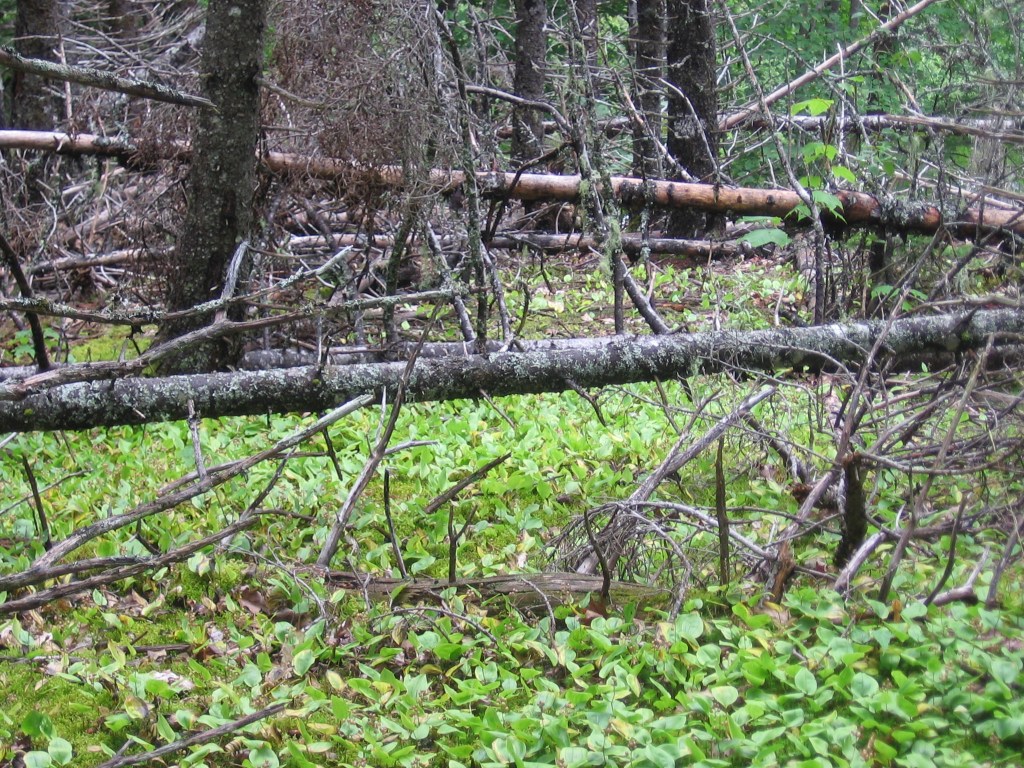
My deceased – and diseased – neighbours are being reclaimed by the forest floor that birthed them. Gravity gradually eases the trunk into the ground as insects and fungi go to work. Moss draws a soft green blanket over the log as it disintegrates into the soil, forming an undulating forest floor. Some seeds sprout on the sunny, well-drained tops of these hummocks while others thrive in the cool shady moisture below. Newly created gaps in the canopy let the sunshine peek in for the first time in decades and birch and maple saplings take root and reach for the sun. The forest succession back to a mixed Acadian forest is underway. But I, alas, will not be alive to see it. I see only this dying. By the time this forest is transformed, my own body, like the spruce, will have returned to the elements. My atoms will disperse into air, water and soil, nourishing new seedlings, inhabiting roots and bark and leaves, cycling through life and death and life again. My neighbourhood is a forest and it is dying. Long live the forest.

by Sue McKay Miller
May 2013


So there you have it. The last bit sums it up: the forest is dying; long live the forest. Because in truth, it isn’t the forest that is dying, it’s the white spruce trees that once dominated this forest that are dying. The individual plants, fungi, and animals that inhabit the forest die, but the forest itself changes and lives on.

When I bought this land in 2003 I was already in my late forties. I assumed that the forest would long outlive me, that it would stay the same, changing only slowly over the course of many human lifetimes. But within five years of my arrival the spruce bark beetle began decimating white spruce trees in our neck of the woods. Milder winters (allowing more beetles to survive) and aging trees contributed to this rapid die off. Not only was the forest changing in my lifetime, it was changing month by month, year by year as spruce trees toppled like dominoes.

Bark beetles are small, the size of a grain of rice, and lay their eggs under the bark. The hatched larvae feed on the cambium, forming galleries that girdle the tree and cut off the flow of nutrients between leaves and roots, eventually killing the tree. The girdling can happen anywhere along the trunk, and trees break or even just bend at the point of infestation. Near the root, midway up, near the top. Spruce are shallow rooted and easily blow down in a fierce wind, but trees killed by the beetle have these tell-tale signs mid-trunk.

The dying spruce were falling across a path I named Tundra’s Trail after my dog. As I wrote in the essay, the trail once felt to me like a cathedral, with towering spruce shading a narrow dirt path. The path was well used, not just by Tundra and me, but by moose, bears, coyotes and other forest critters. Local coyotes routinely scent-marked a mossy mound and Tundra was always keen to check out the latest coyote news. But in 2008, shortly after my dear old dog died, I noticed the beginning of the spruce die-off. It accelerated rapidly thereafter.

Dying and rotting trees were breaking off and blocking the narrow trail, with no easy walk around. So when a tree-cutting crew came to clear the route for my power line, I asked them to also clean up the area around the path. After they were done I could walk Tundra’s Trail again, but the once-shady path was bare and exposed, surrounded by stumps and dead trees. It was a sorry sight.

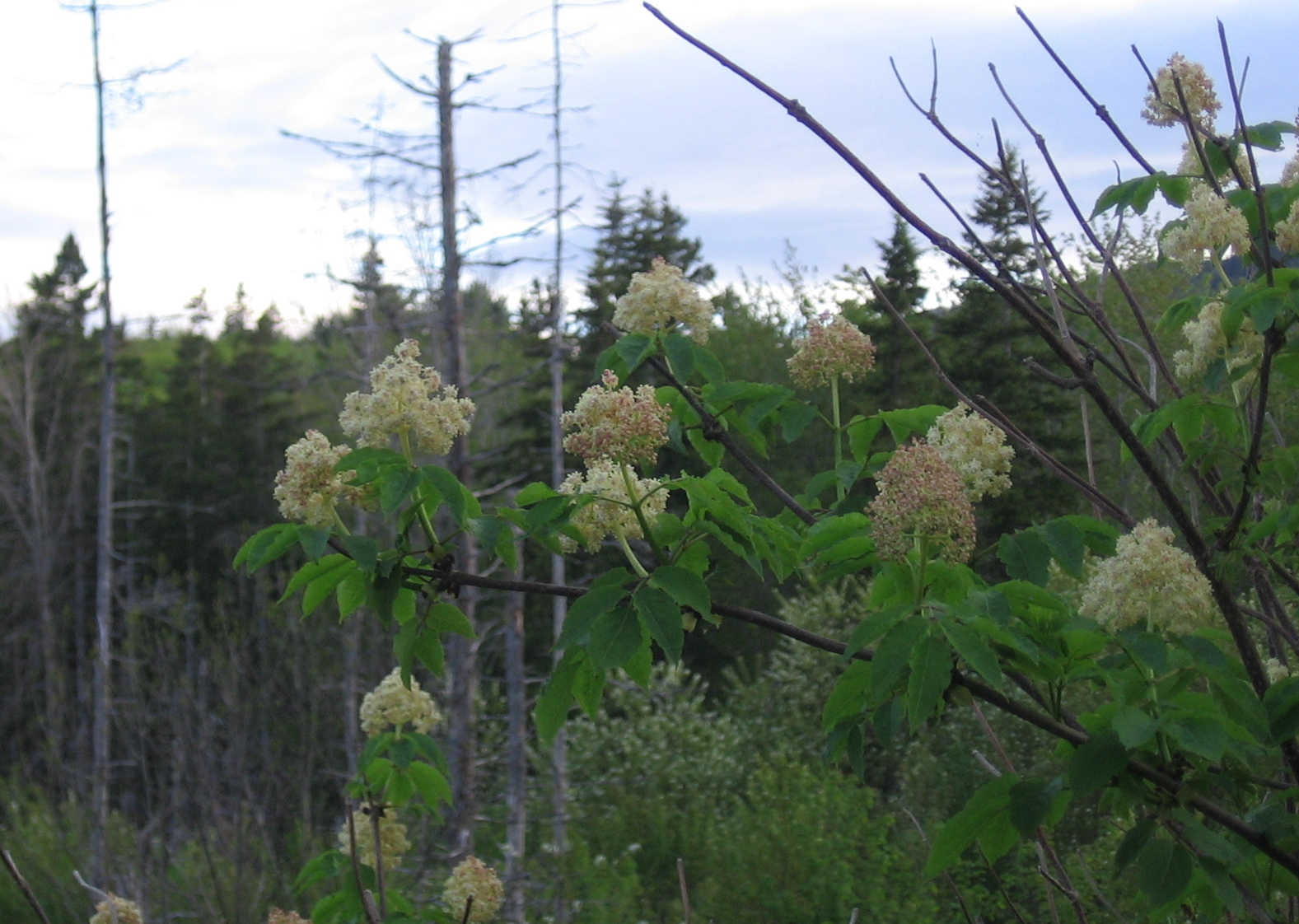
But nature abhors a vacuum and plants will pop up like … er … well, weeds as soon as there’s a patch of sunlight. Pioneering plants rushed in and rose up rapidly, and one of those pioneers was the red elderberry. This fast-growing shrub grows up on disturbed land. Unlike black elderberry the raw fruit is not edible for humans, but it is enjoyed by birds, who return the favour by spreading the seeds in their droppings. The flowers begin as a tight purplish cluster that blossoms into a white cone and fills the air with a delicious scent. The flowers are enjoyed by butterflies, hummingbirds and humans alike.

Red elderberry flowers in bloom.

When I first saw the elderberries blossoming alongside Tundra’s Trail, I felt a rush of joy at the regenerative power of plants. A delicious scent filled the air, carrying with it a whiff of nostalgia. I was reminded of the scent of lilacs filling the spring air in Calgary, my hometown. The scent isn’t the same but both permeate the air with perfume. And although I prefer purple lilacs (or should I say lilac lilacs?), they can also be white, and those look similar to elderberry flowers. It was such a sweet gift from nature, these lovely fragrant flowering shrubs thriving in the sun, renewing the dying forest, reminding me of my childhood.

The dead and the living stand side by side in the ever-changing forest.

As the forest continues to evolve, other plants will grow up. Taller trees will seed the soil and sprout under the sun or in the shade. Birch and maple will thrive in the open gaps created by fallen spruce. Plants are persistent, survivors, relentless (just try to get rid of an unwanted plant – good luck!). As I wrote in Which Way is Up, a plant will do whatever it takes to reach the sun, even if that means growing down or sideways or in a crazy loop-de-loop.

Now we are past the summer solstice and the spring flowers have faded and died. But as we swing into a new season, fruits and berries are forming, bearing within them the seeds of new life. The circle continues. Have a happy summer!

Sue McKay Miller
June 27, 2024


Ma Nature’s Seaside Art Gallery

Well, that’s a wrap. Earth just passed the autumnal Equinox on her annual journey around Old Sol. It’s time to rinse out all my salty beach gear and stow it away for yet another year. It was a soggy summer here in Cape Breton and beach days were few and far between, but all the more special for that. And, as always, every visit to the shore yielded up its own treasures.

I wrote about the beach creations people leave behind in At the End of the Day. People of all ages create for the simple joy of creating, knowing that their sand castles, stone towers and driftwood sculptures will vanish with the tide. But in this blog I’m focusing on a different type of beach art: The random beauty of shells and stones and seaweed, of jellyfish and driftwood washed ashore. So take a stroll with me through Mother Nature’s Seaside Gallery, an accidental art display that is ever-changing and never fails to delight.

Natural shell necklace strung along a strand of seaweed.

Jellyfish Jewels

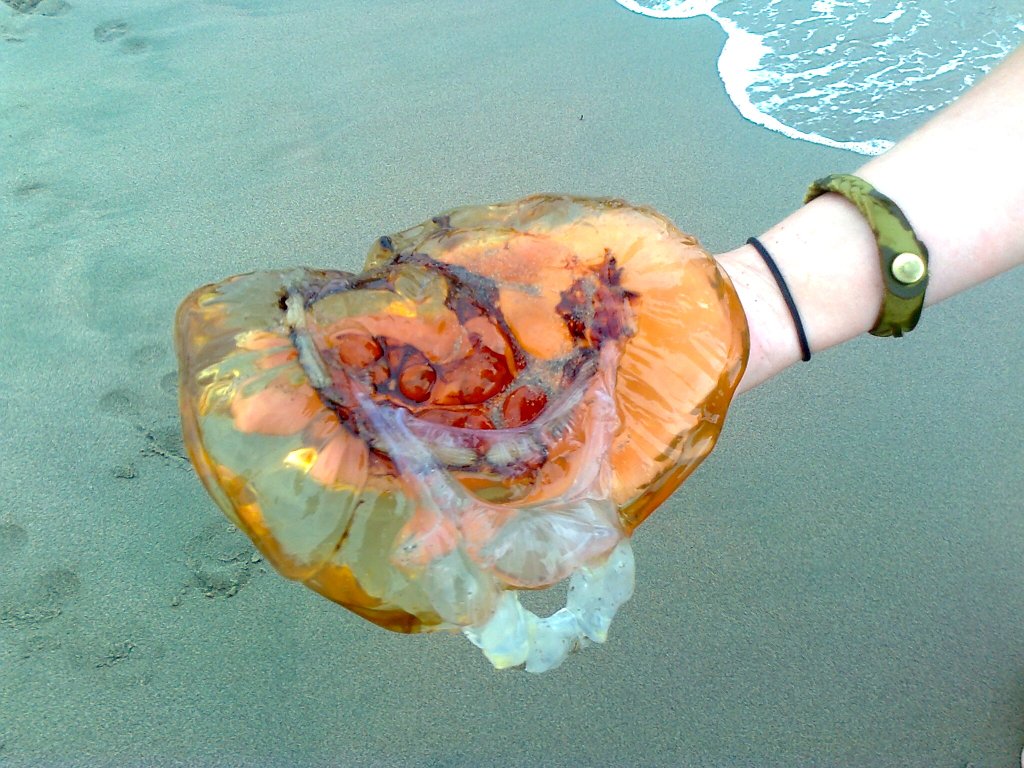
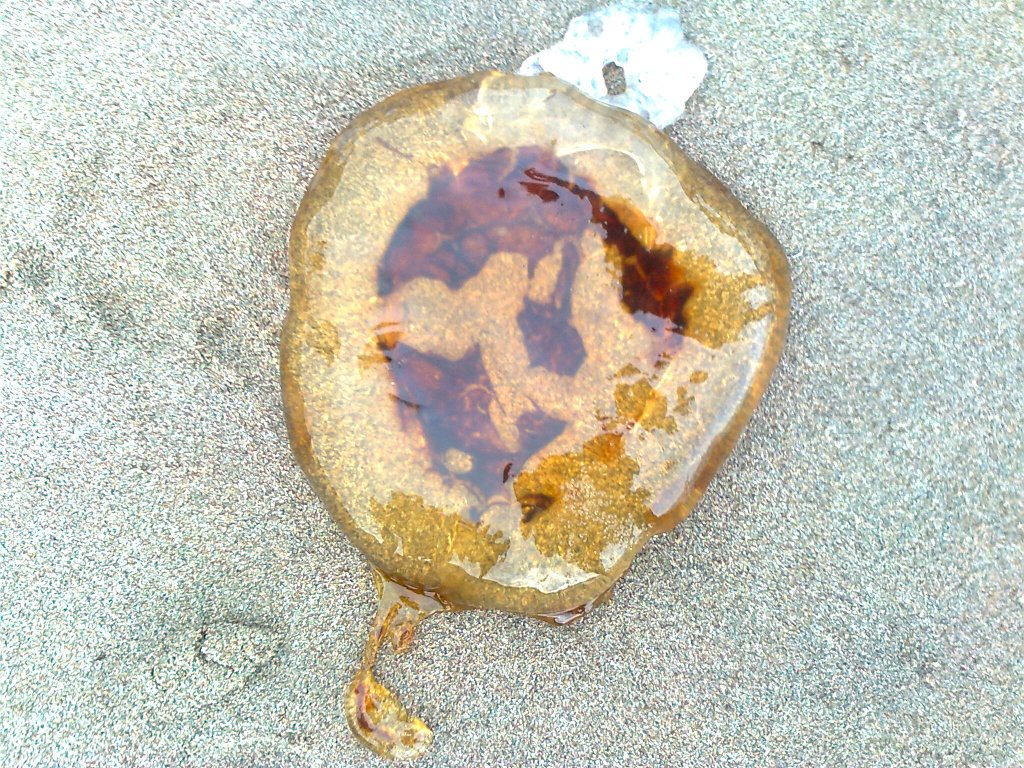
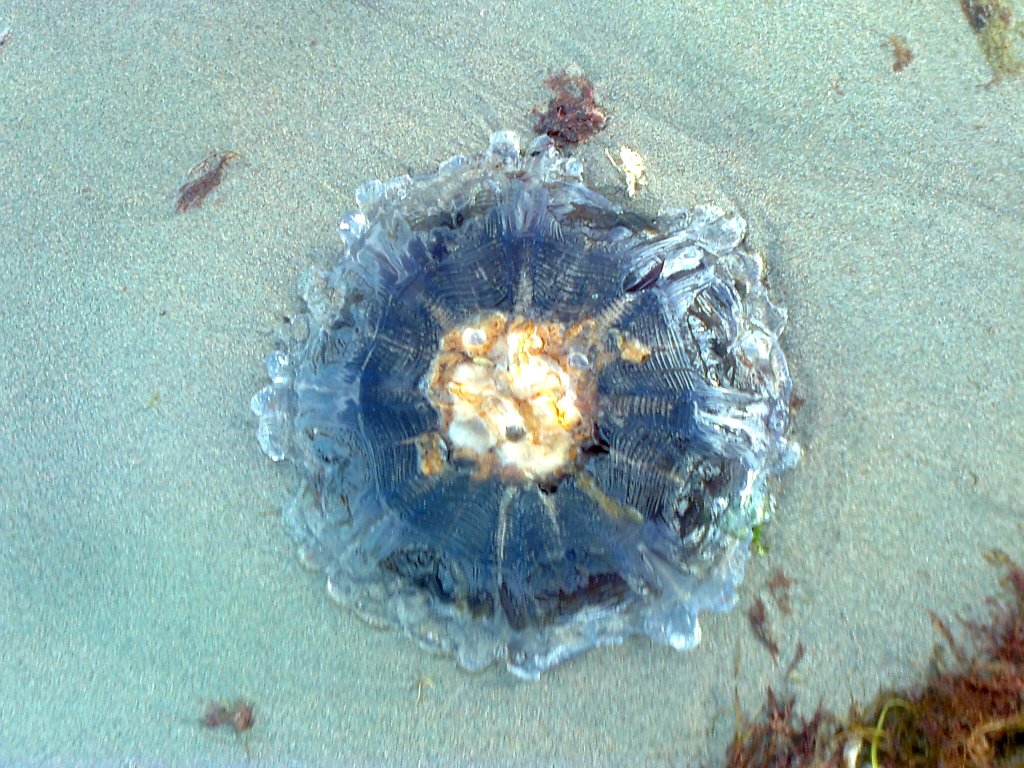
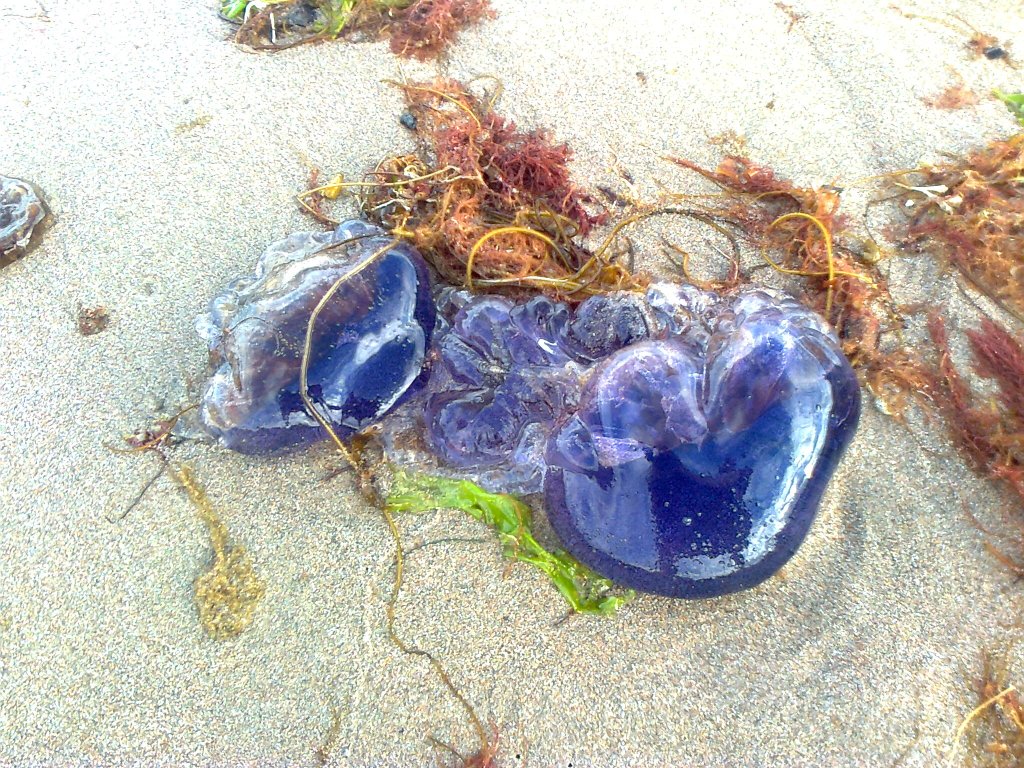
We don’t love jellyfish at the local shores. There are some that are benign, like moon jellyfish, but it’s chiefly the lion’s mane jellyfish that arrive here in July, wafted along on warm ocean currents. They are graceful and otherworldly as they swim, opening and closing their maroon bells, long tentacles streaming behind. But watch out – there’s a sting in that tentacle! Swimmer beware when you spot dark red blobs bobbing in the waves.

Luckily the jellyfish invasion doesn’t last long, and we humans can enjoy swimming in the sea sting free. As the jellies die and wash ashore, they transform through a tantalizing array of jewel-like colours: amber, amethyst, sapphire and topaz. Click on the little photos to see these jelly gems full size.

Tapestry and Lace

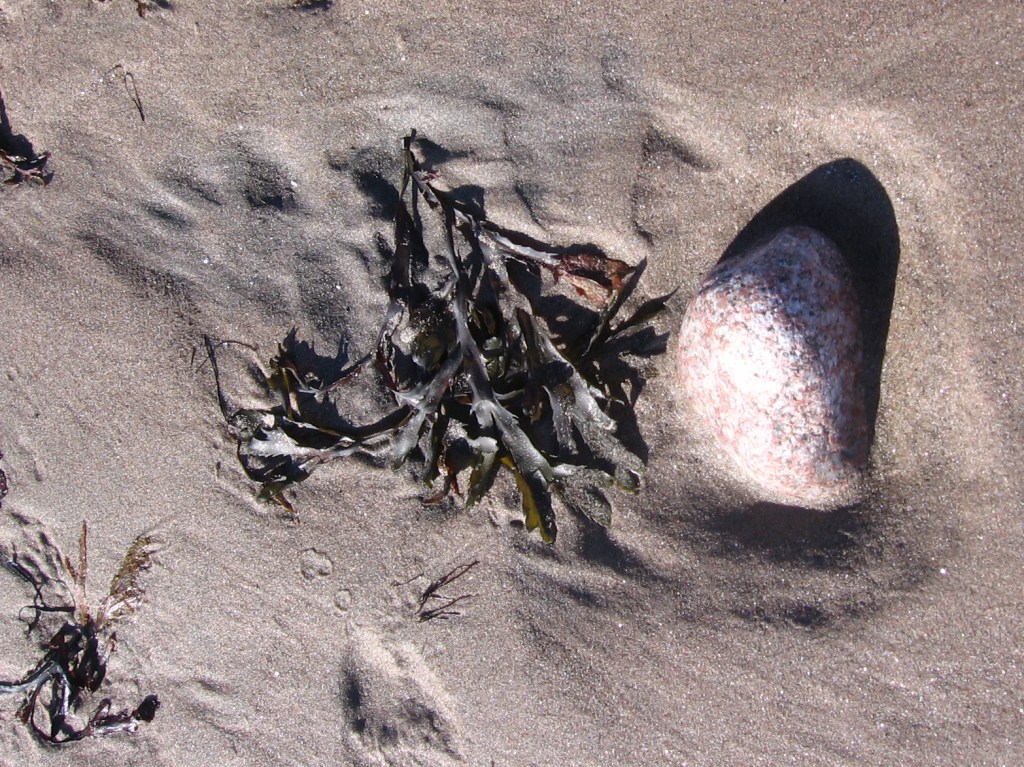
We also aren’t overly fond of seaweed. It can wash ashore in huge piles that get a wee bit ripe as they rot, not to mention spawning flies. But a little clump of seaweed can be a thing of beauty. Purple dulse, vivid green sea lettuce, and the browns, greens and golds of kelp, are woven by waves into a tangled tapestry.

A jelly jewel accents this tangle of colour and texture.
A lovely lacy view of sea and sky!

Seaweed Scribbles

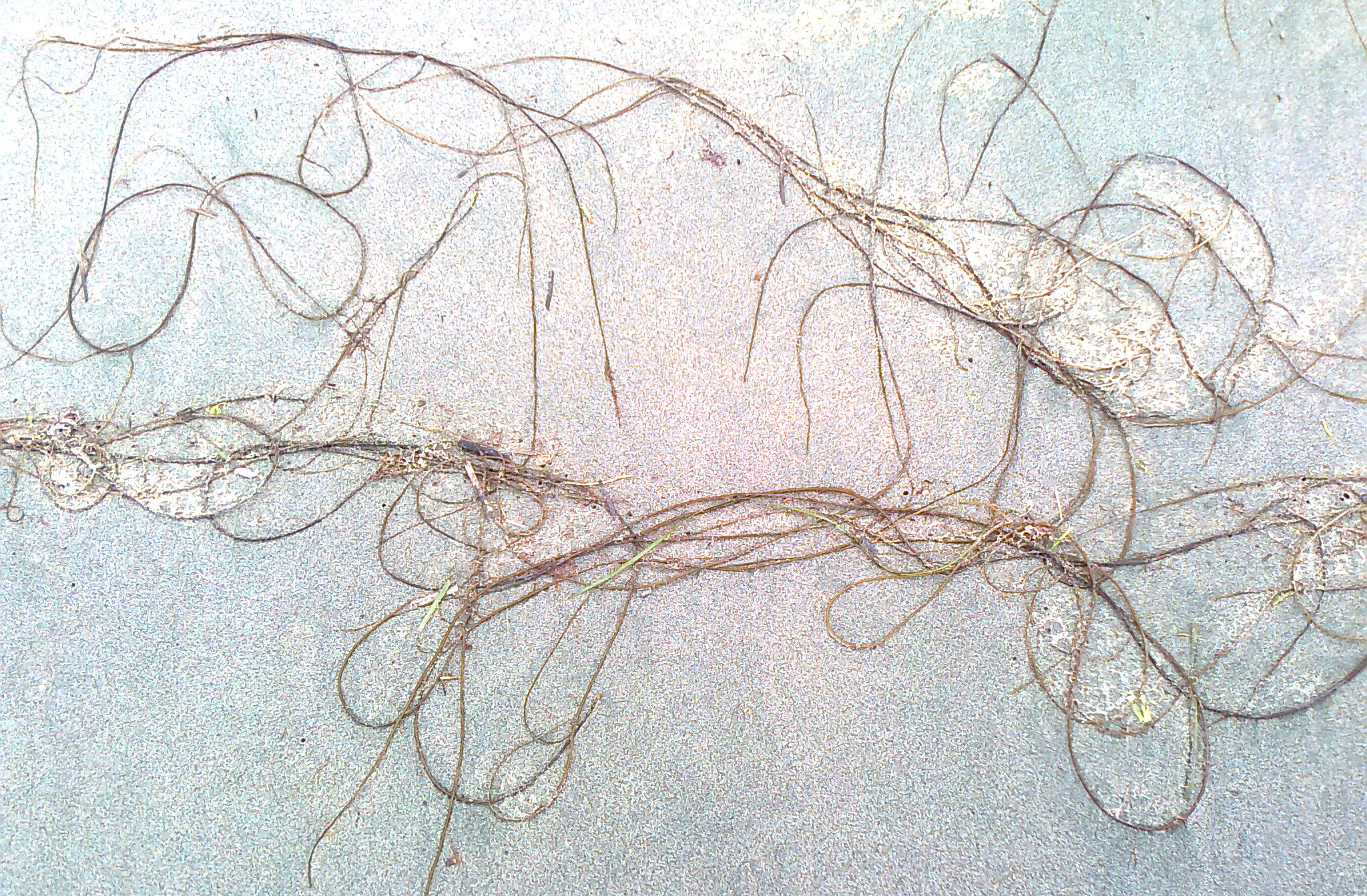
Sometime the sea writes in a cursive script, a mysterious message to be decoded by the curious beach walker.

Is this some secret script?
… or a fanciful line drawing?

Sea Monsters

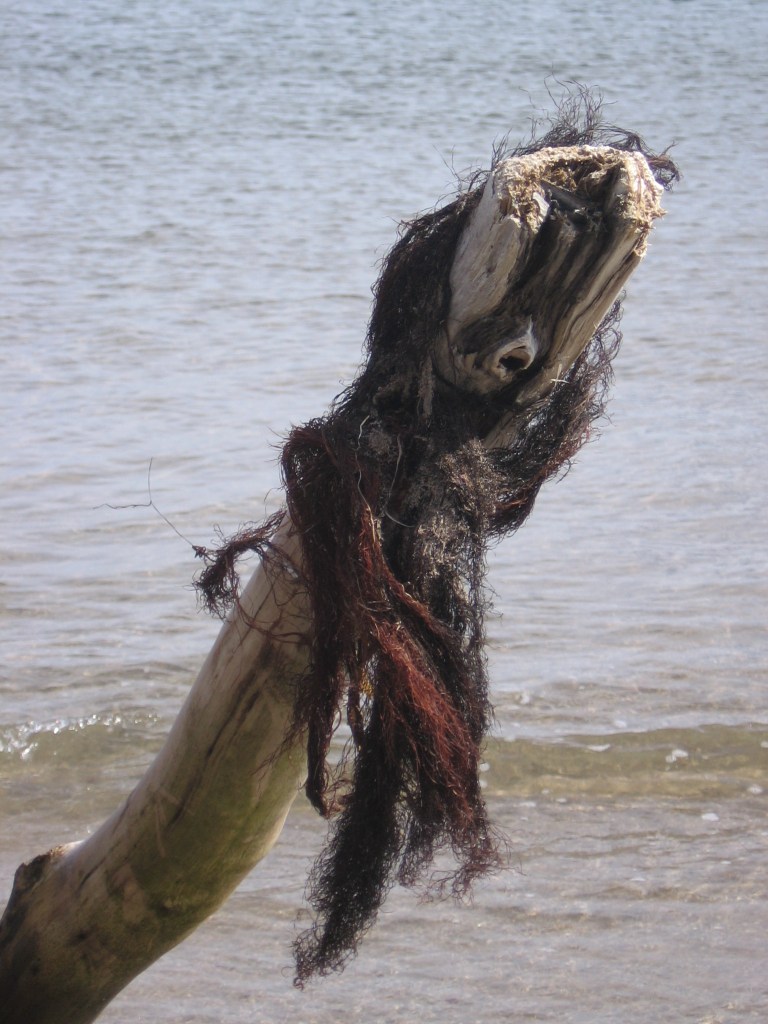
Some seaside gallery creations are beautiful, some are suggestive, but some are downright spooky. Humans have always imagined that monsters dwell in the deeps, and sometimes they crawl out of the sea and onto the shore.

When seaweed wrapped itself around a semi-submerged tree trunk, it reminded me of the wooden masks I saw in Bali – frightening faces draped with coarse black hair. Could this be Ranga, the demon queen?

What sea creature is this, rising from the waves?

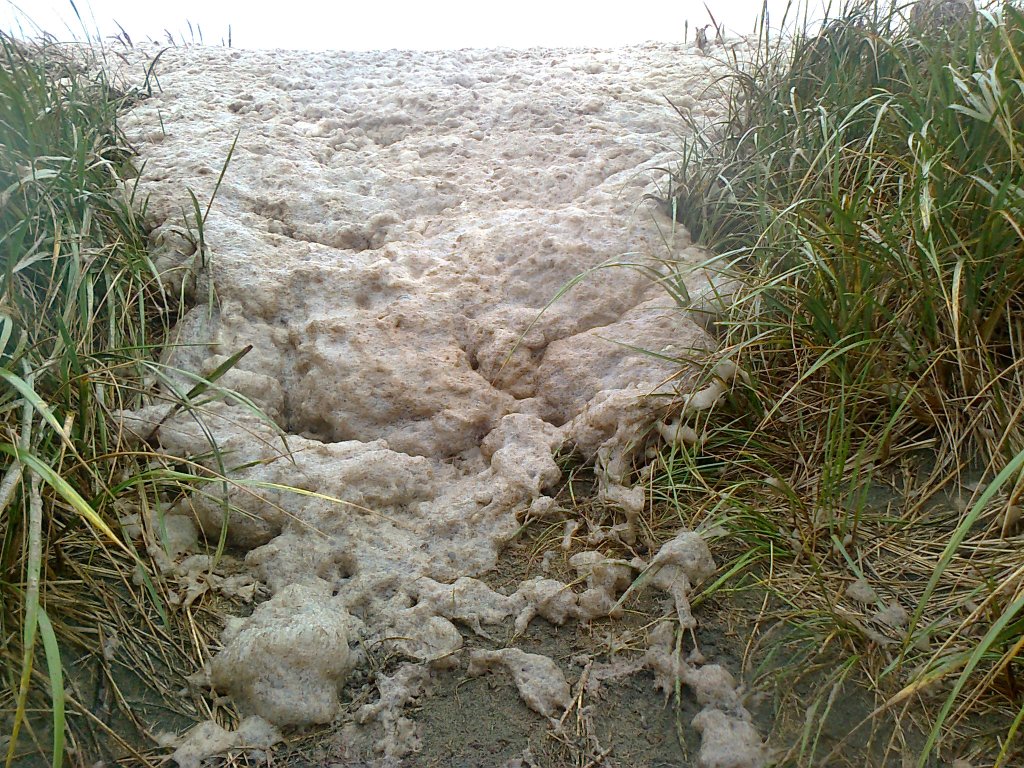
Big mounds of seaweed get washed ashore and then are eroded away by waves and tides into creepy shapes.

What body lies buried here?
This monster looks like it’s trying to crawl back into the sea …

Rock Art

There are so many wonderful rocks in Cape Breton that I wrote a whole blog about them in Stones I have Known. So I’ll try not to get too carried away here, but I just had to include a few arty rocks in this seaside gallery.

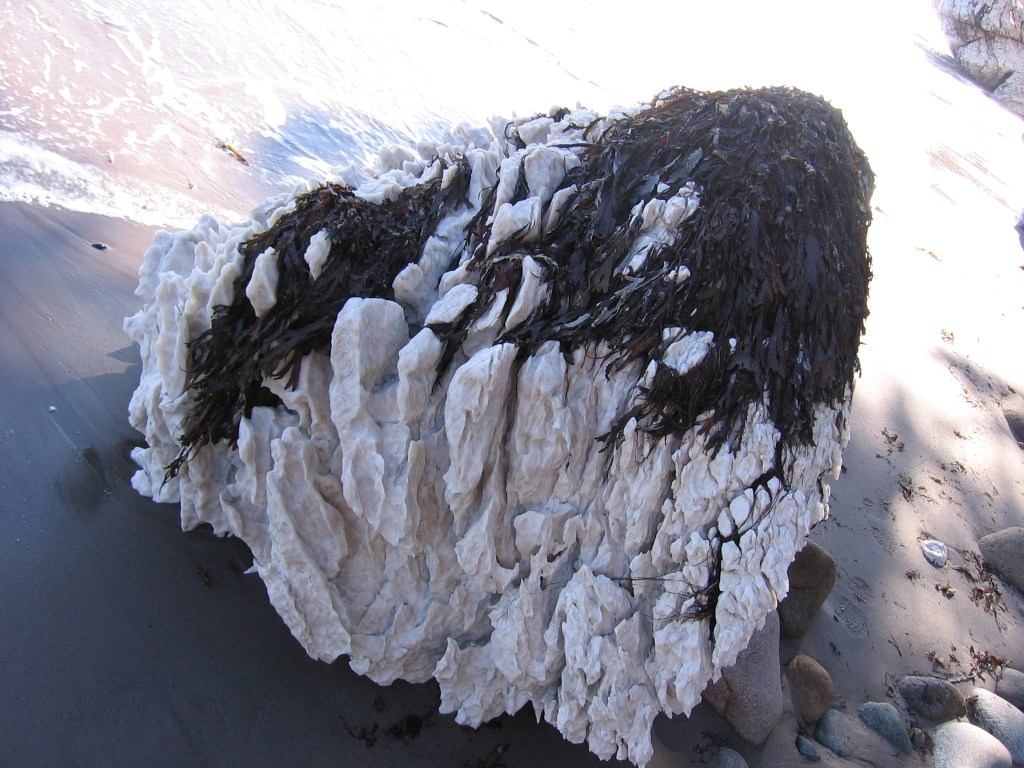
These rocks are all dressed up with nowhere to go. Gypsum is a soft rock, easily carved by the sea. The crevasses and creases in this gypsum boulder have been draped in seaweed to create a striking sculpture in black and white.

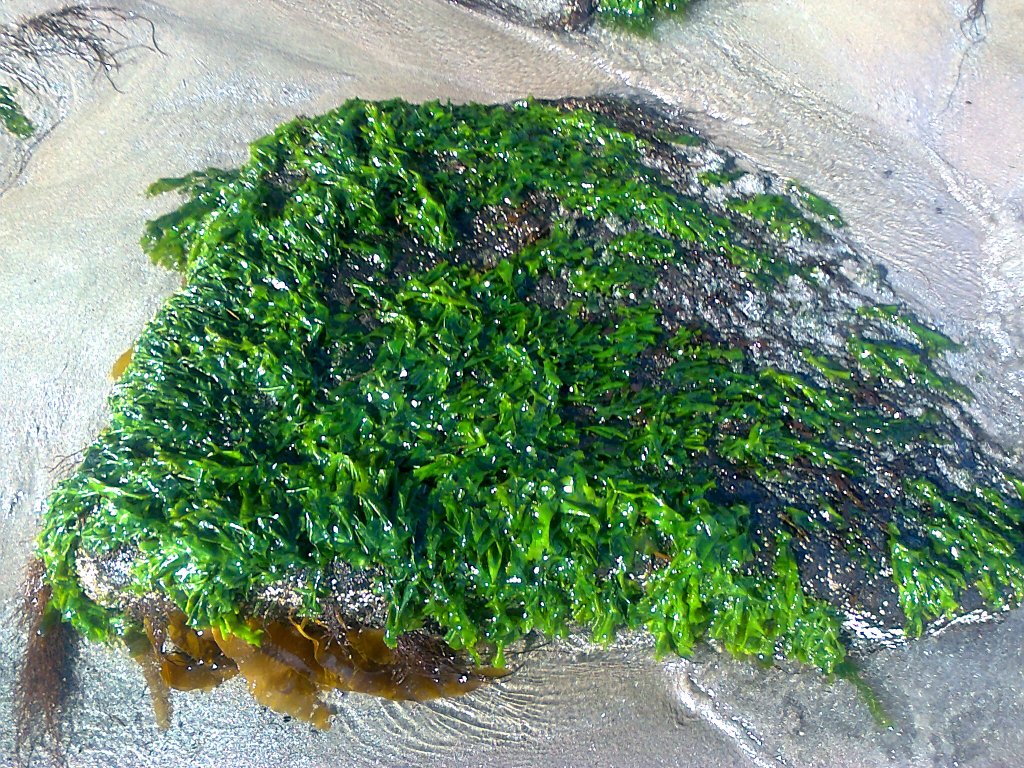
Living sea lettuce is attached to this intertidal boulder. Not only is it a gorgeous green, it’s actually quite yummy.


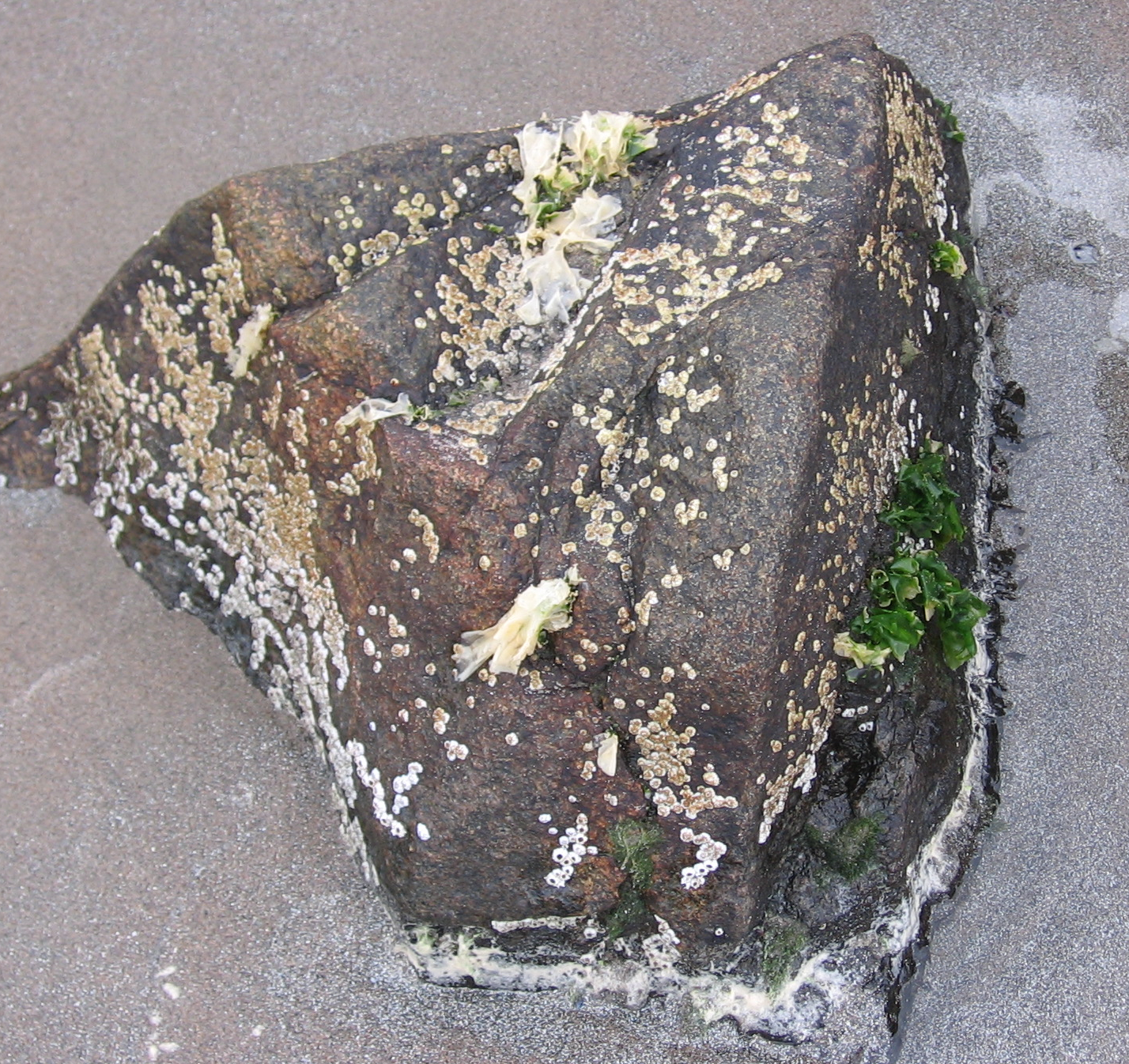
Barnacles are little crustaceans that find something they like and then stick to it. The wee animals add a touch of pointillism to the pink and green rocky canvas on the left, but they took over the whole show on the right.

A few more mixed-media pieces. This finely sculpted rock on the left sports a smattering of seaweed fronds as well as artfully applied dashes of barnacles. On the right, lichens and periwinkles combine in a tidal puddle to create an image of … something.

Rock Paintings

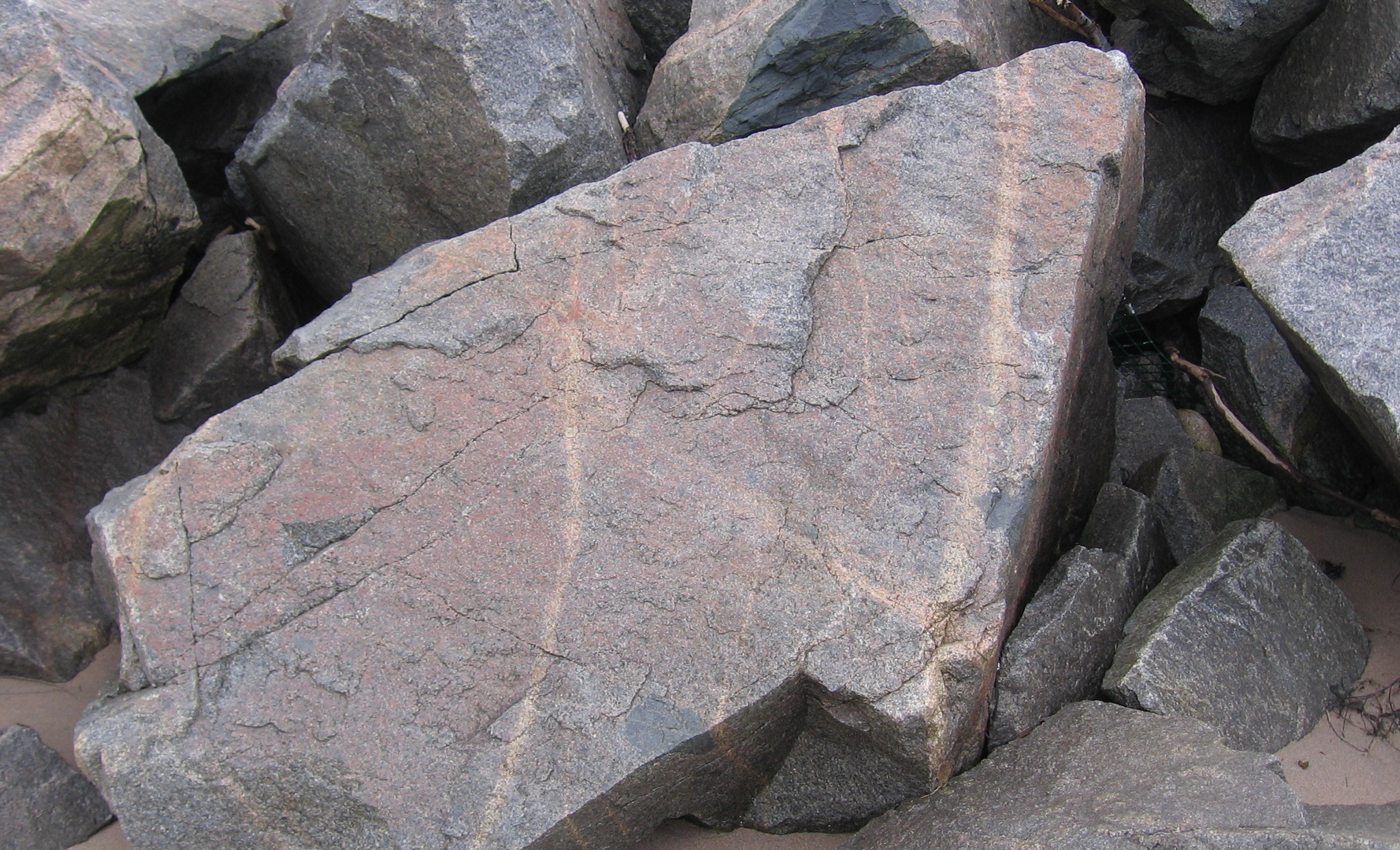
Like many people, I am in awe of the cave art created by our early ancestors. Somehow the patterns and colours on these boulders remind me of those ancient masterpieces. Nature paints with minerals and chemistry to create abstract art that endures.

Is that ‘N‘ Ma Nature’s signature on this arrow rock? Onward and upward we go!

Driftwood Creatures

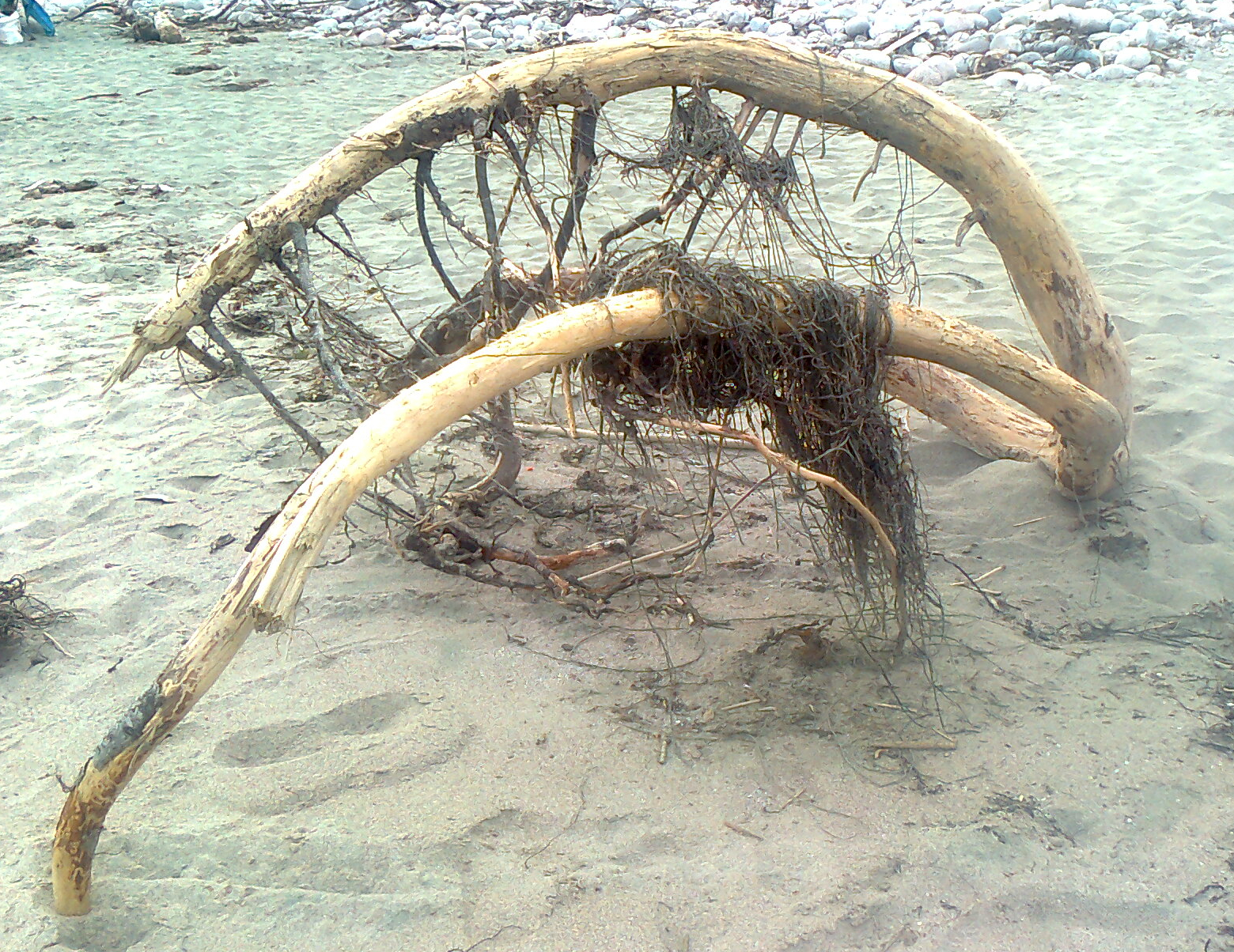
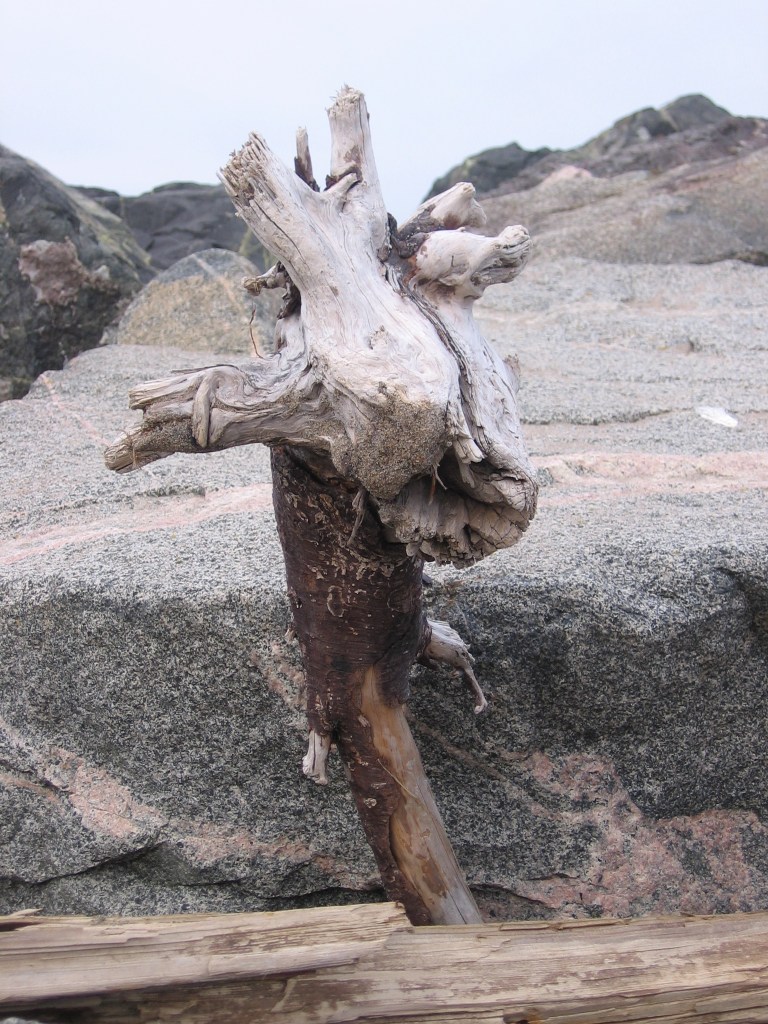
Wood that finds its way into the ocean is sculpted by the sea. Branches and even whole trees are carried down rivers during floods and out into the waves where they are tossed and tumbled, smoothed and shaped, before they drift back ashore, transformed. Like pictures we see in clouds or rocks, driftwood can become all manner of things in our mind’s eye.

A sea horse? I set this piece up against the boulder – so nice with those lovely pink stripes!

Patterns in the Sand

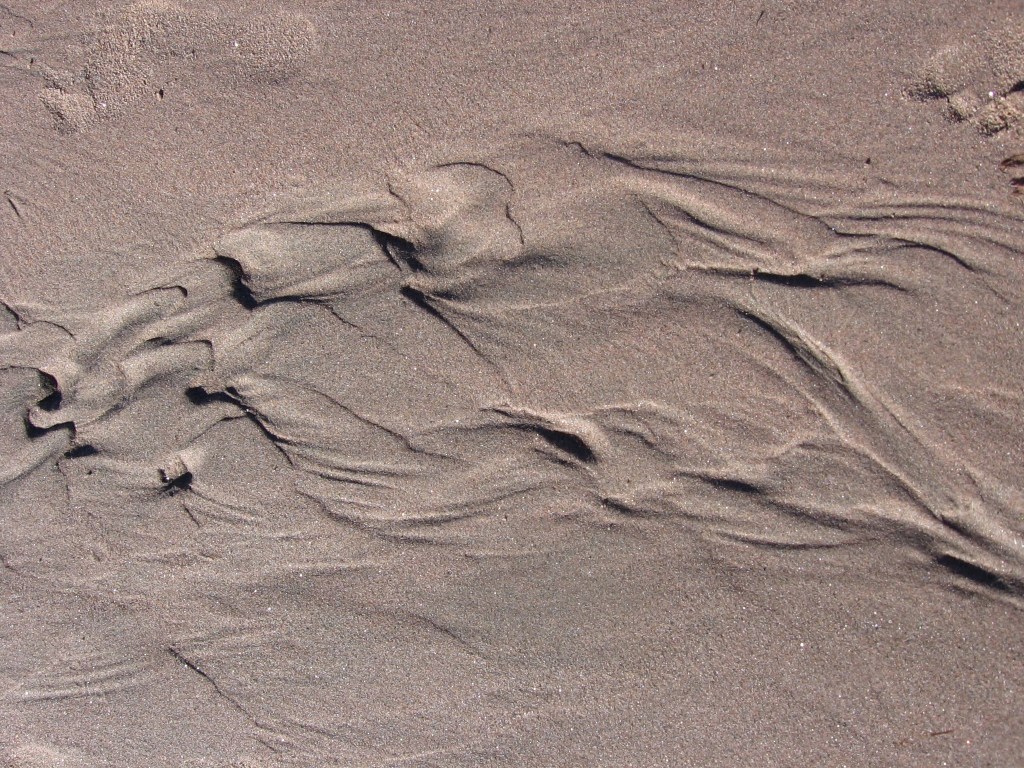
In my blog Winter’s Art Gallery I marveled at the patterns and textures nature creates with ice and snow. Sand is also sculpted, by wind and wave and tide, into elaborate patterns as beautiful as they are transient.

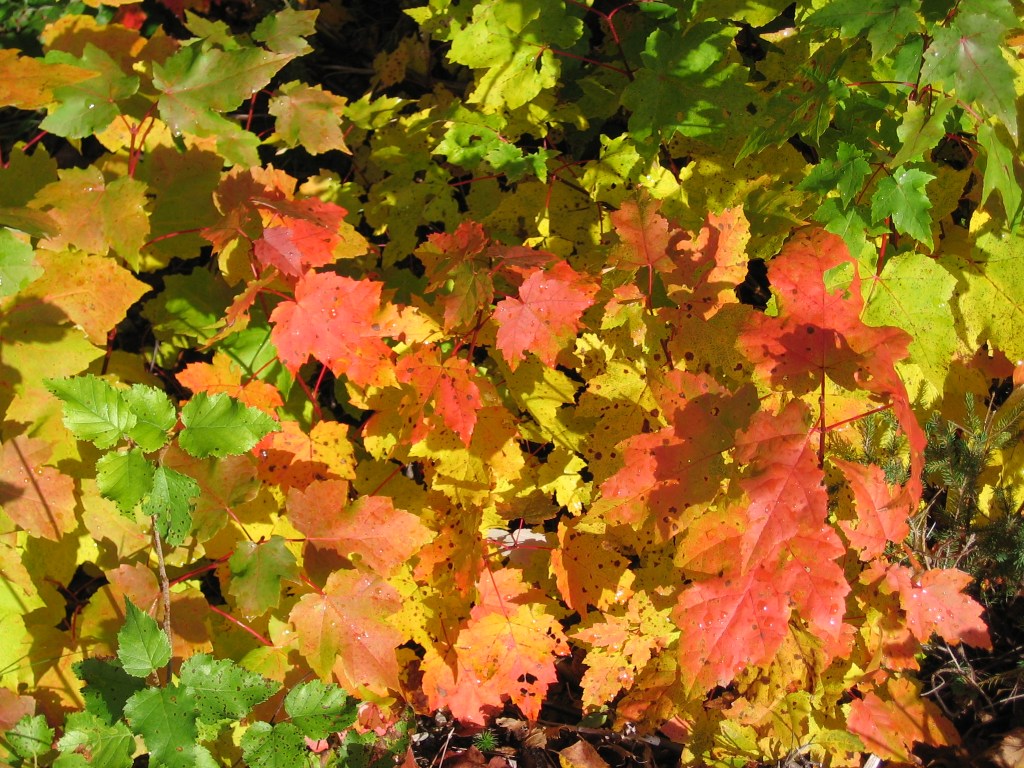
Alas, like ripples in the sand, summer is all too transient. It’s always hard to let go of the seaside season. It’s so short and so very sweet. But here in the Holler the last hummingbird has headed south and the first leaves are turning scarlet. The forest begins to beckon, a place full of more natural treasures to be discovered and savoured. Happy Autumn!

Sue McKay Miller
September 30th, 2023

To everything, turn turn turn
There is a season, turn turn turn


– The Byrds, riffing on Ecclesiastes

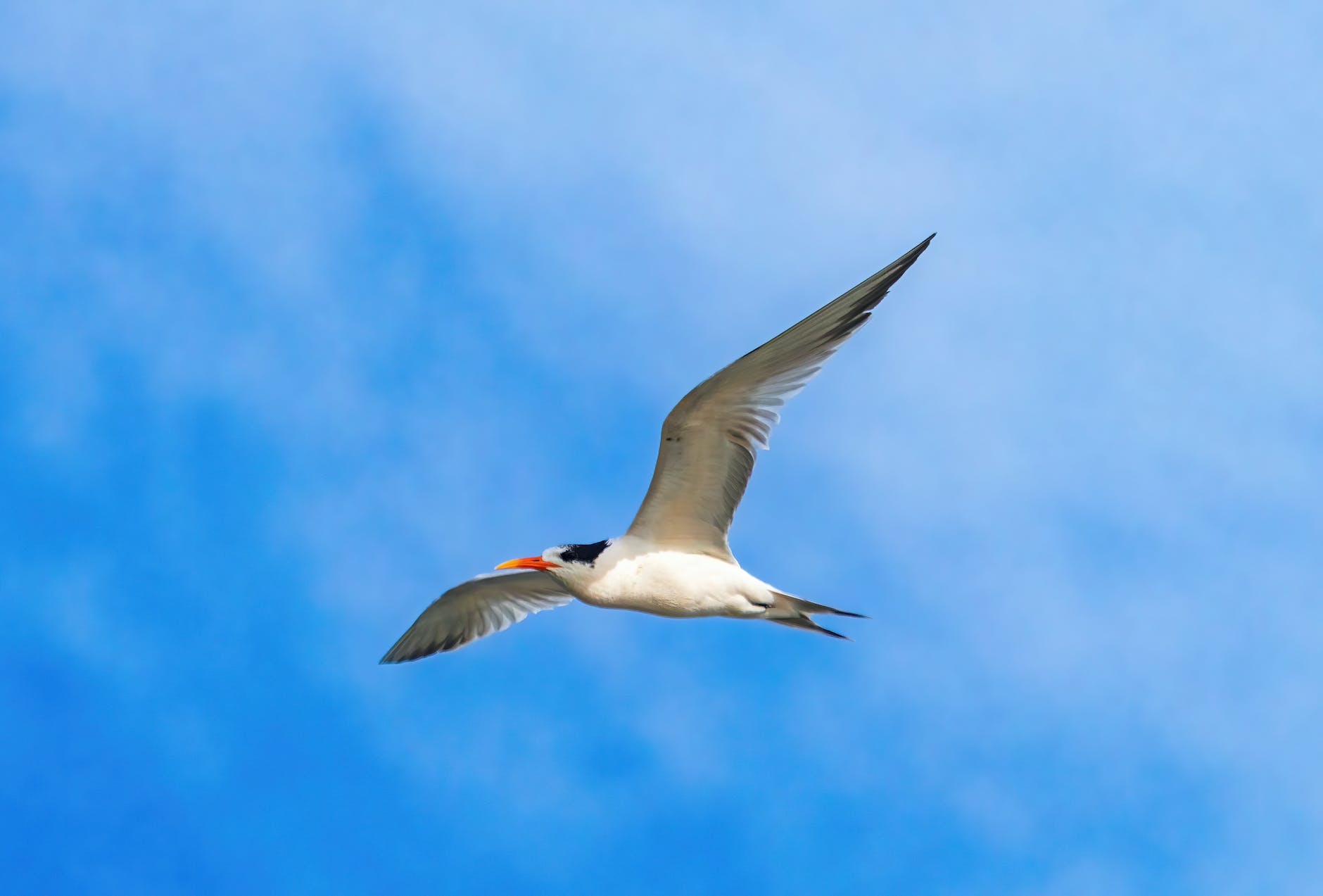
To everything, tern tern tern
There is a season, tern tern tern


– Me, riffing on the Byrds, whenever I see a tern

p.s. After a soggy summer we are enjoying a sunny fall, so I’m back at the beach after all!

The Colours of Winter

Cape Breton boasts a coat of many colours. From the bright greens and colourful wild flowers of spring, deepening into the mature greens and late bloomers of summer, and climaxing with the spectacular flaming foliage of fall. This glorious palette is set against the brilliant blues of sea and sky.

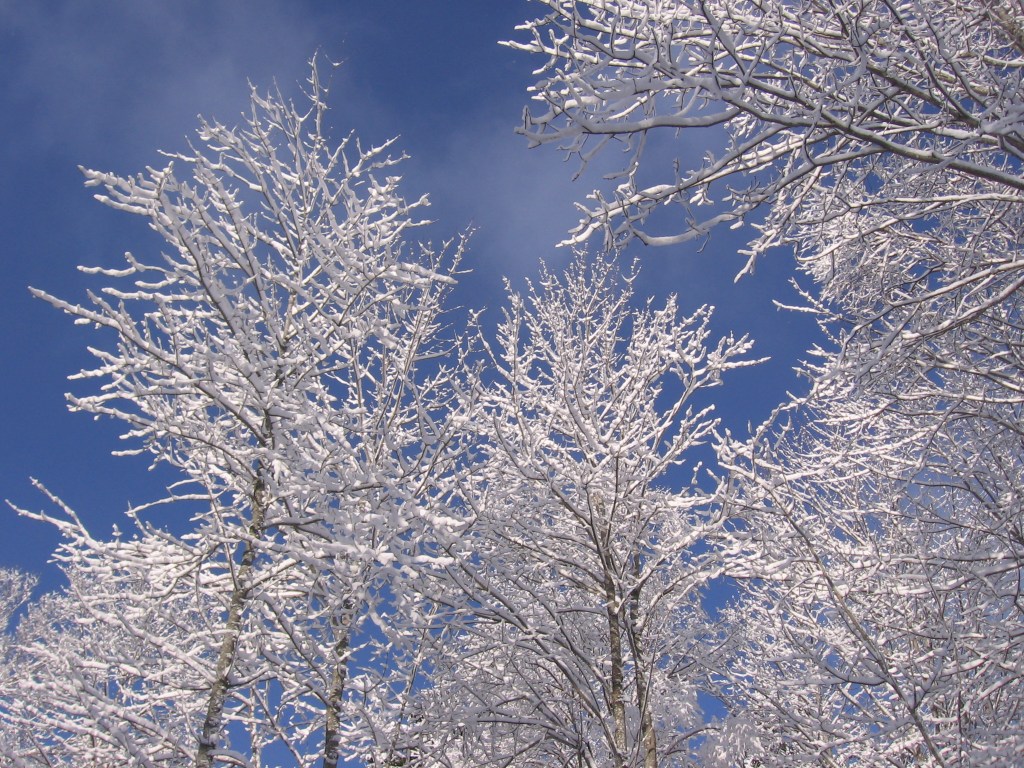
Winter has its own special beauty, featuring wind-sculpted snow drifts, lace spun from ice, and abundant patterns and textures illuminated by light and shadow. I explored this aspect of winter in Winter’s Art Gallery. But for all its icy beauty, Winter seems to specialize in monochrome, like a photographer who works in black and white, or a blue-period Picasso.

This is a colour photo but you wouldn’t know it.

And yet there is colour in winter, all the more special because it stands out against winter’s white. So here is another wintry art gallery, this time focusing on the colours of winter, captured over the years here in the Holler. I hope these colours brighten your day as we make our way toward Spring Equinox. And remember, you can click on small pics to see them full size.

Digging the Winter Blues

Winter days are not always grey, and on sunny days those blues really pop when contrasted with bright snow white. What makes that sky so blue?

The short answer is Rayleigh scattering. We know that visible (white) light is composed of a spectrum of colours, displayed in rainbows and light refracted (bent) by a prism. Light has wave-like properties, and the red end of the spectrum has longer wavelengths while the blue and violet light have the shortest wavelengths. As yellow-white sunlight enters our atmosphere it interacts with air molecules and the waves are scattered. Short wavelengths are scattered the most and thus give the sky its blue colour. (Violet is the shortest wavelength, but there is more blue in sunlight and our eyes are more sensitive to blue.) At sunrise and and sunset, the light travels through more atmosphere. The blue light is scattered away, leaving the longer wavelength reds and oranges to delight our eyes.

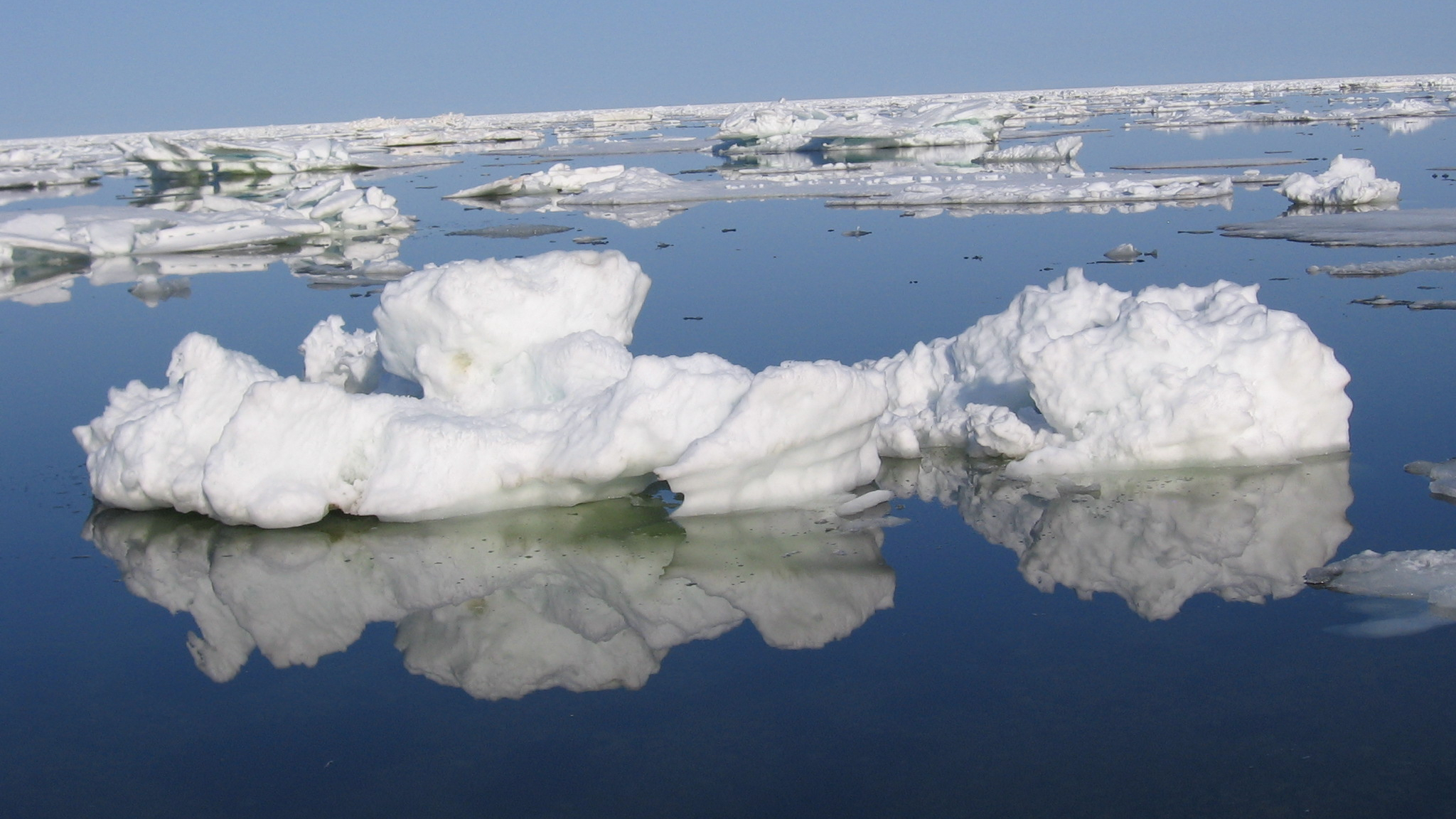
Drift ice on the deep blue sea.

Why is the Ocean Blue?

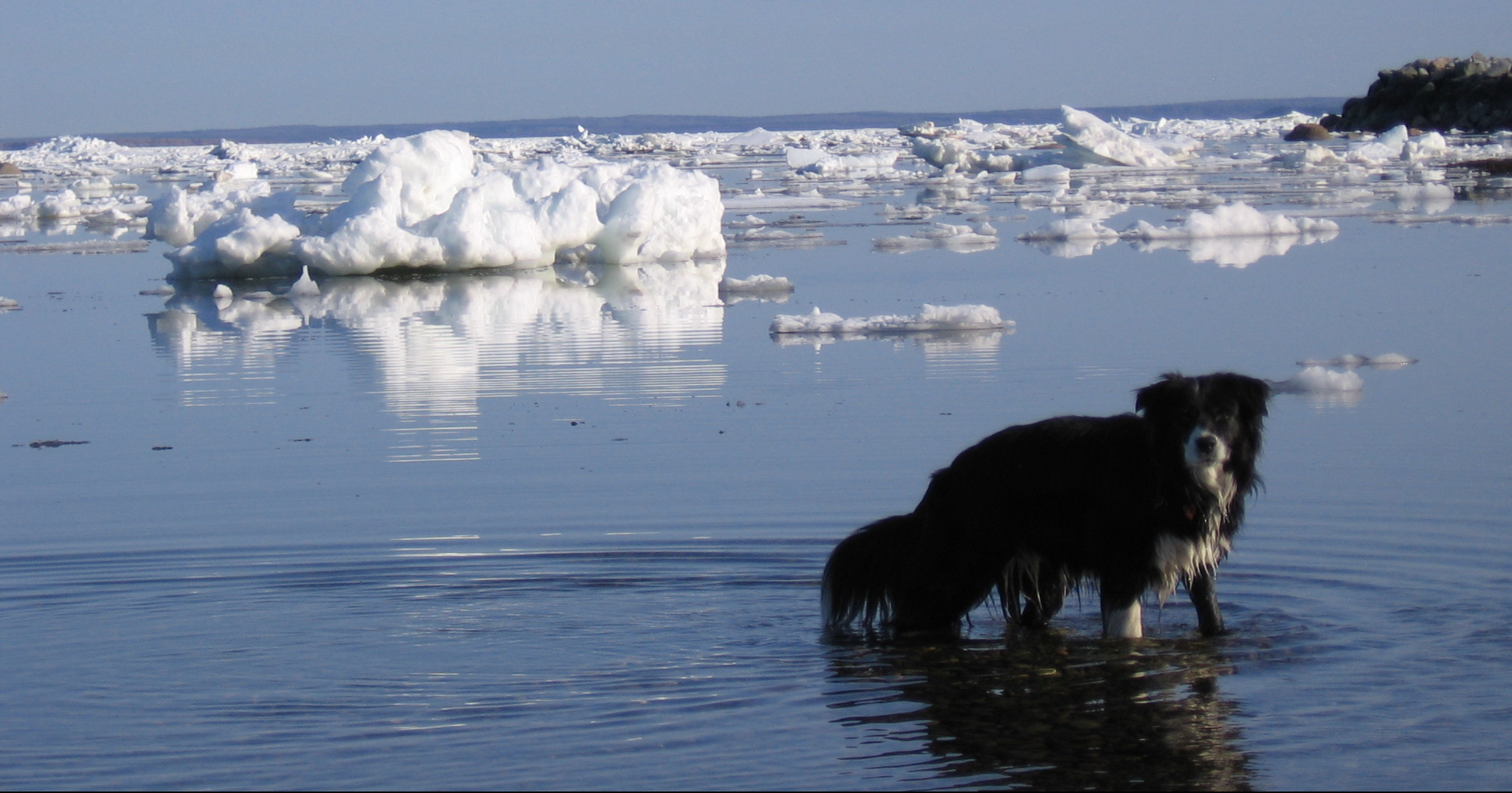
Of course water reflects light like a mirror, as in this photo from Dogs and Drift Ice. But water also filters sunlight. Water molecules absorb more long-wavelength reds and oranges and leave behind the shorter-wavelength blues and blue-greens. So while a glass of water appears colourless, water does have a blue hue that we can see when looking into deep bodies of water like the ocean. Divers observe this blue light because it penetrates deeper into the water than long-wavelength red light.

Winter’s Pond Art

I feel very lucky to live above a pond that offers something for every season. I’ve written about L’il pond and its various inhabitants a number of times, but winter is a surprisingly dynamic season for this little body of water. It goes something like this: Ice forms on the surface as temperatures drop. Snow blankets the ice. Under the ice, just as in summer, (see Ups and Downs in the Holler) water continues to drain out through the permeable soil. As water levels drop the ice eventually collapses under its own weight, sometimes cracking like a rifle shot, other times slumping with a whump.

Pond ice collapses as water levels drop

But of course, this being Cape Breton, sooner or later everything changes. It rains buckets. Or we get a warm spell and a big snowmelt. Or both. Rain water and snowmelt from the highlands pour into the pond, raising the water level. Some ice may be frozen to the ground, but most of the ice surface will be lifted by the rising water. This is one of the miracles of water – most matter is denser in solid form, but ice is less dense than liquid water and thus floats, enabling aquatic life to survive winter’s deep freeze.

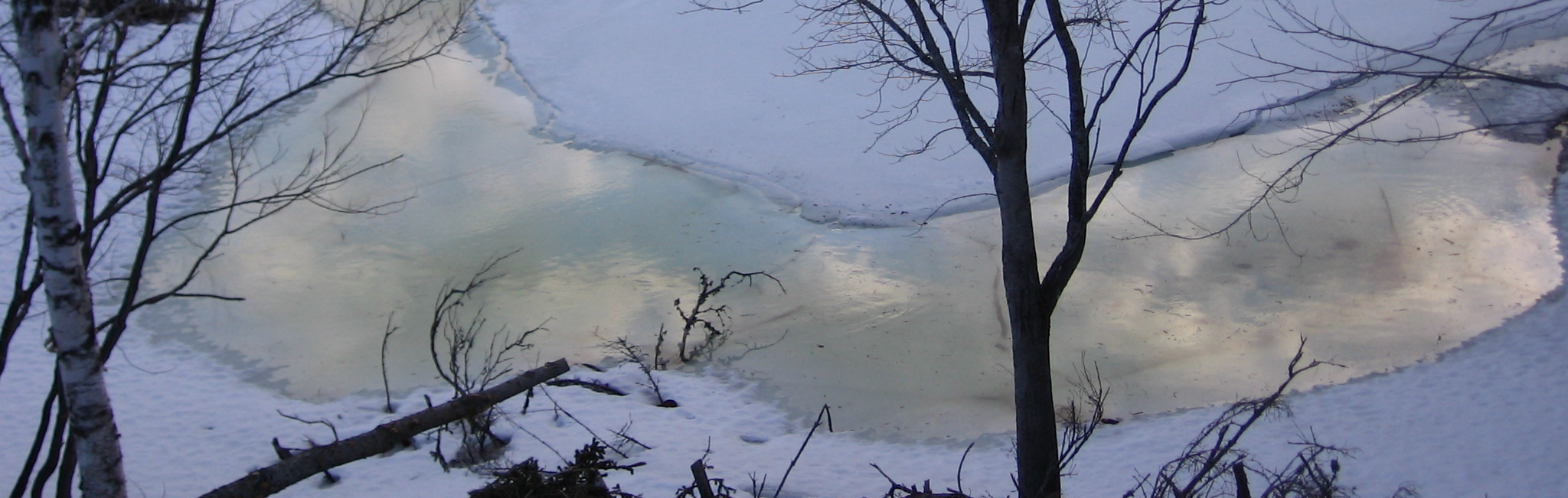
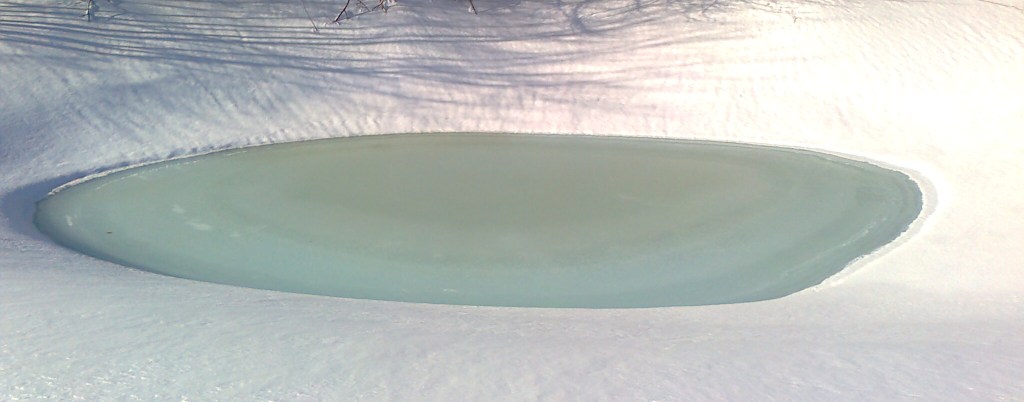
So the ice rises along with the rising water, but the ice surface is now smaller than the expanding pond perimeter. Water flows around the edge of the ice, over grounded ice, and collects in low-lying melt-water pools. And it is in these places where water and light do their magic dance.

Over the years I have enjoyed a gorgeous array of colours. The three photos below are all of the same place, just below the yurt where I lived for eight years.

A pool like an
ammonite,
a spiral
shining with the
nacre sheen of
mother-of-pearl.

Oh wait!
Now that same
pool is an aquamarine gemstone!

And now, transformed yet again, it’s like an amulet for a giant,
carved from jade.

So if water is true blue, why does it display such a kaleidoscope of colours?

This is a multi-coloured question with a multi-faceted answer. I’m no expert on optics – you could even say I’m walking on thin ice – but here is my best shot. (As always, I welcome your comments and corrections.) Water can take on a variety of colours due to light being reflected, filtered, or scattered; by suspended particles like silt or clay; by dissolved substances like iron or copper; or by microorganisms like bacteria or algae. Or, just to keep things interesting, by some combination of the above.

Take mountain lakes, like Moraine Lake in Alberta, featured on older $20 bills. These lakes are famously turquoise from ‘glacial flour’, finely-ground rock particles suspended in the water column. The rock particles scatter light in the blue-green part of the spectrum, and some is scattered back to the surface to our appreciative eyes. So, suspended particles + light scattering = turquoise lake photo op.

Rivers can be muddy brown or reddish from suspended silt or clay (like ‘The Big Muddy’ Missouri River). If the silt or clay settles out, the water will become clear. Conversely, substances that dissolve in water give it intrinsic colour. Think of rushing rivers in spring, tawny with the dissolved tannins released by decaying organic matter. Water with high iron content may look pale yellow or rust-coloured. Dissolved copper from corroding pipes will give water a blue/green tinge.

Reflections on a Pond

When light shines on still water, some rays penetrate the water and are refracted (bent) while others are reflected back off the surface. Depending on your viewing angle, the water may act like a mirror, echoing the world above its surface. In winter these watery pond mirrors are neatly framed by ice and snow.

You could say this pool of water is sky blue.
And you could say this water is ‘cloudy’.
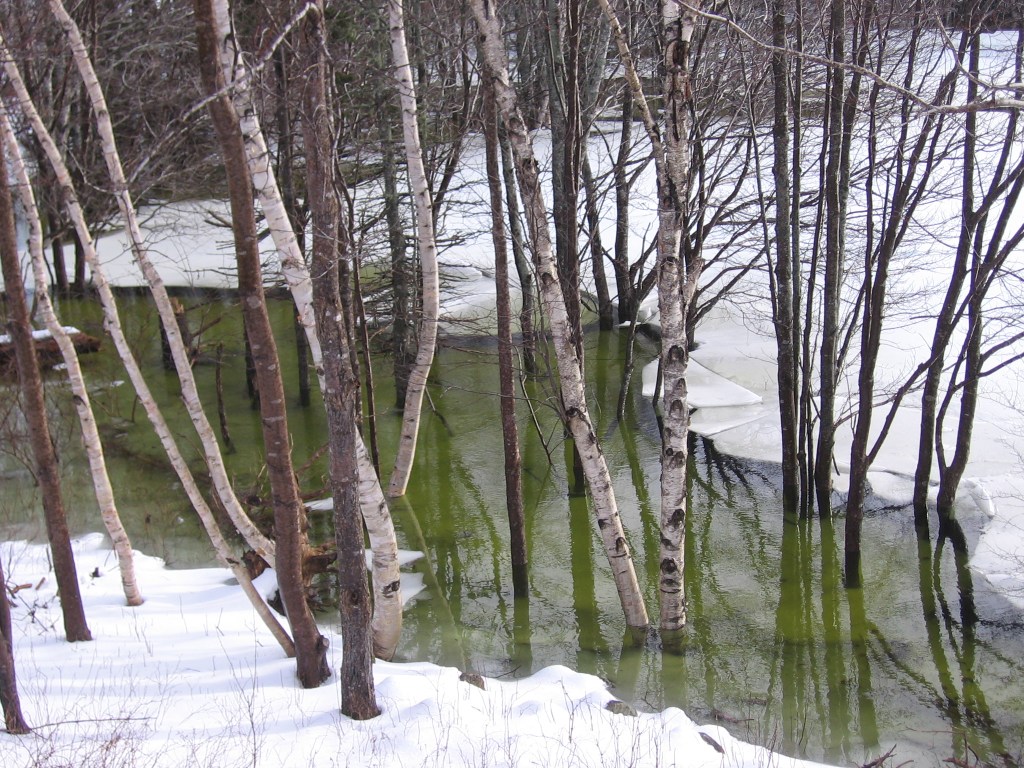
And you could say … Wait. Spruce trees are green but not that green – and a green sky?

Why is the Water Green?

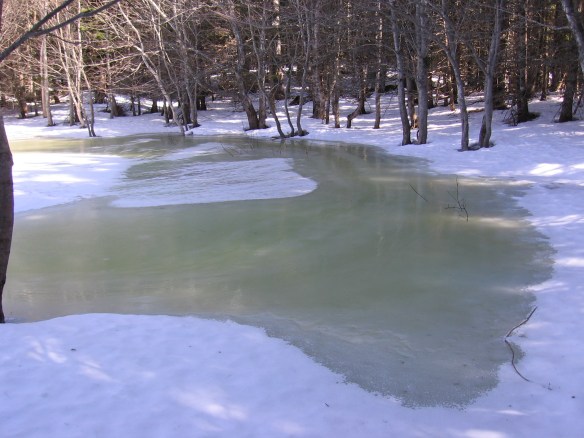
I posted the photos below on Facebook and they sparked a question: ‘Why is the water so green?’ I’d always attributed the pond’s wintry colours to light reflecting and refracting and scattering, but that question got me thinking more ‘deeply’ about that vivid green.

L’il Pond is a lively place all summer, teeming with aquatic plants, including its namesake lilies, that die off each fall. Eutrophic bodies of water like the pond are rich in nutrients, like nitrogen and phosphorous, that allow phytoplankton to thrive. Apparently some of these single-celled algae can survive all winter, feeding from that rich nutrient bath and giving off oxygen that benefits the aquatic organisms beneath the ice. These suspended microscopic algae contain chlorophyll that can give water a green colour. Decaying organic matter consumes oxygen and releases dissolved tannins that dye the water a tawny gold or sepia brown.

Like an artist mixing paint on a palette, winter blends these watercolours to achieve a rich array of hues, from earthy ochres and warm olive greens, to gem-like emeralds, peridots, and the many shades of jade.

Why is the Water Green and Blue?

I’ve ‘reflected’ on this and here’s my best guess. The green water at the top is last year’s pond water that escaped to the surface as the ice contracted. It has that rich olive-green colour from suspended and dissolved organic matter as described above. The water on the bottom is fresh from the highlands and relatively pure. It has a crisp minty-blue colour from reflected and scattered light. As the fresh water mixes with the older pond water, winter will blend yet more watercolours to enrich its paintings on the snow-white canvas.


The Colours of Ice

When water retains its colour after freezing, the colour must be due to dissolved or suspended matter that remains captured in the ice lattice. This gorgeous green ice supports the idea that those watery greens were not just a trick of the light.


Delving Deeper into the Blues

I’ve been lucky enough to see glaciers out west and icebergs off the east coast. Both glaciers and icebergs can display striking blues within the white. As with liquid water, both ice and snow filter white sunlight. The surface reflects almost all the light and is a blinding white, but as the light penetrates deeper, the long-wavelength reds are absorbed and the blue and blue-green wavelengths are scattered, some finding their way back to our eyes.

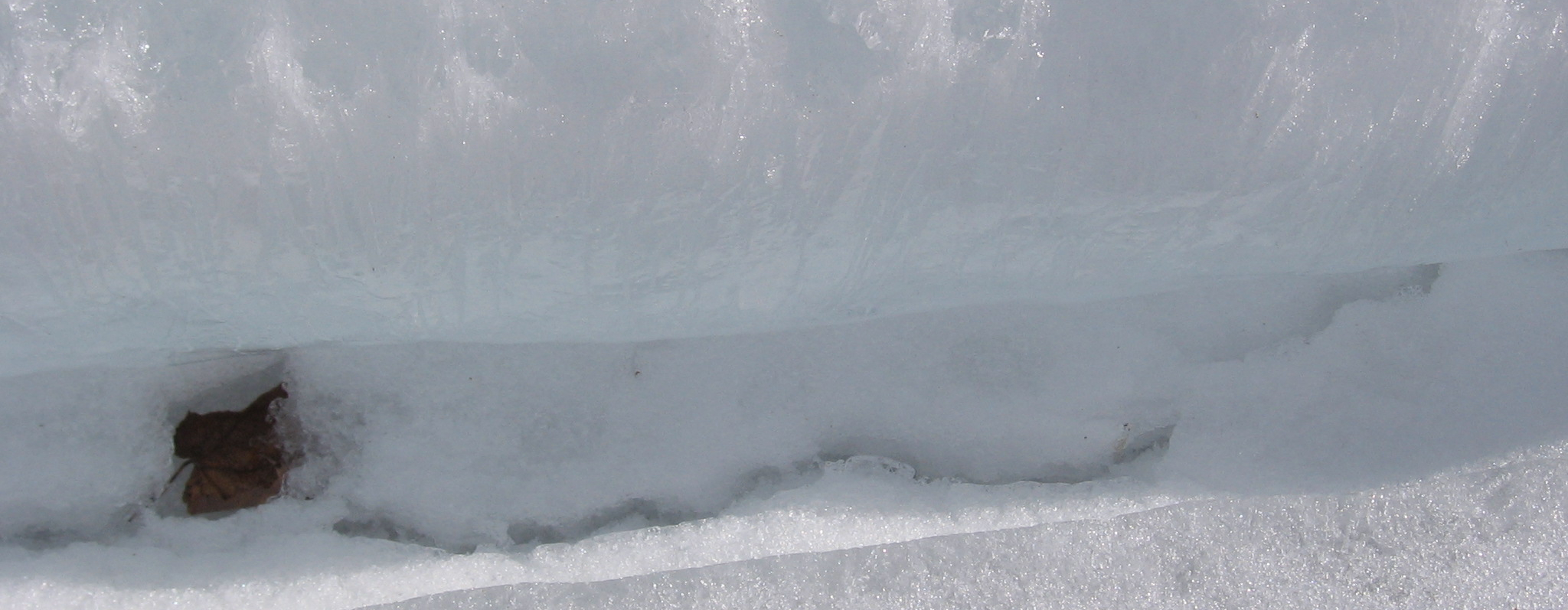
There haven’t been any glaciers in Cape Breton for about 10,000 years, and although we do get smaller ice floes, you have to hop on the ferry to Newfoundland to see the really big bergs. But dig a hole in a snowbank, or look into a crack in the ice, and you might detect a hint of blue.

It was more obvious to the eye, but can you see a hint of blue in this mini-crevasse on the pond?
Leaf: ‘Help! I’ve fallen into a crevasse and I can’t get out!’

Like liquid water, ice can also reflect light for subtle displays of colour, as seen here.


The Colours of Snow – the Shadow Knows (but I don’t)

Next time you’re looking at snow, take a gander at the colour of the shadows. When the sun is low in the morning sky, shadows on snow are a beautiful blue. When the sun is high overhead, they tend to fade to grey, but as the sun drops to the western horizon, the shadows stretch out and shift back to blue.

The length of these tree shadows is an indication of how low the morning sun is.
Later in the afternoon, these beautiful draped shadows are almost as blue as the sky.

Shadows occur when light is blocked – a shadow is the absence of light. When the sun is high a shadow is the absence of white light. That should make shadows black, but often there is enough reflected light bouncing into the shadow zone that they tend to shades of grey. As I described earlier, there are more long-wavelength reds and oranges when the sun is lower in the sky. When this light is blocked, the absence of red and orange light results in a blue shadow, visible on the snow-white backdrop. I think. Maybe.

But it’s more complicated than that. I’ve seen both blue and grey shadows at different times of day. What’s going on? There are a handful of differing opinions on the cause of blue shadows on the web, but which, if any, is correct? I have my own ideas, but I’m not sure if they’re correct either. This is the kind of conundrum my science-geek buddies and I use to discuss over pints at the pub. So if any of you want to join me in puzzling over snow shadows, I’ll buy the beer.

Okay, ‘nuf of dem blues – it’s time to get in the pink. There is a lovely phenomenon known as ‘alpenglow’ when snowy mountain peaks glow rosy pink at sunrise or sunset. But pink snow can be more than just a transient reflection. Algae can lend their colour to snow as well as to water, as shown in the photo below from Dogs and Drift Ice.

Feeling in the pink with watermelon snow.

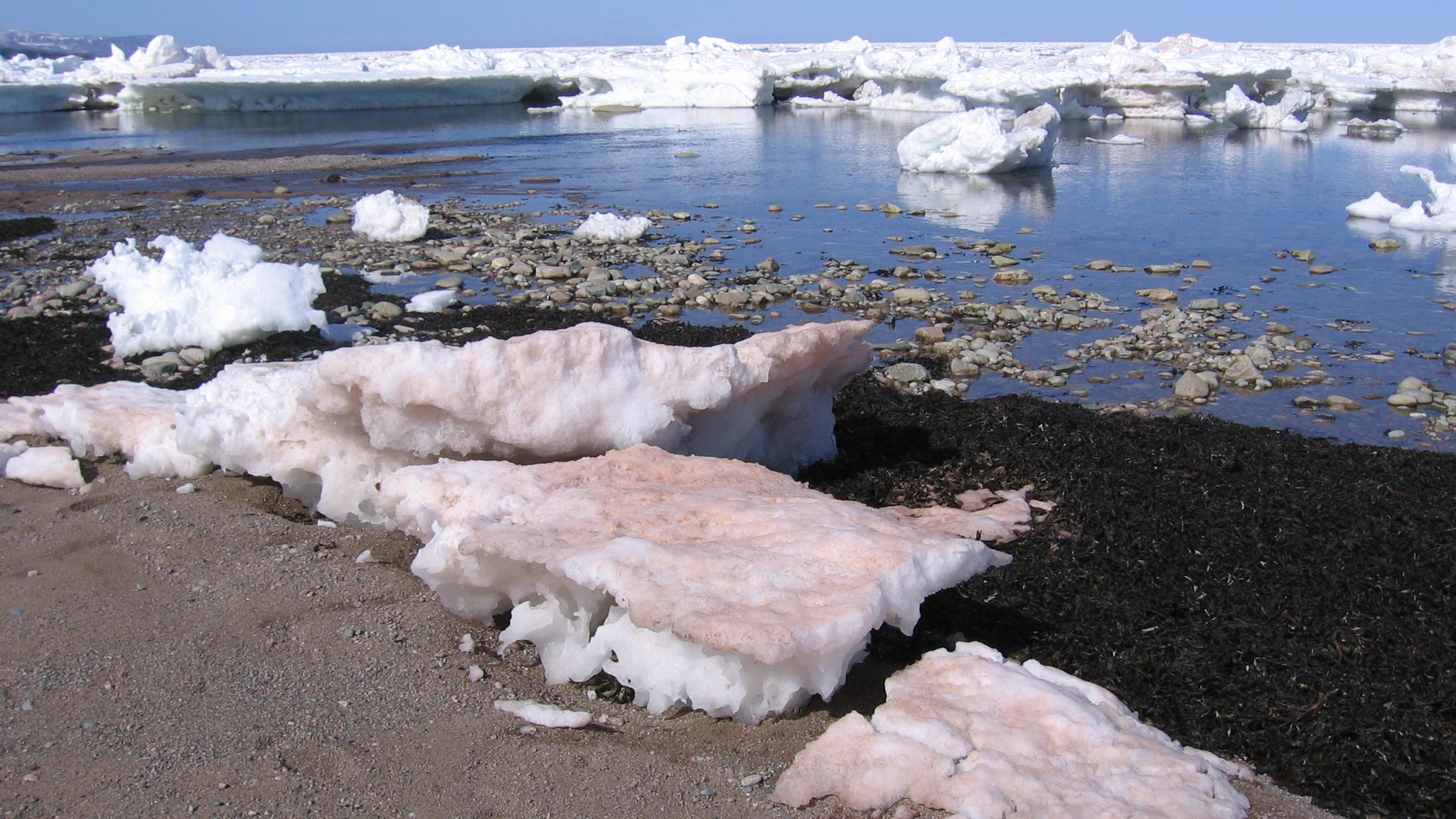
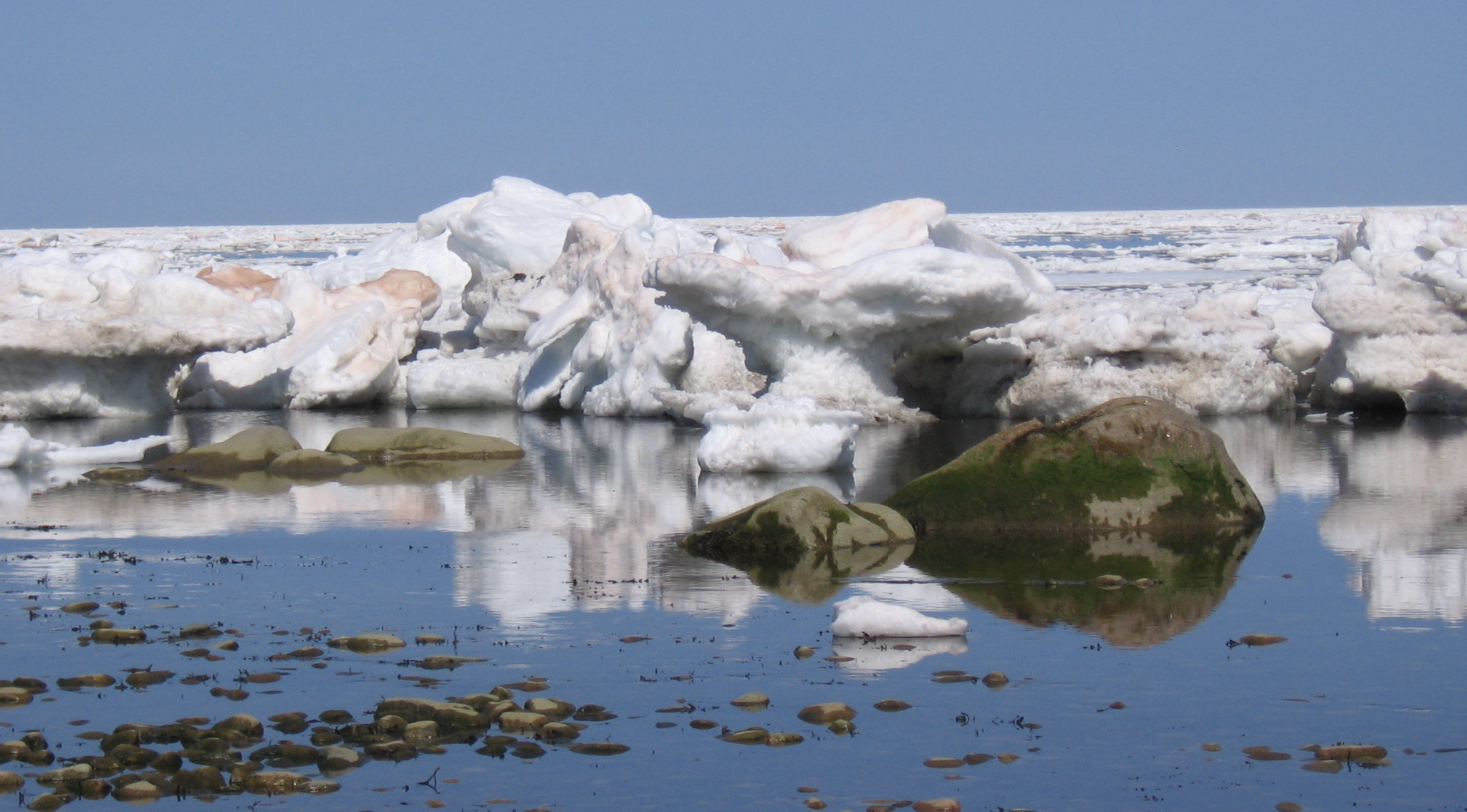
Our drift ice often displays this red-pink tinge. I’d always heard the colour came from the red soils of PEI hitching a ride, but then why is the red on top of the floe? While writing that blog I learned that pink snow is caused by Chlamydomonas nivalis, a unicellular green alga that contains a red carotenoid pigment called astaxanthin. That’s a mouthful, but it goes by the wonderful moniker ‘watermelon snow’ and can also be seen in the mountains.

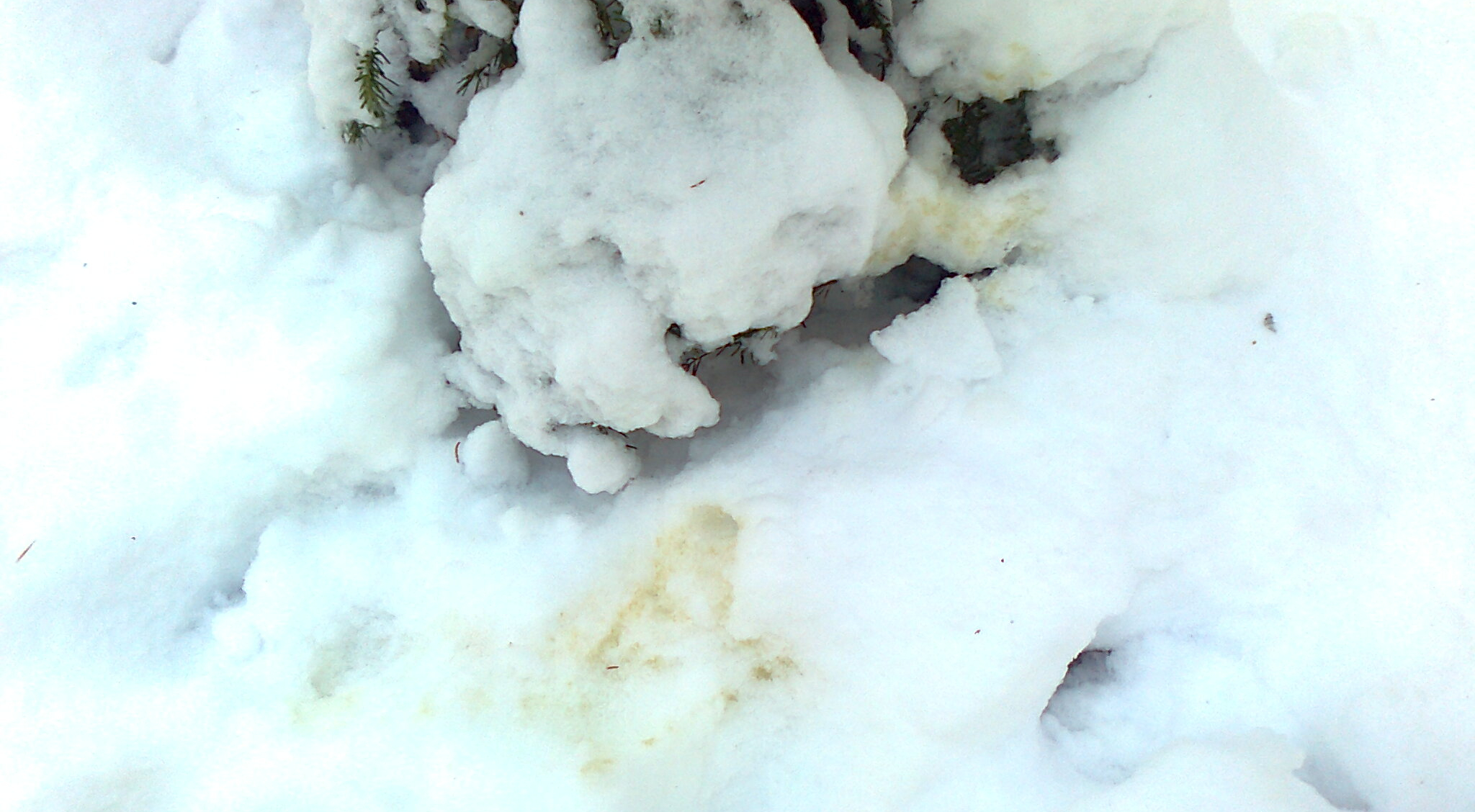
And just a final word of caution about the colour of snow: If it’s yellow? Don’t eat it!

Coyote calling card.

More Colourful Signs of Life

Winter snows cover grass, shrubs, mosses and such with a soft white blanket. Amphibians burrow into mud. Critters go underground or even hibernate. Many of our colourful birds fly south. All those formerly brilliant leafy trees are now bared to their buff. But life goes on in winter and sometimes brings a bit colour into our lives.

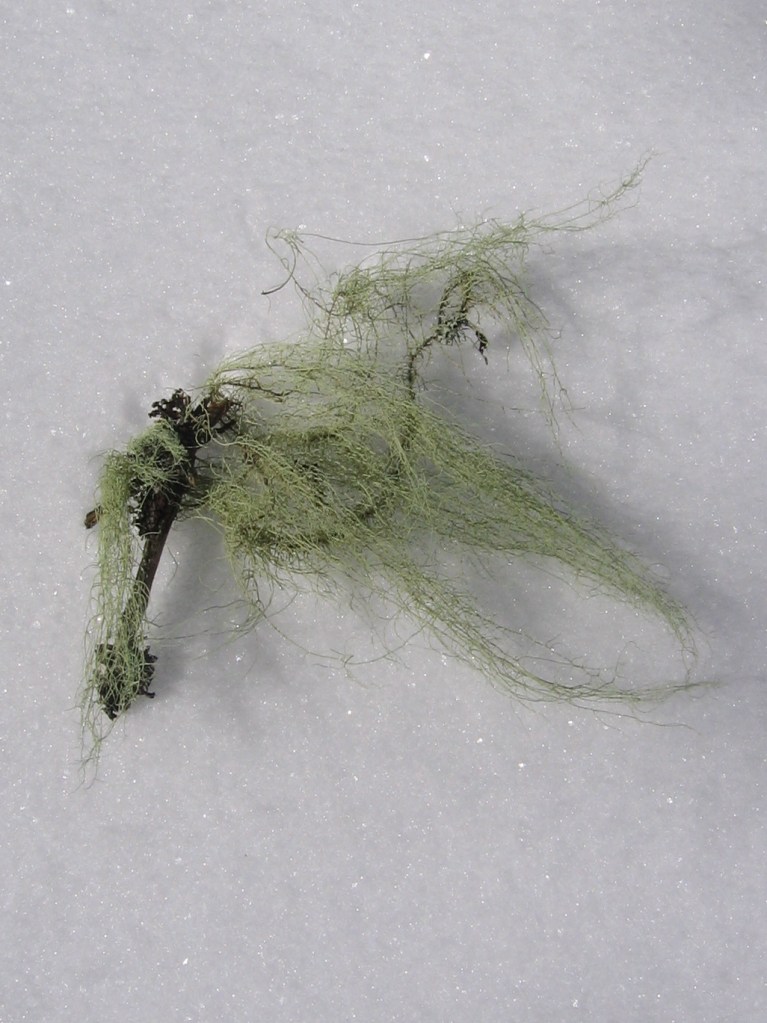
Leafy trees are winter bare but here in the mixed forest there is still greenery. Conifers may lack the pizzazz of deciduous trees most of the year, but they are indeed ‘evergreen’ and wear their subdued colours all year round. Many of our aging white spruce are draped with ‘old man’s beard’, a sage-green lichen (genus Usnea). Last year’s bird’s nest is suspended high above the snow and made mostly from this lichen. This year we’ve had barely any snow, so green things normally hidden are making a rare winter appearance.


And, of course, there are still animals out and about. While many birds head south, blue jays stay and brighten our day. Most mammals wear coats of grey or brown, but there are a few more colourful characters in the neighbourhood.

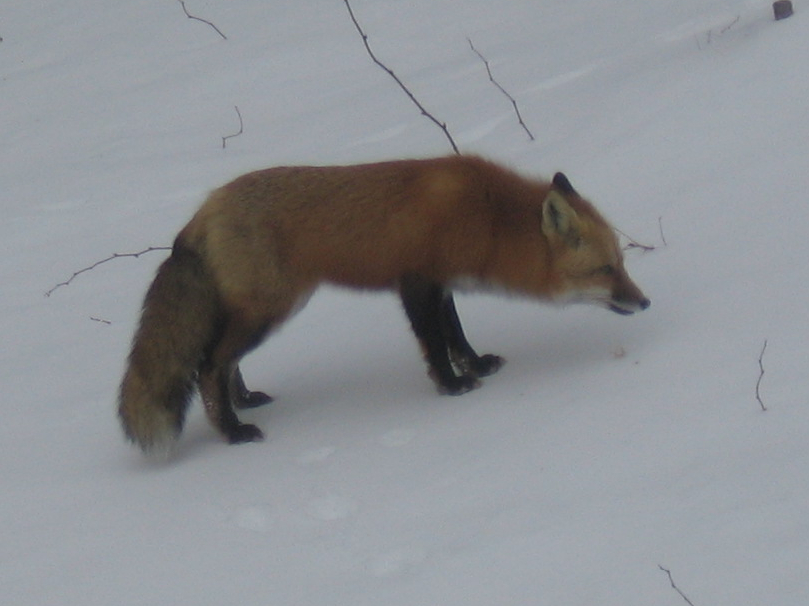
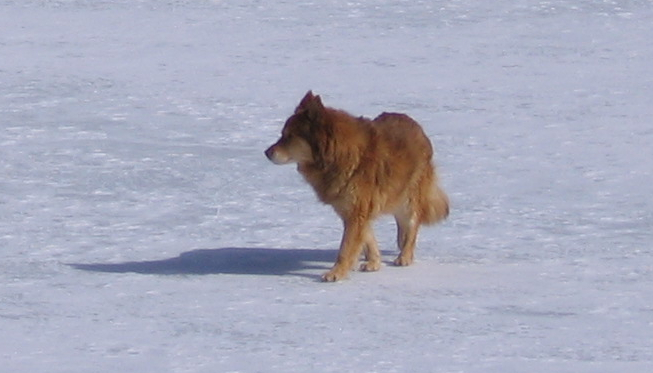
Not a fox! Our red dog Tundra also stood out as she walked across the frozen pond back in 2006.

Sunrise, Sunset

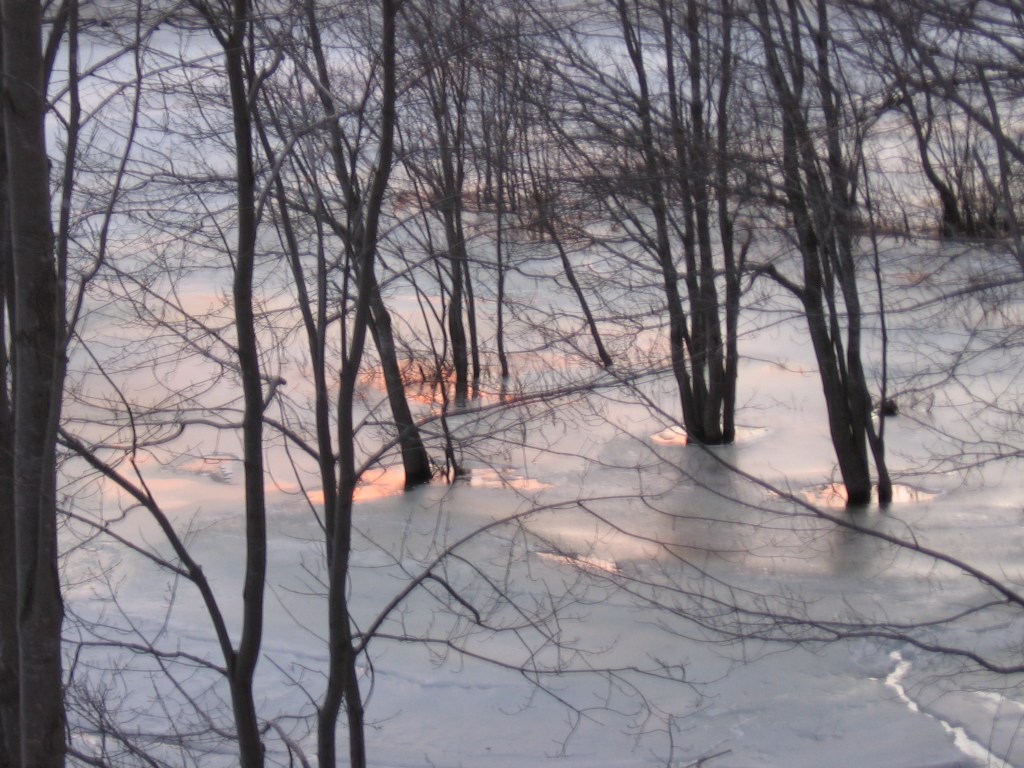
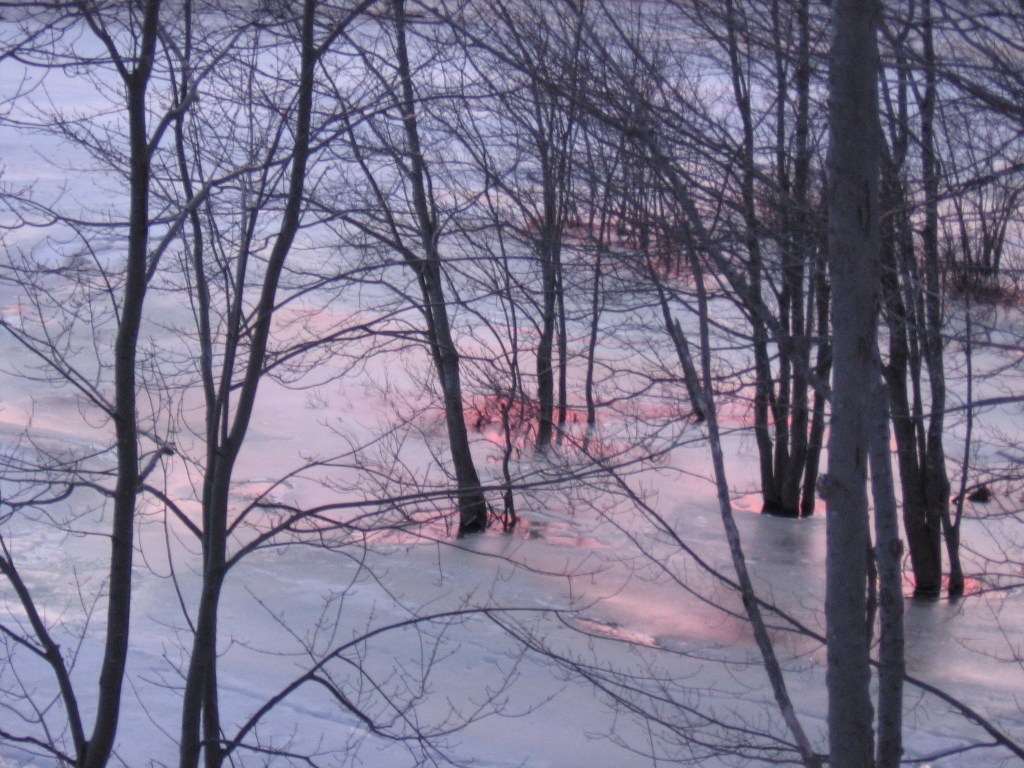
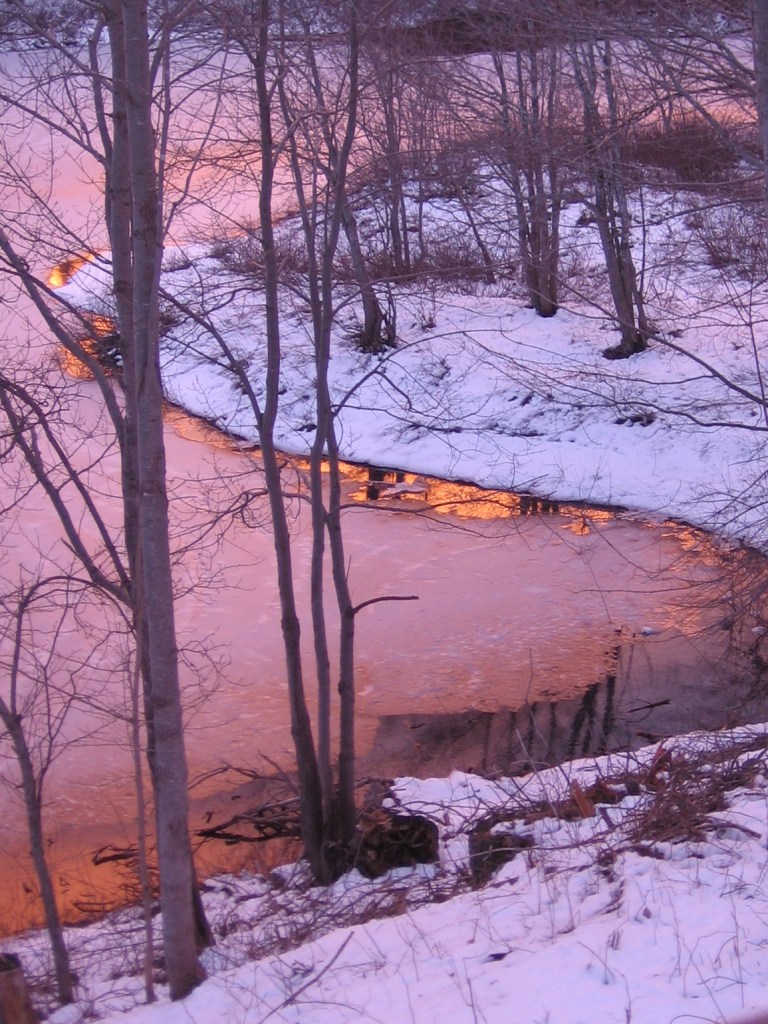
It seems fitting to end this post with sunset and its spectacular colours. Back in Calgary I used to ride my bicycle to work along the Bow River bike path. I loved those mornings when the river glowed red and rose just before sunrise. Here in the Holler I marvel at the sunset colours captured by the pond and framed by white snow and ice. I’ll leave you with these final reflections on the Colours of Winter.

Nature always wears the colors of the spirit.” – Ralph Waldo Emerson

Sue McKay Miller
March 16, 2023

p.s. Phew! Just under the wire to get this winter blog posted before we swing into spring.

Have a Happy Spring Equinox!


Stones I have Known

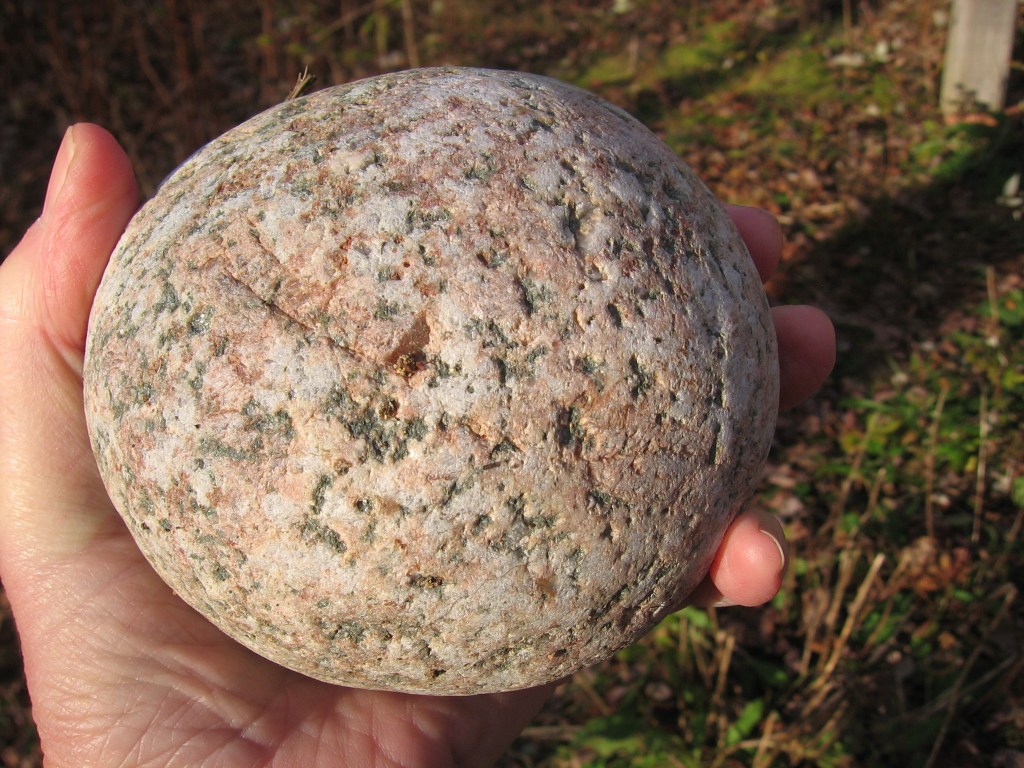
In my former life I was a geophysicist. We use a variety of remote-sensing techniques to image the deep subsurface and work closely with geologists. One Friday afternoon some 20 years ago I was in a Calgary pub and told one of these rockhounds that I was driving across the country to Cape Breton. ‘Ah,’ he said, and a dreamy look came into his eyes. ‘The pink granite…’ He had done a geological survey in the Cape Breton Highlands and kindly gave me a copy of his report. I looked forward to laying my own eyes on this remarkable pink granite – and I wasn’t disappointed.

The best place to see pink granite is at Green Cove in the Cape Breton Highlands National Park. You can walk out onto this granitic headland that juts into the brilliant blue Atlantic. Waves crash against rocks that are 373 million years old. It’s enough to make a geologist swoon, but pink granite is so abundant around here that some locals just don’t get how anyone can get so excited about ‘a bunch of rocks’. But if you do get excited about rocks, you will surely love Cape Breton, because we have lots of great rocks!

It is beyond the scope of this blog – or my expertise – to discuss the complex geology of Cape Breton. But thanks to its convoluted tectonic history, this island boasts all three major rock types – sedimentary, igneous, and metamorphic – in abundance. There are glacial erratics throughout the Acadian forest and cobble beaches lining the shores. You can see outcrops of granite and basalt, a marble mountain, and gypsum deposits sculpted by the sea. But as usual with this blog, I’m staying close to home. So take a walk with me and I’ll introduce you to some stones I have known. Remember to click on a photo to see it full size.

Sitting on a rock in a river – tickled pink to be surrounded by pink granite!

Walking along any of the many local rivers and brooks is a great way to see stones. Running water dances with rock as it rushes from the Highlands to the sea in cascading waterfalls, riffles and pools. Powerful water shapes boulders and flows among stepping stones.

Humble Rock wallows in this meander like a stony hippopotamus. A special spot to reflect on life or, as The Beatles suggested, ‘Turn off your mind, relax and float down stream’.

There’s Hard Rock … and then there’s Soft Rock

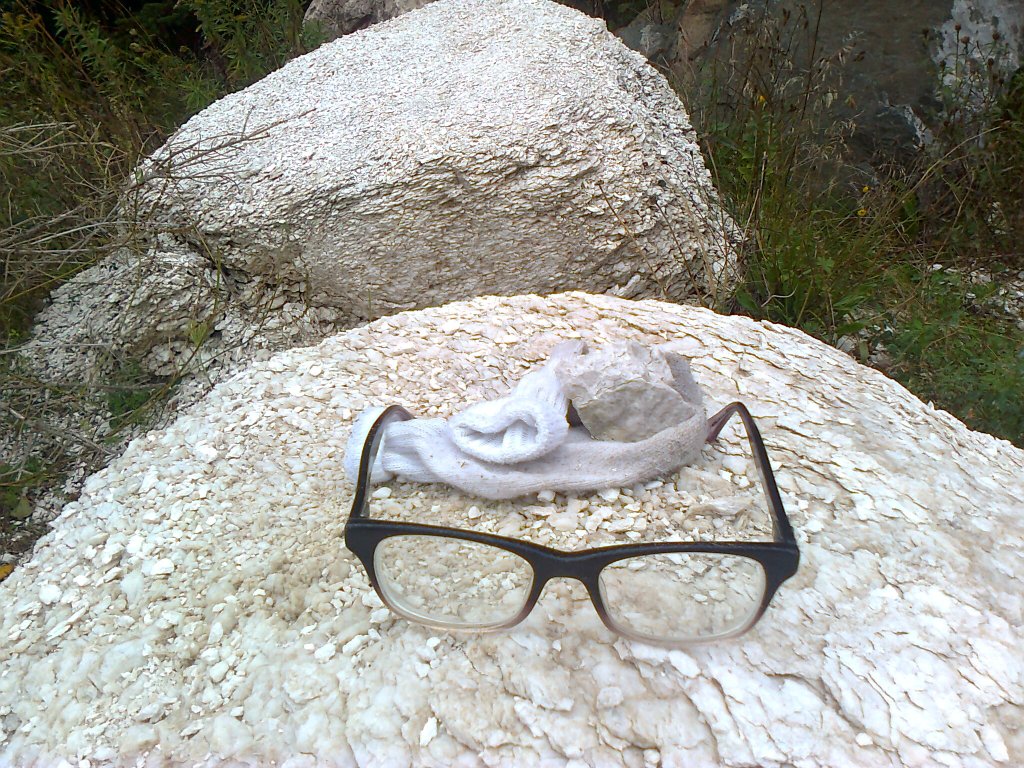
Granite is igneous, forged in fiery magma. It is hard and durable and, like marble (metamorphosed limestone) is used for buildings, countertops, floors and such. At the other end of the spectrum is gypsum, a sedimentary rock so soft you can carve it with a pocketknife. But be careful, your artwork might dissolve if it gets damp! Gypsum is also called plaster rock, and, as these names suggest, is a component in gyprock (aka drywall) and plaster. Gypsum is moderately soluble and when it dissolves it leaves slumps and sinkholes behind. Our local ‘Plaster Park’ was closed due to safety concerns over the sinking land.

Gaping sinkholes formed as (I presume) the underlying gypsum dissolved.

Things I like to do with Rocks

Sit on them

There are so many rocks around here that you can always find one that is just right to sit on and watch the river flow. Or watch the tide roll in and then watch it roll back out again. My daughter-in-law and I demonstrate.

Hug them!

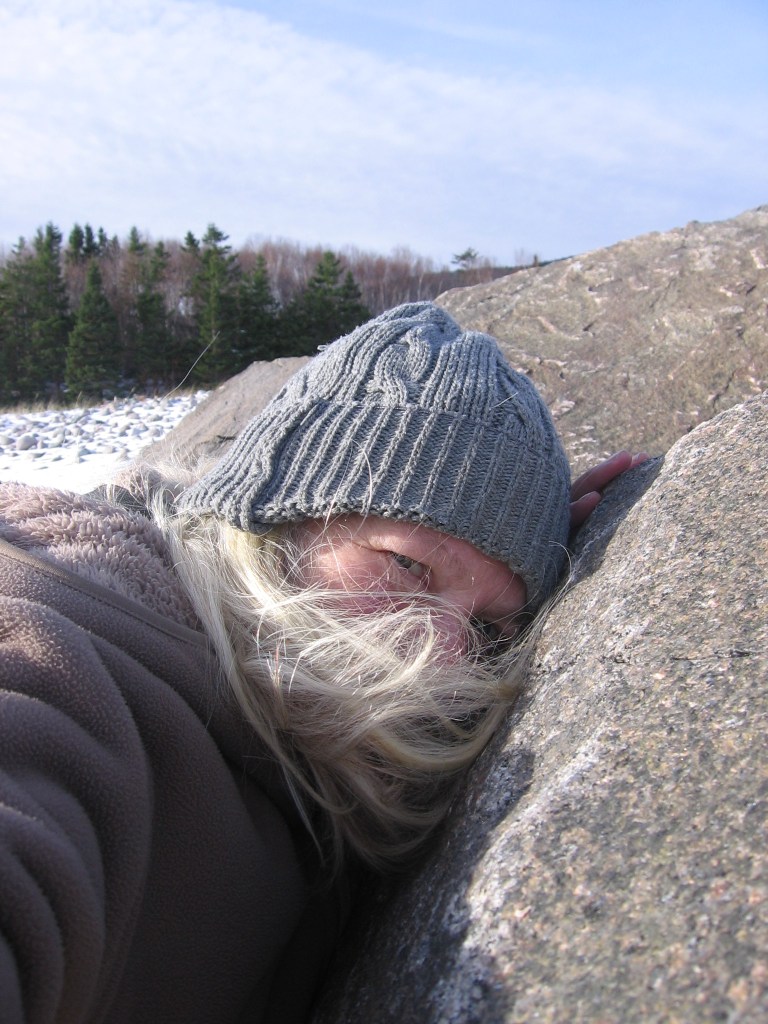
I’m definitely a tree hugger, but when I emerge soaking wet from the Atlantic, I just love hugging a hot rock that has been soaking up the sun’s rays. The breakwater stone pictured below is my favourite hugging rock – it is just the right size and at the perfect angle of repose. My beach buddies have seen me draped over it many a time.

Pile them up or throw them down …

Or balance them all around!

Beach rocks are often featured in spontaneous beach art. To see everything from balanced stones to mysterious rock patterns, check out my blog At the End of the Day from September 2021. And, for the record, I didn’t do this balancing act. A young fellow named Jordan did.

Gauge the sand thickness

Beach sand washes in and out, dependent on tides, winds, waves, and storms. But boulders abide. These lovely sea-sculpted stones appear and disappear depending on the thickness of the sand. When they vanish entirely? There’s a lot of sand onshore!


Use them as landmarks

Inuit make inukshuks to guide them across the vast expanse of the arctic, but naturally-occurring rocks can be useful waymarkers too. Erratics are boulders that were transported by glaciers and then unceremoniously dumped as the glaciers retreated. These stones are randomly strewn throughout the forest. As I described in The Humbled Hiker, I like to bushwhack around on the highland slopes. There are no trails up there so erratics serve as useful landmarks, or touchstones. And I do touch them. In fact, I was so happy to see this familiar boulder on a recent exploration that I gave it a big hug.

The glaciers left behind large boulders, but they also dumped glacial till – an unsorted mix of sand, silt, pebbles and cobbles – across the landscape. Till is easily eroded along shorelines, as shown below. As the cliff retreats the cobbles and pebbles pile up below. Lighter sands and silts may be picked up by the waves to form beaches or be carried offshore.

Tundra stands on an eroding cliff of glacial till – an unsorted mix of sand, silt, pebbles and cobbles.

Write a story about them

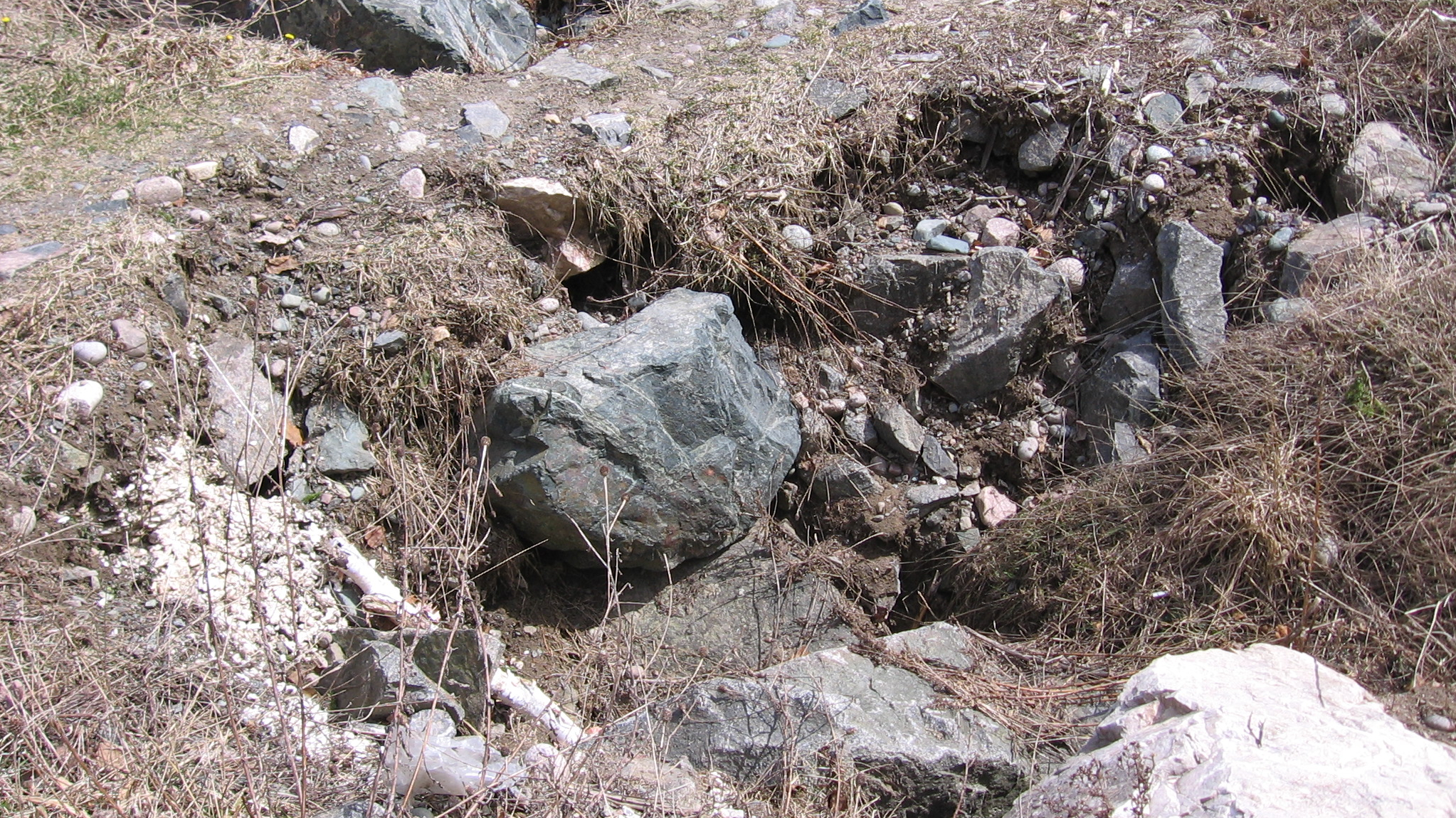
Glacial till is not very fertile. I doubt the Scots who settled this area had any love for the stones they had to pick from the ground to prepare the land for farming. The evidence of their backbreaking labour is all through the forest that has since swallowed up the old farms. Rock piles, rock walls, and even old rock-lined root cellars are scattered throughout. I was wandering in the woods one evening and stumbled across a huge rock pile I’d never seen before. It inspired my short story ‘The Stone Mound’, published in ‘Magine magazine, March 2022. https://suemckaymiller.com/short-stories/

This huge stone mound inspired a short story of the same name.

Collect them

I liked rocks long before I became a geoscientist. I was traveling overseas when a taxi driver went to take my suitcase. I weighed all of 110 lbs and he expected to take it from me and easily toss it into the trunk. The weight of it so took him by surprise that he nearly dropped it. His look said, ‘What’ve you got in there? Rocks?’ Well, actually … yes.

And now I that I live a mile or so from a cobble beach I keep bringing stones home. They sit around in piles all over the place. I’m not alone. Many a beach goer leaves with rocks in their pockets. That special stone that spoke to them. It said, ‘Take me home with you.’

Which one would you pick?

Make Rock Art

Stones are naturally beautiful, but they also make a great medium for artwork. I sometimes paint on rocks, make stone mosaics, or create sand-on-sandstone pieces. Collecting and selecting is part of the fun! Here are a few samples of my rock art.

Are Rocks Alive?

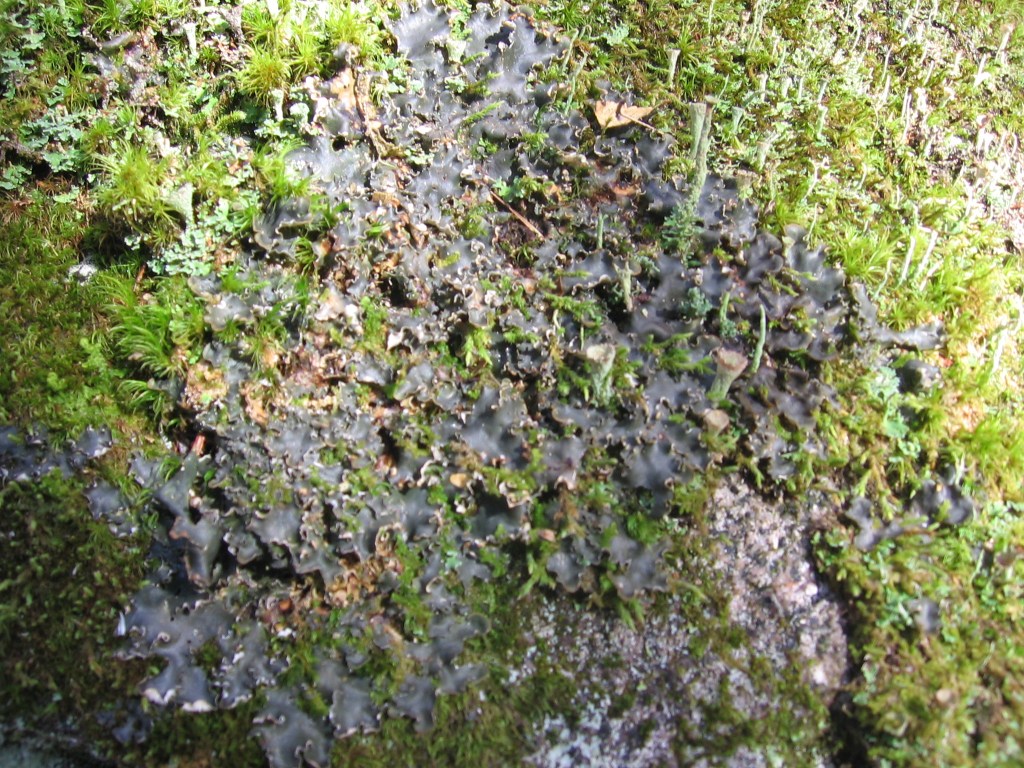
Not technically – at least not in the way western science defines life. But rocks beget dirt and dirt combines with organic matter to form soil and soil begets life. It always amazes me to see lichens, fungi and mosses transforming a lithified collection of minerals into a living organism.

This big boulder is a nursery for the moss and lichens shown below.

It’s Alive!

This glacial erratic sports a mossy cape and a fern headdress.
Yes, dear reader, there is a boulder somewhere under there.

Judging by all the moss they’ve gathered, I’d say these are NOT Rolling Stones.

(They rock, but they don’t roll!)


Sacred Stones

Alive or not, rocks have their own special energy and power. People have always known this, and ancient standing stones and mounds are a testament to that connection. Rocks are ancient compared to we short-lived humans, but even they have their cycles, cycles that stretch over eons too vast to imagine. Mountains slowly erode, carried bit by bit to the ocean, only to be reborn. Perhaps at the bottom of oceans as heat and pressure turn sediments into stone; stones that rise again, thrust into mountains by massive tectonic forces. Or perhaps subducted into the fiery cauldron of Earth’s mantle and then shooting out of the depths in a volcanic eruption. Birthed in fire or water, rocks hold this elemental energy within, and we humans somehow sense that.

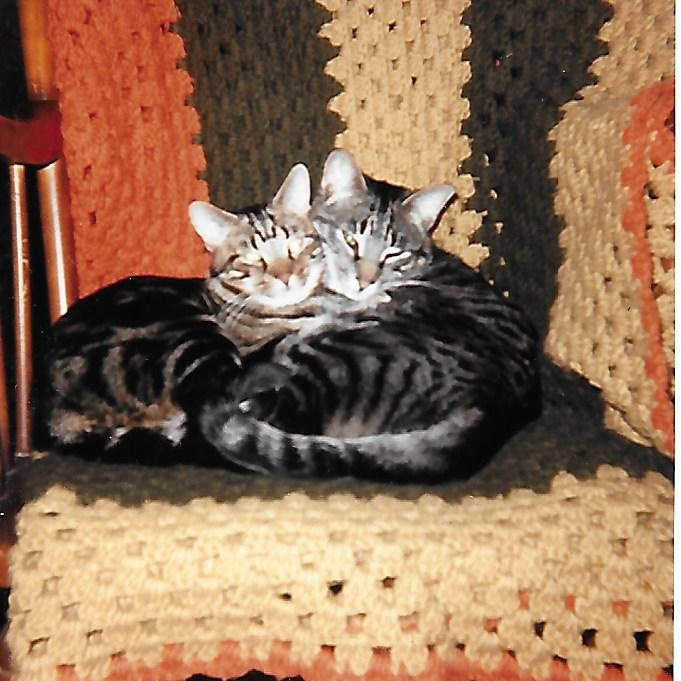
Like so many, I am drawn to the ancient standing stones and neolithic mounds I have visited in Scotland and Ireland. But stones can mark a sacred spot in a much more humble manner. We can pile stones over bones to create a burial cairn. We did this when our aged cats died within months of each other, a pair of cat-cairns way up a creek in the BC interior.

I built another cairn years later when our dog Tundra died, 15 years ago now. I can see her rock cairn from my window as I type this. I often visit this special spot and from time to time I add a new beach stone, carefully selected and placed. Rest in peace, Tundra.

Sue McKay Miller
December 9th, 2022

‘Everybody must get stoned.’ – Bob Dylan

Swimming with Frogs

I wasn’t going to do it again. Really. Surely two frog blogs is enough. But you know what they say: ‘Write what you know.’ Do I know frogs? Well, not in the sense that a herpetologist does – I’m no expert – but I have learned a thing or two just by being around them for the past 18 years. It’s a kind of knowledge by osmosis, that passive process of absorption from the environment. Akin to the way frogs absorb water through their skin rather than drinking it down.

But I never much liked that ‘write what you know’ advice anyhow. After all, if every author complied, there would be no science fiction or historical fiction or fantasy. I prefer ‘Write what fascinates you.’ Of course, sometimes ‘what you know’ is also what fascinates you. And I do find frogs fascinating. So here I go again with yet another frog blog.

‘She finds me fascinating. How thrilling.’

Actually, I’m amazed by all amphibians. Of all the vertebrate classes, only amphibians undergo such radical transformation during their life cycle. Baby mammals look similar to adults only smaller and way cuter. Baby birds look like adults only smaller and, in some cases, way uglier – until they get all downy and adorable. Baby fish and baby reptiles emerge from their eggs looking like miniature versions of their parents.

But members of the class Amphibia have a more complex journey to maturity; more akin to some insects, like butterflies or dragonflies. They don’t just get bigger, they are utterly transformed in appearance, habitat and lifestyle.

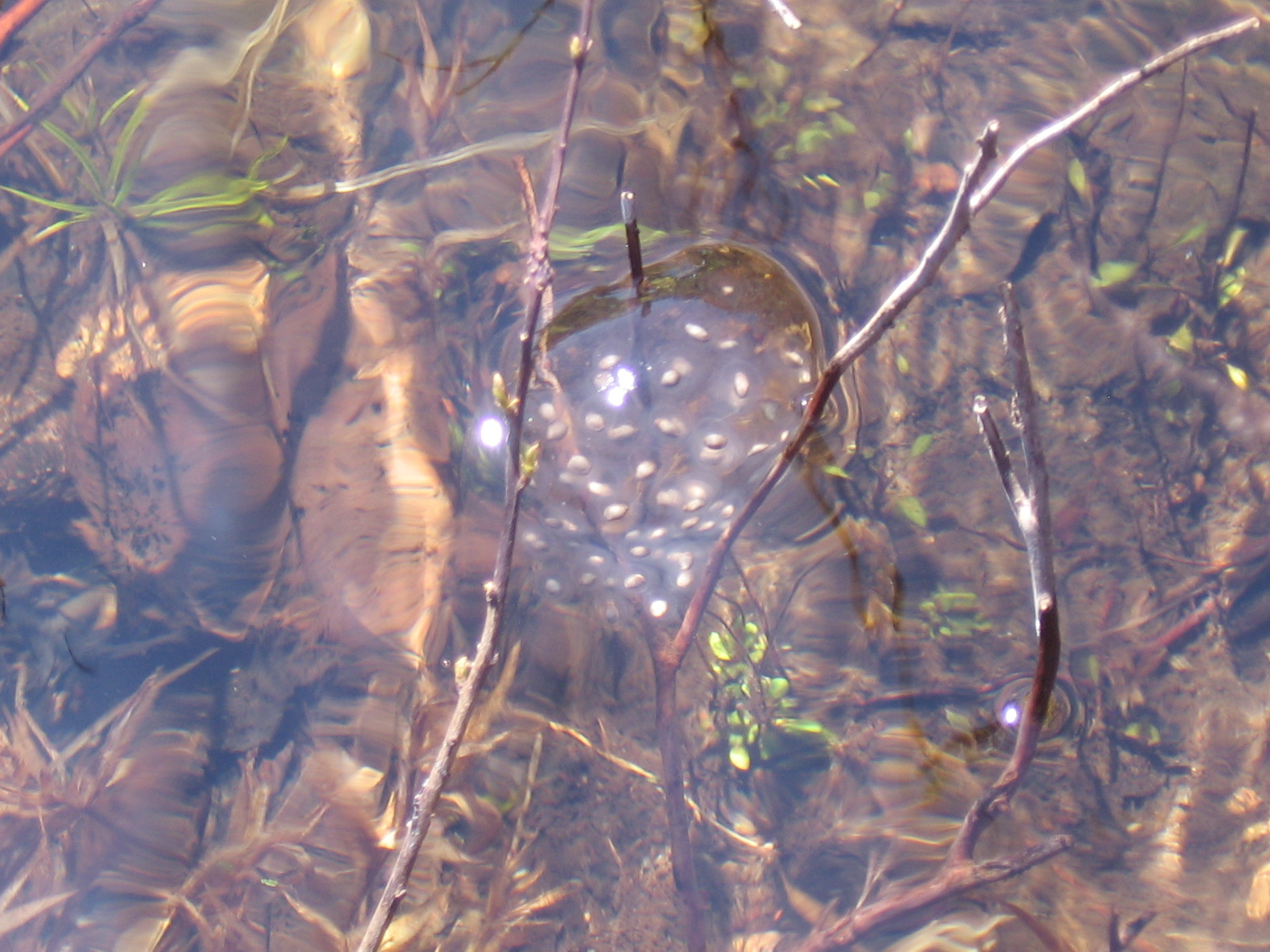
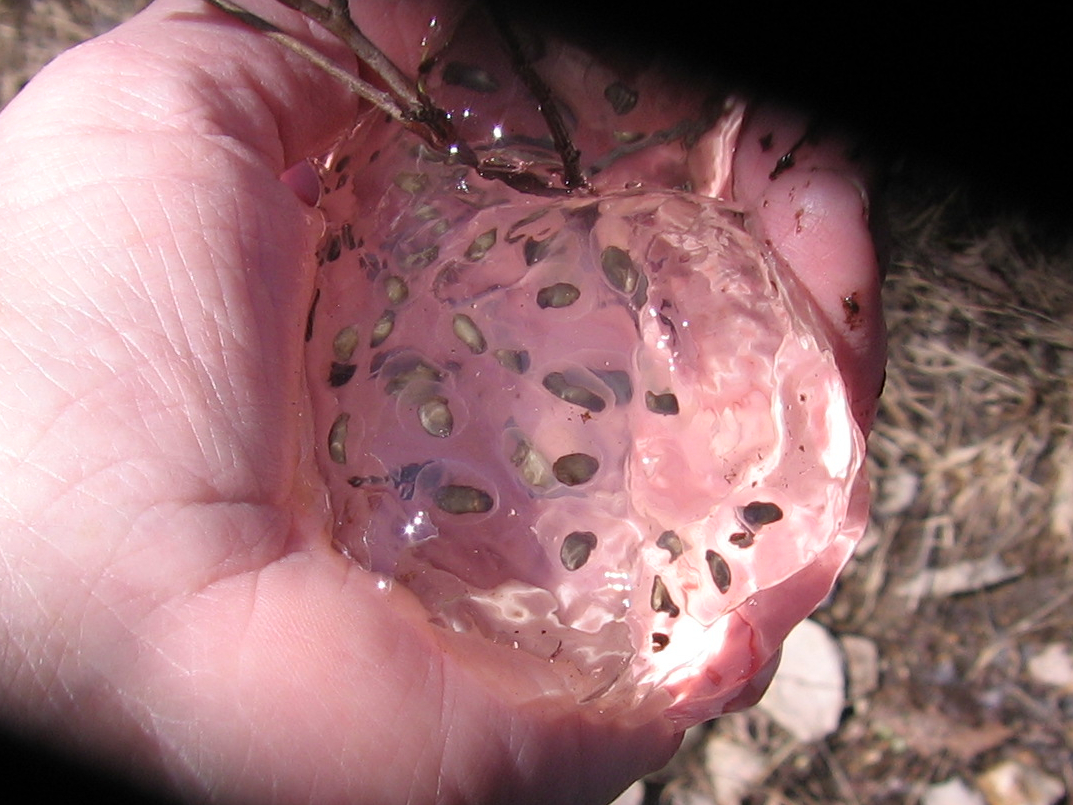
Living with frogs has given me the opportunity to observe this fascinating journey at various ages and stages. The cycle begins soon after spring melt, as described in Funky Frogs, and carries on with matching and hatching, as I posted in Frogs, Globs, and Pollywogs. The female lays jellied egg masses attached to twigs underwater. That’s it for maternal care from mama. She just lays lots of eggs and lets nature – natural selection that is – take its course. As pond levels drop, these egg blobs can be stranded high and dry, like the one I’m holding. By this time I can see the embryos wiggling around in their egg sacs and feeding on the algae that colours the eggs green. I put stranded blobs back in the water to give the wee ones a shot at survival.

The eggs hatch, releasing the little wigglers into the water. At this larval stage the pollywogs, or tadpoles, seem more like fish than frogs. They live and breathe underwater and suffocate without it. They swim like fish, look like fish, live like fish. But unlike the proverbial duck, they aren’t fish. Because they aren’t done yet.

Next comes the magic – metamorphosis! And this is why I am amazed by amphibians, fascinated by frogs. The tadpole sprouts tiny, skinny hind legs. They are useless, dangly things at first. The pollywog keeps on swimming like a fish, swishing its long tail and breathing through its gills. Then forelegs sprout, mere nubs. But the legs keep growing, becoming stronger and thicker.

‘What the heck are these things anyhow?’ (Yes, I had pet tadpoles at one point.)

And then one day the tadpole uses those legs to venture up into the world of air. I can’t help seeing this moment as a tiny reenactment of those very first animals who emerged from the ocean onto land. What a transformation! The pollywog is now a froglet. It is no longer a fishy thing but looks like a tiny frog with a tail. That tail will be absorbed as nutrient by the froglet and will be the only food it consumes during this transitional phase. The gills will also be absorbed and the frog will breathe through its skin while underwater, or its mouth or lungs on land. This aquatic animal has become a creature of two elements: water and air. It is truly amphibious. And that is the miracle of metamorphosis.

Other Things that Change

And now I turn to a different transformation. I left the Highland Holler at the end of May to spend some time with my family on Vancouver Island. When I left, the pond was already low and gungy with detritus. The shallowest pools had separated from the main pond, as I described in Frogs, Globs, and Pollywogs in June 2021. There weren’t ‘gobs and gobs of jellied egg blobs’ yet, but a fresh crop of amphibians had begun their perilous journey in freshly-laid eggs.

I returned home three weeks later to a world transformed. The barren brown of spring had exploded into the verdant green of summer. Trees had leafed, shoots had shot up, and the shrubs and wildflowers (aka weeds) were threatening to engulf the cabin. I’d anticipated a change, but the extent of the growth in such a short time was startling.

But something unexpected and delightful also happened while I was away: L’il Pond was full again, totally rejuvenated by the June rains that fueled all that plant growth. All the pools had filled and joined to form one large pond. The egg blobs were gone, hatched into tiny tadpoles, hidden amidst the bright green aquatic plants. The water was crystal clear, fresh from the Highland lakes.

All this meant it was time again – time to swim with the frogs! I don’t get this opportunity every year. Often the pond is too shallow and gungy by the time summer rolls around. I was lucky last summer, as described in Ups and Downs in the Holler, and now I was getting another chance.

I hauled my pond gear through the brush and out to the gravel point, which was mostly submerged. I set down my chair and beach bag and was gazing around, trying to decide where to get in, when – Eek! There he was! He was big. He was green. He was a Green Frog. And he was just. Right. There.

If I want to swim, I have to share the pond with this fellah. He’s as big as my hand.

Green frogs are the biggest frogs we have here in Cape Breton. (We don’t, so far as I can determine, have bull frogs on the island.) I wrote about them and other frog species last June, but here’s the recap. The tadpoles take two years to mature and by their second year are bigger than some frog species will ever be. The tads are bizarre looking creatures. To quote myself, they ‘look positively freaky, a kind of FrankenFrog with a full-sized frog-head attached to a tadpole-tail but no torso. Seeing dozens of these scatter in the shallows is a strange sight indeed.’

Given the size of the tadpoles, it’s no surprise that these frogs are the jolly green giants of the pond. And their mating call is as loud as they are big – a percussive ‘Gurnk!’ that echoes around the Holler. Get a bunch of them going at it and they keep me awake at night. Noisy party-animal neighbours! They are also the last to leave the party, still gurnking away long after all the other male frogs have given up on getting lucky.

Absurdly, I felt a bit intimidated about going swimming alongside this guy. It’s not like frogs prey on people, like some Creature from the Black Lagoon. But … he’s just so … there. There are all kinds of critters in L’il Pond: Snakes and newts and a myriad of insects at various stages of their complex life cycles. Swimming in the Holler is not for the squeamish. And I’m kind of squeamish. But it just seems silly not to go swimming in my own pond. So, with some hesitation and dithering, I finally waded in, launched myself forward and dove under. It was refreshing and absolutely lovely – and not a single sneak attack by a rogue frog.

What creatures lurk beneath that calm surface?

Then I sat down to dry off, relax, and enjoy the view. The pond level was so high that I set my chair in the shallows. I glanced down and there, right beside me, the miracle of metamorphosis was underway. This froglet seemed unaware of me, perhaps too perplexed by the strange turn his life had taken to care about the giant looming nearby. We hung out together for quite a while, pondering the mysteries of transformation.

Now it is August and the pond has once again drained to levels too shallow for homo sapiens swimmers. It’s only fit for frogs and bugs and snakes and newts and for the ducks, sandpipers, kingfishers and such that feed on them. The frogs are content, with a surface cover of lily pads to keep them shaded and hidden from predators, and lots of lovely silty detritus on the bottom.

Happy as a frog in muck.

So I will leave the pond to the local critters now – they need no longer fear a gigantic primate invading their watery habitat. Unless, of course, a post-tropical storm brings buckets of rain to the Holler and refills L’il Pond with clean Highland water. Then I will once again be swimming with the frogs. You can count on it.

Sue McKay Miller
August 10th, 2022

p.s. Uh oh! Look who just landed!

A great blue heron arrived today and is stalking the shallows – watch out Froggie!

Need more frog blogs? Check out:
Funky Frogs and Frogs, Globs, and Pollywogs from May and June of 2021. These cover more frogs species – including spring peepers, wood frogs, pickerels, and leopard frogs – that live in the Holler alongside the green frogs. As always, click on any photo to see it full-size, and please feel free to comment below with observations or corrections.

Dogs and Drift Ice

Twenty years ago my dog Tundra and I spent the winter on the northern tip of Cape Breton Island, house and dog-sitting. The owner of the handbuilt house and of Max the dog warned me that the roaring and pounding of the nearby ocean would start to drive me crazy after a while. Then one morning I’d wake up to … silence. That silence meant the drift ice was in.

It happened exactly as he said. I started by loving the sound of the ocean but eventually I wondered ‘Will it ever stop?’ Then one February morning I woke up and … dead silence. The dogs and I walked onto the beach and gazed across a vast expanse of ice where wild waves had been just the day before.

Tundra contemplates drift ice for the first time in her life: ‘Where did all the water go?’
Max is a local and has seen it all before. That’s Cape North in the distance.

The pooches and I spent many hours on that shore. The ice, formed in the Gulf of St. Lawrence, breaks apart and drifts, blown about by the wind. Some days it crowded up against the shore, other days the wind blew it offshore until it was just a brilliant white line on the horizon. At times it was so tightly packed you could walk on it, but often it was broken into pans, or clampers, that shifted and jostled with the ocean’s motion. Clamper jumping is a sport of sorts, but only for The Young and the Reckless ;-)

One thing these photos don’t capture is the sounds the shifting ice makes. More that once I was spooked by the ghostly moans and shrieks from grinding ice. It put me in mind of those explorers, like Franklin and Shackleton, whose ships became trapped in the ice. The sounds (which included their ships being crushed) must have been hair-raising.

I’ve never been to the Arctic (see ‘bucket list’) but that winter, when I turned my back to the forested highlands and stared across the ice extending all the way to the horizon, I imagined myself there, alone in the arctic. I had a profound sense of my smallness and insignificance in the face of that vast white expanse. Of course, unlike those unlucky explorers, I could turn my back on the ice and head up to the house to warm up by the wood stove.

all alone

Unlike the Arctic Ocean, the open Atlantic rarely freezes. Salt water has a (slightly) lower freezing point than fresh and the constant mixing motion of waves, tides and currents inhibits freezing. Harbours and bays are more protected and they do freeze over. Seasonal ice also forms in the Gulf of St. Lawrence and the Strait of Belle Isle (between Labrador and Newfoundland). When the ice breaks up it finds its way to Cape Breton’s shores, usually arriving in northern Cape Breton in February and staying until April or May. Ice passes into the Cabot Strait between Cape Breton and Newfoundland, arriving here on the North Shore around March. That is, if it comes at all. With milder winters and warming oceans, there are years when there is little to no sea ice in the Gulf.

(Oh, and just in case you’re wondering, the North Shore is on the east side of the western peninsula of Cape Breton, just south of the area called ‘Down North’. Got it?)

This beauty, pretty in pink, is stranded on a bed of seaweed. Its drifting days are done.
Oh no! I’m falling apart!

I’d heard that the pinkish-red tinge often seen on the snowy ice is a souvenir from Prince Edward Island’s red sandy beaches. But it turns out to be Chlamydomonas nivalis, a unicellular green alga that contains a red carotenoid pigment called astaxanthin. Or, if you prefer, you can skip all the jargon and just go with the delightful name ‘watermelon snow’.

‘The Ice is in!’

The arrival of the ice is something of an event here (we lead quiet lives). Word gets out. There are photos posted on social media and comments about the sudden silence. But drift ice is more than just cool to look at (ha ha). Sea ice forms a protective barrier against winter’s heavy storm surf and reduces beach and cliff erosion. Loss of seasonal ice due to climate change removes that barrier and accelerates coastal erosion.

Where does the beach end and ocean begin? The ice protects the cliffs from winter storm surges.

The ice is also a convenient means of travel for all kinds of animals, including the human kind. It has become more treacherous for people and their heavy vehicles to traverse as our winters warm, but many animals still travel on the ice. I saw coyotes out on the northern drift ice a few times. It’s a convenient shortcut and easier going than deep snow. When coyotes migrated from the mainland to Cape Breton they didn’t need the causeway – they just sauntered across the ice. Drift ice is also a hunting ground for coyotes on the lookout for a seal meal.

No, that’s not a coyote in the shadows on the lower left, just a Tundra, cruising easily on the drift ice. Max, with built-in crampons, had no trouble scrambling around the icy boulders.
Tundra demonstrating how coyotes travel on ice.

Ice is the nursery where seals pup and nurse their young. Years with low or no ice can force seals to give birth on the shore, with greater exposure to predators. Or, as in the picture below, thin ice platforms might fragment before the pups are old enough to survive in the water.

A whitecoat all alone on a small floe in March 2011. I sure hoped mum was nearby.
Female grey seal on the North Shore, March 2006.
Note how the ice is protecting the beach from the heavy winter surf.

Drift Ice Gallery

What I love most about the ice is the astonishing array of shapes and forms it takes. Last December I posted Winter’s Art Gallery, a photo essay of winter’s beautiful creations of ice and snow. I omitted drift ice from that gallery since it deserves a page all its own. Now, combing through dozens of photos taken over the years, I’m finding it hard to choose. But here are the finalists. Click to see full-size versions of these any of the photos on this page.

The Beauties …

And the winner is …
Reflections
Upside down mushroom cloud
Right side up pink mushroom on a bed of seaweed
Mushrooms galore!
View north to Cape Smokey with mini icebergs, called bergy bits or growlers.
One more for the ‘dogs and drift ice’ department: Neighbour dog Mya with more growlers in 2008.

… and the Beasts

In March 2012 an ice wall formed along this beach. Waves jumbled and tumbled ice chunks and also froze in place to form these strange shapes. Do you see sea monsters too? Or is it just me …

Enter the monster gallery if ye dare …
Winged sea monster rising from the deeps.
Meeting of the Monsters. Big Mouth on the left and Sea Sasquatch standing waist deep on the right.
Creepy Face!
Ice raft of the doomed.
Ice bears awaken and look out to sea.

And then we go from the sublime …

Canada geese drift past drift ice


… to the ridiculous

The flying saucer has landed
The alien emerges on its floating watercraft and waves hello

The drift ice has already come and gone along the North Shore but I spoke with my faithful correspondent and there is still ice down north. So who knows? Perhaps the ice will drift over for one more visit before it goes into a final meltdown. But by July it will be us, not ice, floating about on the ocean.

Not quite lobster season yet but coming soon to a wharf near you!

One final note: I’m a transplanted Albertan and my knowledge of the sea, sea ice and sea-ice terminology is limited. If I’ve made any mistakes or if you have any observations to add, please feel free to let me know in the comments below. I’m always keen to learn.

Sue McKay Miller
April 6, 2022

In memory of Tundra, my faithful traveling companion on the road and in life (1991-2007)

Meet the Mystery Mammal

Last October I introduced you to a few of My Wild Neighbours. This month I want to focus on a newcomer to the neighbourhood, first encountered in April 2020. The tale begins with a tail: a long, round tail attached to a long-bodied, short-legged critter diving over a roadside snowbank. I only saw the backside of the furry animal, but the size and shape and that long round tail suggested an otter from the nearby river.

A few days later I was snowshoeing through old spruce forest and saw some unusual tracks. In The Secret Lives of Animals I wrote about my favourite winter activity: following animal tracks on snowshoe. Tracks tell me who is out and about and where they go on this land we share. I’d been following tracks for some 15 years at that point, so I was familiar with the usual suspects. And these weren’t any of those.

Hmm … Who have we here?

I recalled the otter-like animal I’d diving over the snowbank. Otters are water weasels. When they visit, they slide along on their bellies, leaving distinctive grooves, and head straight for the pond, dipping under the ice into the frigid water. These strange tracks were in a dense stand of trees up beyond the pond. And not a belly-slide in sight. I began to wonder if there was a new kid on the block.

Otters like water!

I soon found out. I was lingering over coffee on a sunny Easter morning and looked out the window. An animal was loping along on the far side of the frozen pond, very dark against the brilliant white snow. I grabbed my binoculars and got a good look. My suspicions were correct: It was a fisher! He – or she – did a circuit all the way around the pond before heading up into the woods.

Now this was exciting! I’d seen a wide variety of mammals in the Holler over the years, but this was the first time I’d seen a fisher. What a thrill, after so many years, to see a critter for the first time! Later that afternoon I was bundled up, sitting outside. I heard the strangest sounds coming from the woods on the far side of the pond. My go-to animals when I hear weird noises are crows – they have an astonishing repertoire of vocalizations – but this didn’t quite fit the usual cacophony of a crow mob.

Mystery solved a moment later. A fisher came barrelling out of the woods onto the ice with a second fisher hot on its heels and making those bizarre growly sounds. Growly chased the other fisher across the pond and up into the woods. A minute later he came back down, loped back across the pond and headed back up into the forest. A very exciting Easter Sunday here in the boonies!

(Above photos taken in 2021)

Fishers are members of the weasel family (Mustelidae) which includes otters, minks, martens, and ermines, plus off-island species such as skunks, badgers, wolverines and other weasels. The name fisher is misleading. Unlike their water-weasel cousins, otters and minks, fishers rarely fish. These carnivores feed mainly on hares, rodents, grouse, and, alas, the occasional small pet. We don’t have porcupines on Cape Breton Island, but mainland fishers hunt these prickly prey. Fishers prefer mature forest habitat and are remarkably adept tree climbers. Like all members of the weasel family, fishers are fierce and punch well above their weight.

Don’t mess with this character!

Those first sightings were in April, 2020. Fast forward to winter 2021 and once again I strapped on the snowshoes and began checking out local animal tracks. In February I posted a photo of some mystery tracks in The Secret Lives of Animals. The snow was too soft to form a clear impression, but I found other mystery tracks soon after, possibly from the same creature. After that I started seeing these new tracks all over the place – near the house and through the woods and all over the pond. As you can imagine, I had my suspicions as to the likely culprit.

And what about these? Tracks can look very different, depending on snow conditions and gait. When the hind foot steps onto the forefoot track, it can alter the shape. Very confusing.
Running track typical of weasel family; hind feet register in the front tracks. (Ruler is 46 cm/18″)

A track is evidence but a sighting is proof. One day I looked out and there he was, poking around in the snow beside the house. My compost pile is under there so he may have been rooting for root veggies. On the other hand, the local squirrels have a network of snow tunnels there too, so he may have been hunting something more appetizing than rotten banana peels.

Like coyotes and other carnivores, fishers patrol large territories. Based on all those tracks I’d been seeing, it looked like my home was smackdab in the middle of this fiesty fellah’s new territory. (After seeing Growly in action, I’m going with ‘he’.)

My new neighbour had no qualms about inviting himself right up onto my deck. I think these predators, like Ollie the barred owl (Hoots in the Holler) and the great horned owl (My Wild Neighbours) like my deck for the same reason humans like hunting blinds in trees – all the better for spotting prey. Plus fisher’s nose may have led him up onto the deck after squirrel’s scent, since squirrel seems to think I built the deck purely for his pleasure. One thing for sure, fisher is just as able to climb posts and trees as his wily prey. Watch out squirrel!

Fishers, known locally as fisher cats, are not unknown in this area. Some of my neighbours (the human ones I mean ;-) have seen them now and then, but they aren’t common. It does seem that there have been more frequent sightings of fishers around the island lately, so perhaps they are making a comeback. (Fishers virtually disappeared from Nova Scotia about 100 years ago due to trapping and habitat loss but were reintroduced to the eastern mainland in the 1960’s.) Or, as someone suggested, maybe we are seeing more fishers around because ongoing clearcutting is forcing them to find new territories. The current population and status of this animal seems to be yet one more mystery.

So now here we are in 2022 and it’s snowshoe time again. I haven’t seen a fisher-in-the-fur lately, but I have been seeing tracks in the woods and on the frozen pond as fisher prowls his territory. He’s not a mystery mammal anymore, or even the new kid on the block. He’s just another one of my wild neighbours, hanging out here in the Holler.

Sue McKay Miller
January 31st, 2022

p.s. Please share your own fisher sightings and observations in the comments. As always, I welcome any corrections or additional information – I’m still learning!

Just moseying across the pond.