The Drought of 2025

As I write this it’s raining. It’s pouring. It’s raining cats and dogs and pouring buckets and falling in sheets. And we are glad of it. The rivers and brooks and ponds and wells are finally filling after the longest drought anyone can recall. All summer and into the fall the ground was parched. Thirsty plants were slow to grow, and water levels in rivers and ponds and wells kept dropping. One by one, ponds, brooks, and wells went dry.

There were forest fires on the mainland and the woods were tinder dry all over the province. At the end of July the government declared a province-wide fire ban, with $25,000 fines for numbskulls who ignored the ban. A few days later the province went a step further and closed the woods. No hiking, no biking, no ATVs allowed in the forest. People working in the woods required permits.

The woods ban did affect some tourism operators and disappoint keen hikers. Others were just whinging about their personal rights and freedoms. But many of us living in the woods were glad of the ban. One hundred people can go in the woods and cause no harm, but it only takes one idiot to toss a butt or start a campfire that can destroy our forests, our homes, even our very selves. I could still walk around on my own forested property, but why would I? Why risk being stranded up on the highland slopes if a fire broke out?

Besides, for me summer in Cape Breton is beach season. The silver lining in the lack of rain clouds was a grand beach season. Hot, sunny weather and warm ocean waters day after day. Nova Scotia is blessed with miles of beaches, for walking and swimming and all manner of watery fun for us and our visitors. We are, after all, Canada’s Ocean Playground.

Playing in the ocean in Canada’s Ocean Playground.

But even at the beach we wished for rain. For overnight soakers, or even a post-tropical storm that would bring a drenching and move on, anything. But every forecast of rain fizzled to a drizzle. Now and then showers would bring 10 or 12 mm, but it was soaked up and burned off so quickly it seemed like a wet dream. Sometimes the rain came in thunderstorms – a terrifying forecast with the woods a tinderbox. More than once, I gathered a few important papers and piled them by the door, ready to grab if a nearby tree ignited and I had to flee in the middle of the night.

Apparently one of those lightning strikes did find a target, not far from my place. I was visiting friends when we got word of forest fire on our shore. When fire trucks roared by, sirens screaming, I decided to hightail it home. I passed by where the fire trucks had pulled up and saw smoke billowing out of the woods. It was 3-4 kms north of here. Once again, I piled essentials near to hand and waited. But we were lucky – our local firefighters managed to douse the blaze, which had been smouldering for some time.Thank you firefighters! We so appreciate your work and dedication.

So this drought has been historic, one for the record books. I’m from Calgary, from a dry prairie climate where droughts are part of the normal cycle. But lately it seems that Calgary keeps flooding while both east and west coasts suffer droughts. It’s all topsy turvy as the climate changes and there in no ‘normal’ anymore.

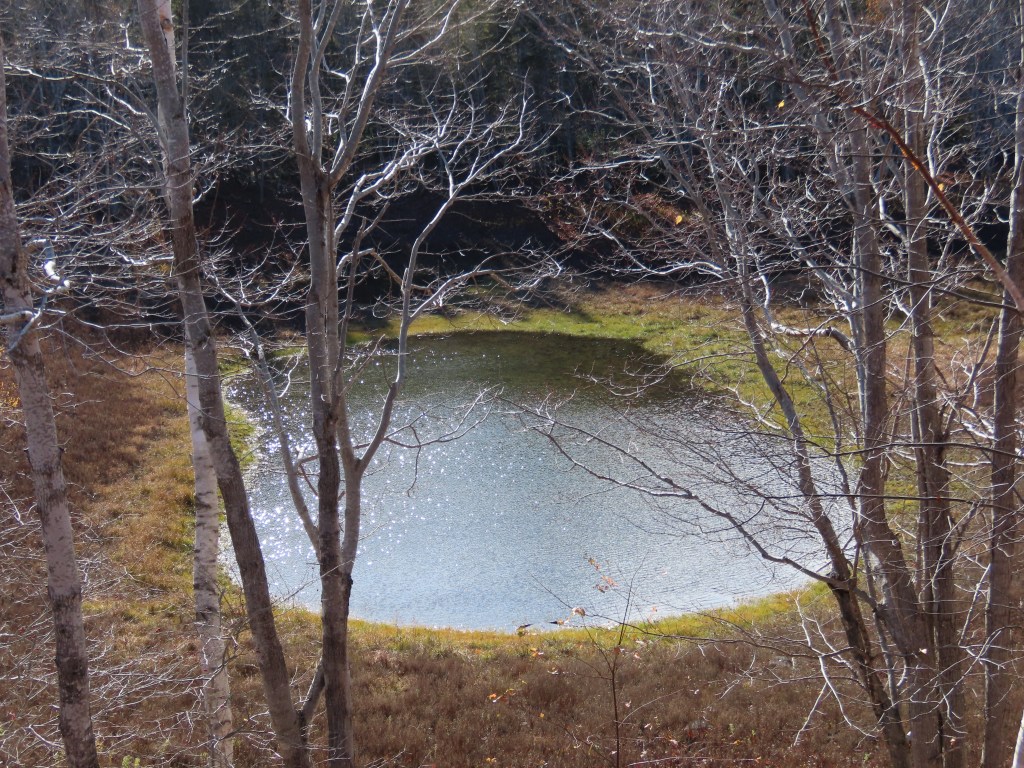
L’il Pond Vanishes

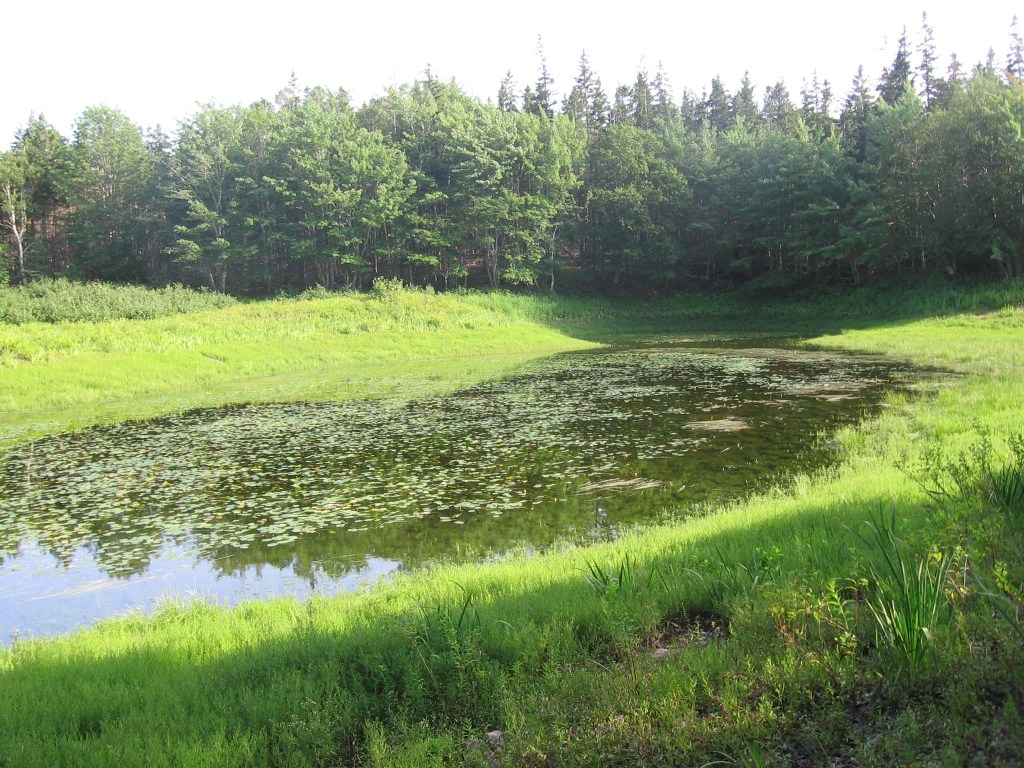
As I wrote in Ups and Downs in the Holler, the water level in L’il Pond rises and falls with the season. In spring it can rise so high with snow melt and rain that it floods into the forest. Over the summer it subsides, a few inches a day, until it stabilizes at the local water-table level. Sometimes there is enough water to go Swimming with Frogs or drift around in a dinghy. Other summers the water is grungy and shallow and only fit for frogs and other aquatic flora and fauna.

Shallow parts of the pond routinely dry out and I’ve transported tadpoles, stranded in a shrinking pool, to deeper water so they have a chance to metamorphose, as I described in Frogs, Globs, and Pollywogs. As summer goes on the lilies grow up, the water drops down until the pond is covered in lily pads – hence L’il Pond, aka Lily Pond.

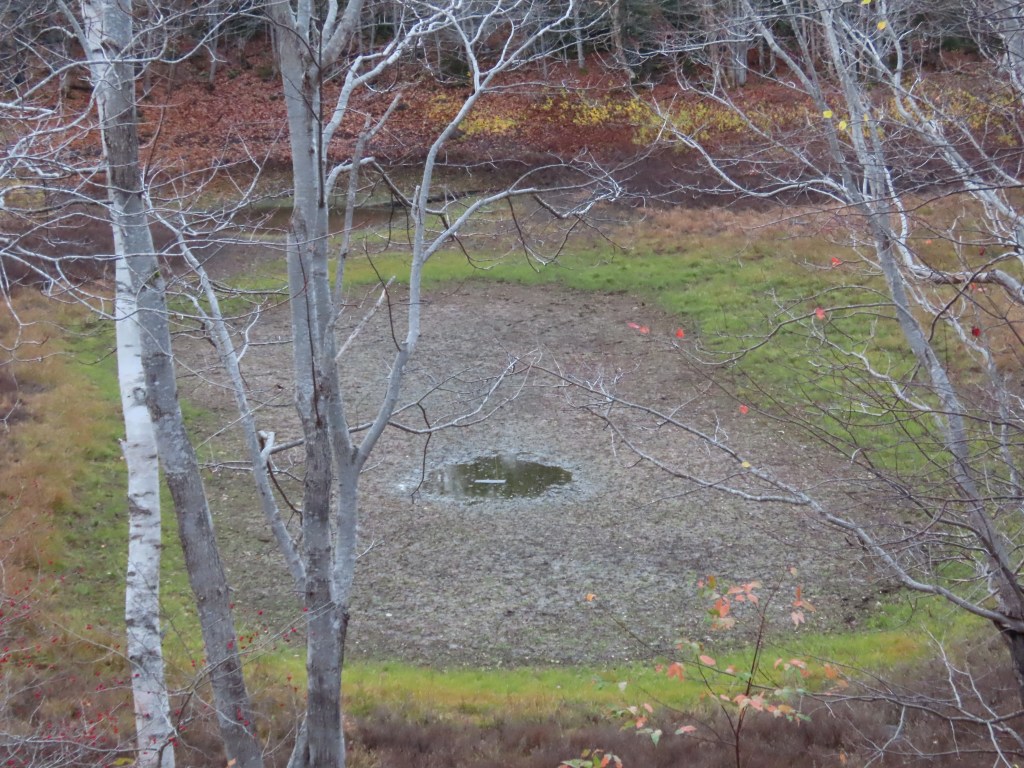
So the pond almost always gets low in the summer but it very seldom dries out completely. And yet it dried out by mid-September last year, the first time since I moved into my cabin ten years earlier. And then along came 2025 – and blew all the records out of the water.

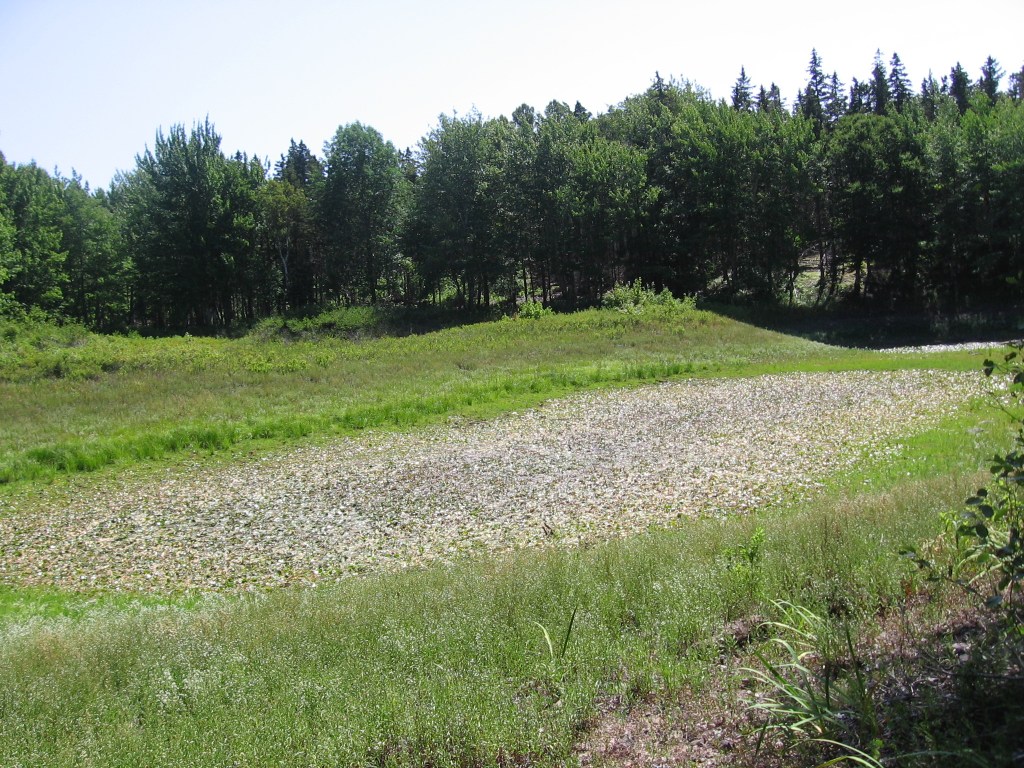
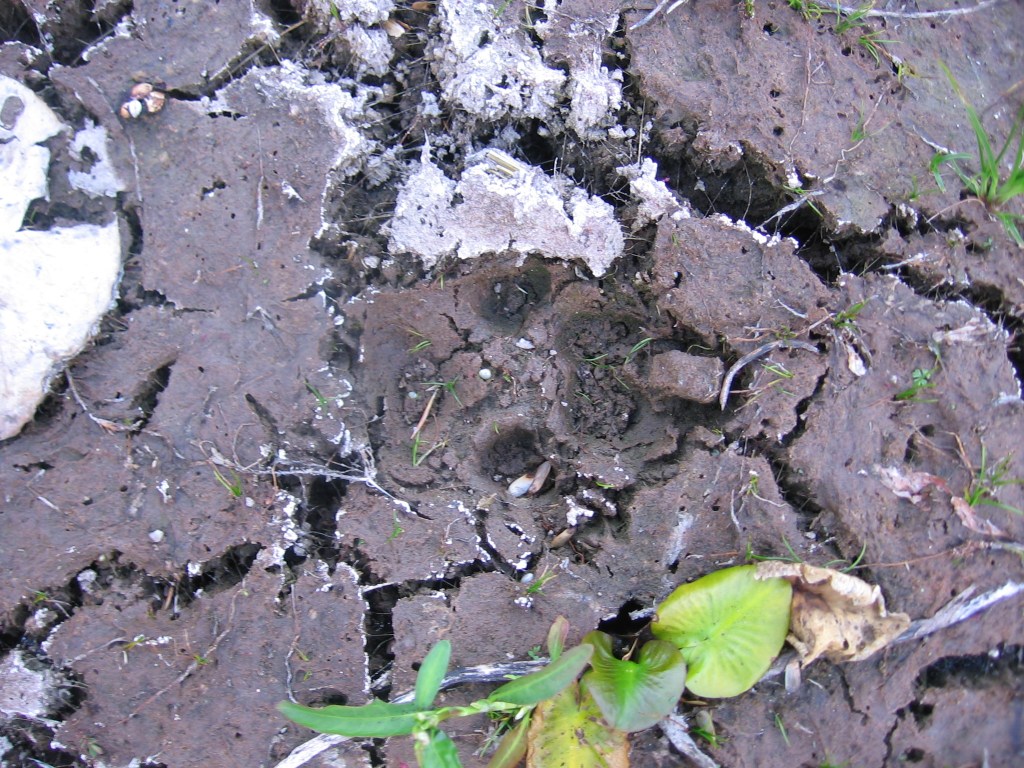
This year the pond dried out in August. And it stayed dry, all though September and October. Even when it does dry out, it’s usually muddy – the kind of mud that could suck you in and never let you go. But this year even the mud dried out until it cracked. I could walk right out to the deepest section of the pond.

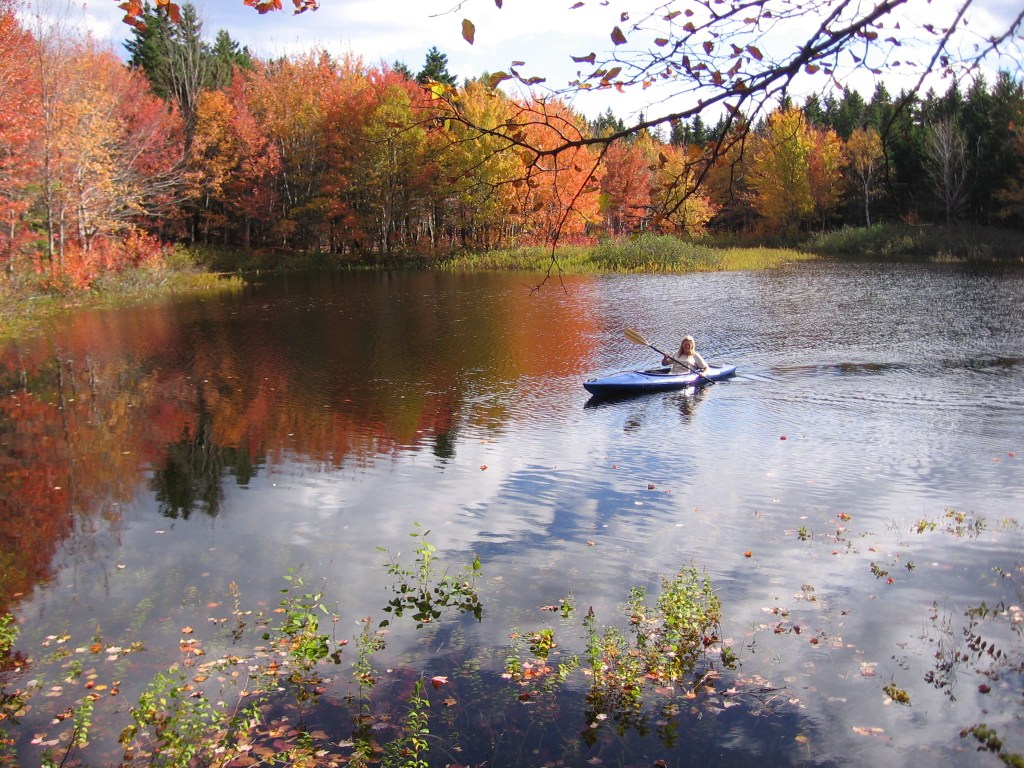
Quite a difference from 2023, when it wouldn’t stop raining. By October the pond had flooded into the forest and I went kayaking among the trees. Or October 2006, when we paddled around on the pond and enjoyed the fall foliage.

Wee Brooks Falls Hike

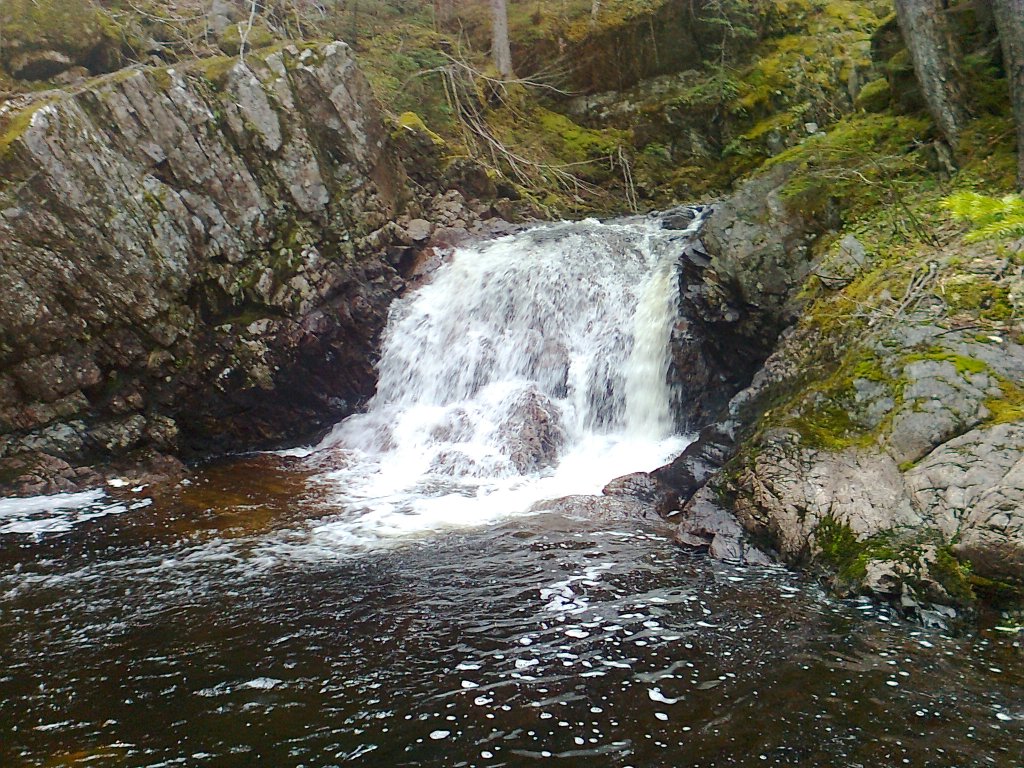
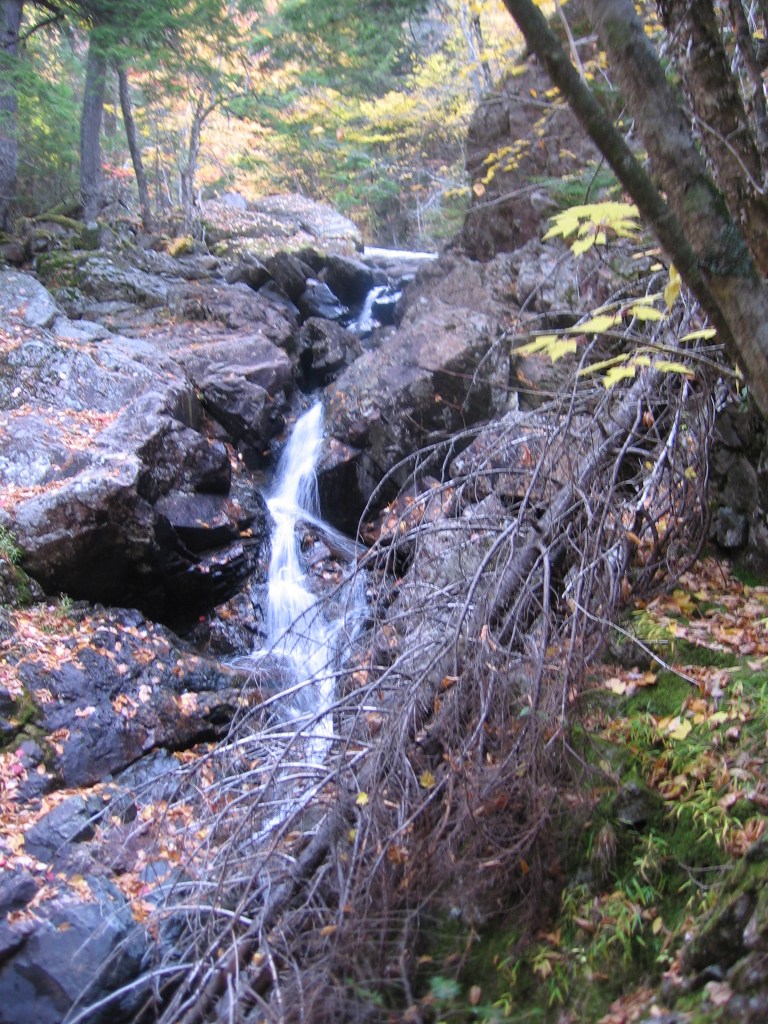
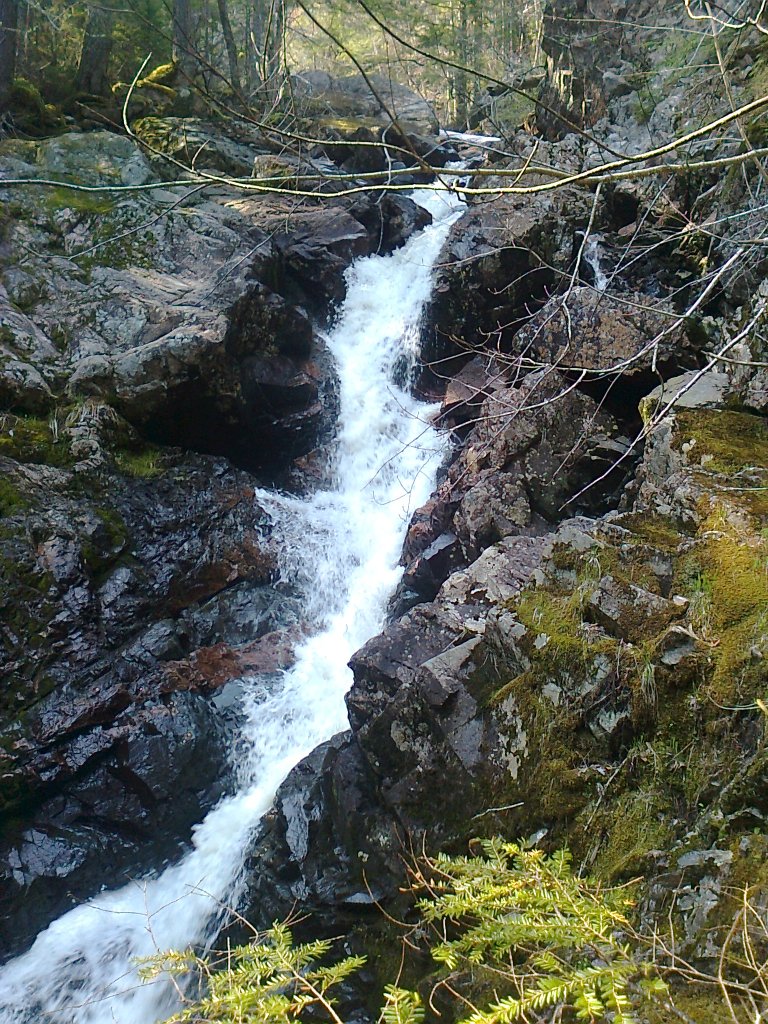
There is a trail nearby that follows the Little River valley westward, ending at a fork where an unnamed brook meets Little River. My son and I dubbed it ‘Wee Brook’, to match the ‘Little River’ theme. If you cross Wee Brook and follow it upstream into a box canyon it leads to a waterfall. Wee Brook Falls reveals itself one section at a time as you climb upward, twisting this way and that as it tumbles down from a lake, high up on the highland plateau.

I have walked this trail dozens of times, but, as often as not, I don’t cross the brook and so don’t get to the waterfall. Crossing involves stepping on unstable river rocks that are slippy with moss and tend to tumble under your feet. And there is usually a wide gap of fast-running water to cross. I don’t want to ‘fill my boots’ with icy water, or worse, fall and twist a knee, turn an ankle or even smack my skull on a stone. So I err on the side of caution and instead walk upstream on the near side of the brook, until the slope becomes too steep to traverse.

But in mid-October, with the woods ban ended and the colours still blazing, it seemed the perfect time to get to the falls, with the rivers still so low. I walked for half an hour or so until the trail led me to the water at the fork where Wee Brook flows into Little River. And there I stopped – gobsmacked.

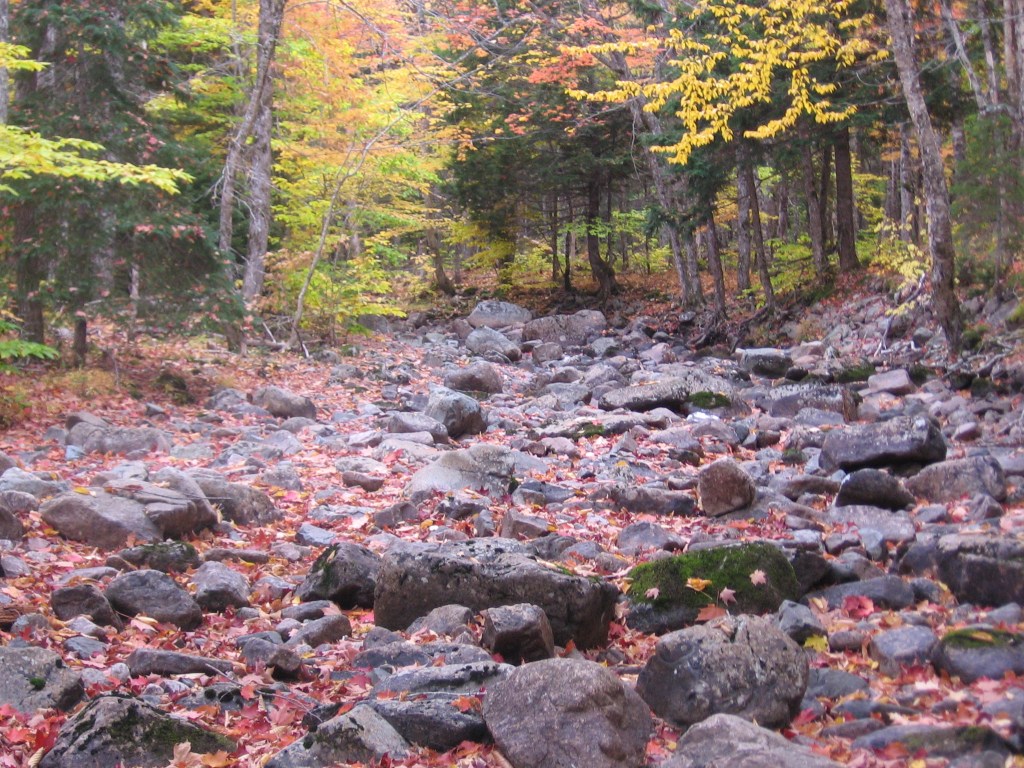
I expected the brook to be low, but I was staring at a bone-dry creekbed, just a jumble of river rocks. Even the Little River was mostly dry rockbed, with a narrow stream of shallow water on one side. In all my visits to this place over 22 years I’ve never seen the like.

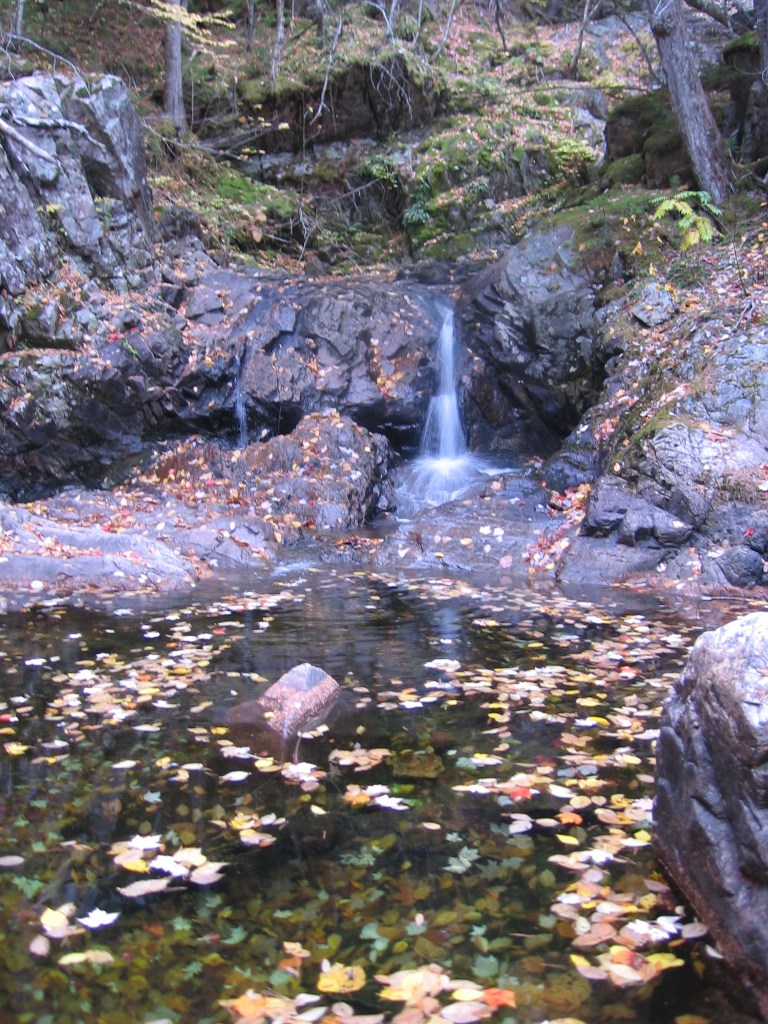
So, no problem crossing, no boots required, every stone a stepping stone. I crossed and walked upstream. A narrow stream of water surfaced, but so shallow it had gone underground when it reached the fork. After about 10 or 15 minutes I arrived at the lower section of the waterfall. This is usually a broad wall of water, but there was only a narrow stream. I’m showing a photo from 2021 for comparison, but remember – I only cross when the river is quite shallow, so the photo on the right is when water levels are relatively low.

I climbed upward over fallen logs and scrambled up a short, steep slope and around the bend. From here you can see the next section of the falls, before it curves away out of sight again. Here are the 2025 vs 2021 pictures, for the record.

Halloween and the Rains Begin

On Halloween the rains came at last – bad timing for trick-or-treaters but still very welcome. Amounts varied widely across short distances, but my rain gauge recorded 50 mm on October 31st and 15 mm on November 1st. A good soaking. And yet all that appeared in the pond was a shallow mud puddle, mere inches deep and about 5′ across. The water table was so low that 65 mm barely showed. (Note: I’m mixing units because I’m Canadian and that’s what we do.)

Then came another dousing of some 40 mm a few days later. More mud puddles appeared and they began to spread out and join up. But even with over 100 mm of rain, the pond was still a shallow pool with a wide rim of mud.That demonstrates how large a water deficit we incurred during this prolonged drought.

After all that heat and sunshine, we seem now to be stuck in a cycle of rain, rain and more rain. It never rains but it pours? Yesterday, when I started writing this, another 33 mm poured down. So, after 138 mm in the course of a week, the pond has risen to the grassy verge. Much better but still very low – no kayaking through the forest this fall. But the forecast is for lots more rain (be careful what you wish for) so the pond will keep filling and rising. It’s been a long dry spell, but Hallelujah! The great drought is over. Now if only it would stop raining long enough for me to stack my wood, which was bone dry for weeks and is now sopping wet – doh!

Sue McKay Miller
November 7th, 2025
p.s. After I posted this blog we had 125 mm of rain over two days, for a total of 281 mm of rain in 12 days. The pond kept rising and rising until it overflowed and flooded into the woods. But with fresh snow on the mountains, I won’t be kayaking though the forest this year!

The pond on November 12th, 2025, after 281 mm of rain over 12 days.

One Too Many

No, not that type of one too many. One too many drinks or donuts is never a good thing and usually fits under the category ‘it seemed like a good idea at the time’. No, I mean pushing a season just a bit past its best-before date. In my case, going out just one more time after that perfect hike, swim, or snowshoe at the end of the season.

Snowshoe Season

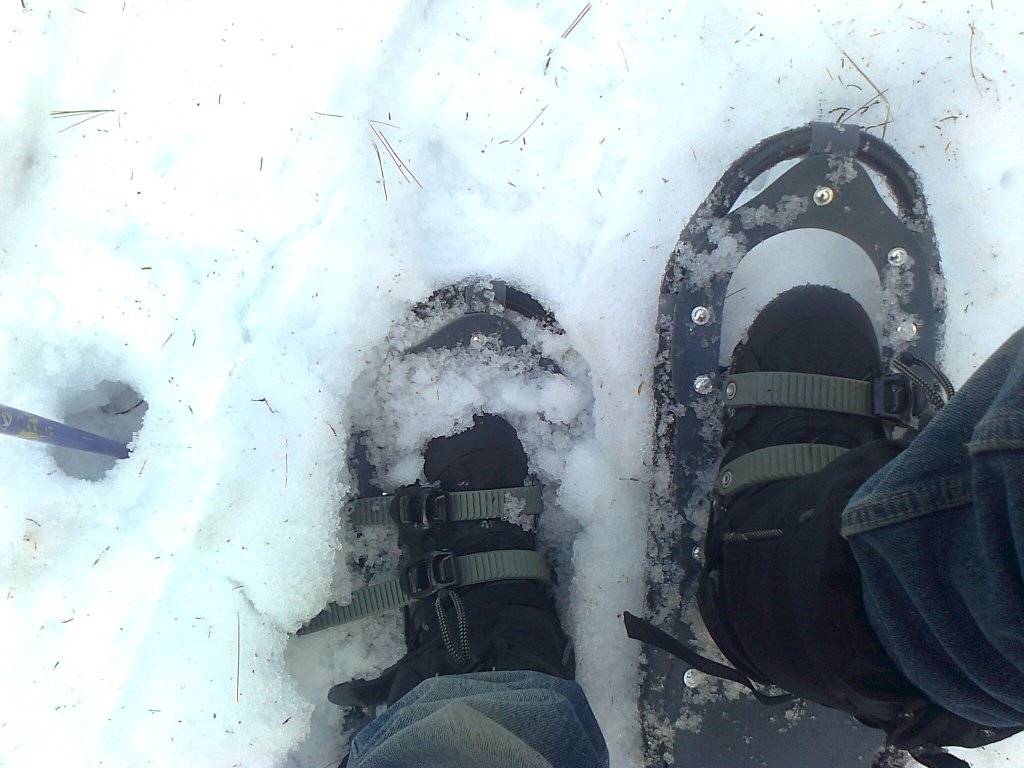
We haven’t had much snow this year, but as I wrote in The Secret Lives of Animals, my winter joy is strapping on my snowshoes and following animal tracks. With warm weather on the way I took advantage of a sunny afternoon in mid-March and went snowshoeing up the hill behind my house along an old wood road. I hadn’t gone far when I saw fresh tracks – first a pair of coyotes, then a moose. I followed the tracks up until they all fed into a narrow trail I’d cut through new growth blocking the road. I was pretty chuffed that the critters were using my trail, but it was too narrow for snowshoes, so I headed back down, past some grouse tracks. (These photos were taken a couple of days later, hence not-so-fresh or clear, and with human tracks alongside. They’re a bit better full size.)

Ruffed grouse (aka partridge) tracks in the snow.

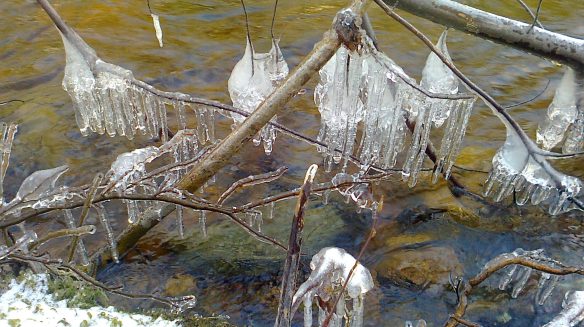
I crossed the slope over to a trail, then went down, down, down to Little River. The river was beautiful. The boulders wore icy skullcaps and stranded branches were festooned with fairy goblets and lacy necklaces of glittering ice. I paused to admire Winter’s Art Gallery, then snowshoed downstream. Before long I spotted small tracks emerging from the open water, up a steep slope, and along the riverbank. It was a mink, I think. Next came the tracks of a coyote who’d crossed the river, and, farther along, a second coyote who’d crossed over.

By chance I found myself following in the footsteps, so to speak, of these two coyotes on my way back home. We all took the same route away from the river and through the woods, but I parted ways when their tracks went straight up a very steep slope. I was almost home when I crossed their paths again. The coyote tracks went up the hill through the forest – and then out onto the old wood road above my house. This was the same coyote pair I’d started tracking when I first set out. I’d come full circle. Perfect! It was the best snowshoe I’d had in a couple of winters.

Little River ice art.

One Too Many Snowshoes

What a great way to finish up the season, right? Wrong. Of course I had to try to squeeze in just one more snowshoe before the snow disappeared. A couple of days later I set off with hope in my heart, detouring to take the track photos before heading off in the opposite direction, away from the river. It wasn’t a complete loss. I did see the tracks of a mother moose with her yearling, and a depression left by a sleeping moose. But I also had to snowshoe across moss and grass, jump over streams of snow-melt, and detour around puddles to get back onto the icy snow crust. April and the Albedo Effect was in full swing, even though it was only mid-March. It was my one-too-many snowshoe hike.

Dark late-day photo, but Moose had a snooze here.

I’ve done ‘one-too-many’ snowshoe hikes so often that it has become a Rite of Spring. A fantastic snowshoe must be followed by a rotten one. Sometime literally. When deep snow rots from below, I might break through up to my knees, as described in April – Awful or Awesome?

So why do it? Why not end on that perfect note, that ideal snowshoe? I can trace the whole one-too-many business back to 2019. I had a sublime snowshoe one brilliant blue-sky afternoon at the end of March. I’d seen lots of animal signs and enjoyed views of two waterfalls. I paused on a hilltop and looked back across the expanse of pristine white snow, shining under the sun and stretching to the next hill. I felt a deep sense of belonging, of being in the exact right time and place in the universe.

The snow had started to rot in the woods, but I couldn’t resist going again the next day, trying for just one more day of bliss. Hardly bliss. The conditions were atrocious. I tried an old wood road to the ocean, I tried through the woods to the river, but everywhere I went I kept breaking through the rotting snow. It was all frustration and no fun. I cursed myself for not having the sense to finish the season on a high note. But later I realized that ending on a sour note wasn’t all bad. It meant that I had pushed the season to its limit and a bit beyond. There was no second-guessing if I coulda/woulda/shoulda gone out one more time. And the one-too-many didn’t tarnish my memory of that perfect, penultimate snowshoe.

After my one-too-many snowshoe this year, I washed the mud off my snowshoes (no lie!) and stored them away. Why so reluctant to call it quits? Partly because now there is a pause. There is too little snow to snowshoe, but too much to bushwhack through the forest. So now I wait. And wait. Until the snow melts enough to swing into – spring hiking!

Spring Hiking Season

I don’t really ‘hike’ so much as mosey through the forest, bushwhacking up and down the highland slopes. I follow freshets and brooks flowing from the highland plateau, linger in hemlock stands, and watch waterfalls tumble down. I explore new places and revisit to my special spots, as described in The Humbled Hiker.

I head for the hills as soon as the snow melts. I live and play in a mixed forest, so there is a time before the trees leaf out at the end of May that is ideal for exploring. The lack of leaves allows for more open vistas, better ocean views, and easier route-finding. But before the veil of leaves appears, a spring scourge drops the curtain on my spring hikes. I jotted down these notes a few years ago:

One Too Many Spring Hikes

“I went on ‘one too many’ hikes the other day. I realized it as I was beating off black flies during one of my Highland explorations. The black flies won this bout, and even the dreadful DEET didn’t stop their frenzy. The plan had been to climb part way up a ridge to a hemlock stand, and see how far I could traverse along that slope. I aborted my plan once I reached the hemlock stand. I just wasn’t having fun anymore.

I enjoyed the ocean view – briefly – and the towering hemlocks – briefly – and then made my way down slope and out onto the cutline where the gusty southwest winds kept the little buggers at bay. I set out on this walk somewhat tentatively. The flies had exploded a week earlier and were annoying on a couple of previous treks, but not enough to spoil the walk.

In fact, my previous walk to a waterfall had been delightful. There were flies, here and there, and it wasn’t a good time to linger by the water, but it was worthwhile. So why not end on that high note? Because fomo. Fear of missing out on one more wonderful walk in the woods. I didn’t regret my last bushwhack, even though I had to flee from the blackflies. That one-too-many hike confirmed what I had suspected: Time to stash away the hiking gear.”

So there you have it. If a lack of snow marks the end of snowshoe season, an abundance of black flies has me fleeing the forest each spring. They breed in fresh running water – abundant on the highland slopes – and usually emerge in mid-May. I find the wee pests so distracting that it’s hard to focus on my footing, which is dangerous as well as frustrating. As my notes suggest, I’d had a wonderful walk to a waterfall that would have made for a grand finale, but I just had to push my luck.

As with the end of snowshoe season, there is a hiatus after spring hiking. The black flies are biting but the ocean is still frigid – and it takes a long, long time to warm up. So I must bide my time before I can dive into …. swim season!

Swim Season

Ah, summer in Cape Breton. We are blessed with an abundance of places to swim: lakes, rivers, and ponds galore – including my own L’il Pond (Swimming with Frogs). But my favourite place to swim is the ocean. And by ‘swim’ I mean being immersed in water. I might swim a few strokes, then roll over and float on my back and gaze at the clouds bobbing by above. Or I might do a little bobbing myself, gently rocked by the waves while I watch the terns and gulls and gannets. I’m a prairie girl who fell in love with the ocean and I feel happiest when I’m held in her briny embrace.

Dive into blue bliss!

Summer is sun, suds, sand, swimming in the salty sea, and a smiling Sue. The perfect beach day is hanging out with friends, going for a swim, drying off in the hot sun with a cold drink, then diving back into water. Repeat.

One Too Many Swims

Unlike snowshoeing or hiking, there can be one-too-many swims in a single day as well as a season. The water is so tempting and the air so warm, but that last swim of the day can be a bit risky. The air temperature drops abruptly when the sun drops behind the highlands. One swim too many and I might get … the dreaded chill. Cold that gets so deep into my bones that there’s only one cure. I have to go home and get immersed again – in a nice hot bath.

Swim season in Cape Breton is sweet but vanishingly short, which is why I try to get in the water every day that the weather allows. That’s also why I push the season and end up diving in one-too-many (or even two-too-many or three-too-many) times, because it’s a long while before beach season rolls back around. Here’s a (lightly-edited) passage from my diary dated Sept. 15th, 2023. (Mervi is my beach buddy (pictured above) who is a glass blower, which is very hot work.)

“Went for a beach walk and to see waves ahead of (tropical storm) Lee. Wore tights and a cotton shirt but threw in my swimsuit and towel in at last minute. After walking in the tidal wash I felt quite warm and a couple of tourists were in the waves. It was cloudy but warm and humid. Tourists said they felt fine getting out, so after they left I put on my swimsuit – still damp from previous swim – and immediately felt chilly. Considered putting clothes back on but opted to wait for Mervi. She was hot from glass blowing and went right in. I waded out but a biggish wave soaked me almost to my neck so, after hesitating, I dove under and floated a bit cuz probably final swim.

Got out and brrr – cold. Needed to get out of wet swimsuit. Tried to wrap a towel around and change back into dry clothes but skin so clammy I couldn’t really get really dry … everything sticking and icky … I felt all chilly and clammy and sticky. Yuck! Wished I hadn’t gone in. But it was okay, I told Mervi, because this had been my one-too-many swim.”

Swim season is the hardest one of all for me to let go. And sometimes we do get a surprise blast of heat late in the season. But there comes a time when the heat has gone out of the air and the ocean is cooling down. A time to rinse out of all my beach gear and store it away, to accept that swim season is over for another year.

Just as a day at the beach must end, so swim season must come to an end.

The consolation is that there isn’t any waiting around for the next fun activity to begin. Just as the ocean turns grey and cold, the forest begins to glow with red, gold, yellow, and orange. The autumn woods are warm and welcoming, blazing with colour and fecund with fungi. Fall hiking season begins when swim season ends, and carries on through November, as I wrote in my very first (and very short) blog Bared Trees and Barred Owls. But one day the snow will fall and stay put, hiding all the hazards underfoot. Then it’s that in-between time again – too much snow to bushwhack but not enough to form a good base for snowshoeing. It’s time to wait for more snow so the seasonal cycle can start all over again.

One Too Many and Me

This one-too-many thing is a sign of my reluctance to switch gears. Even if that means shifting into neutral and idling until I can start my next fun outdoor activity. But doing something one-too-many times is also a strategy of sorts. It’s a way of forcing me to face the facts, ma’am – this season is over.

If the ideal snowshoe, hike, or beach day is a perfectly-crafted sentence, the one-too-many day is the period that ends the sentence and closes out that chapter. For me, one too many is just about right. Happy April everyone!

Sue McKay Miller
April 6th, 2025
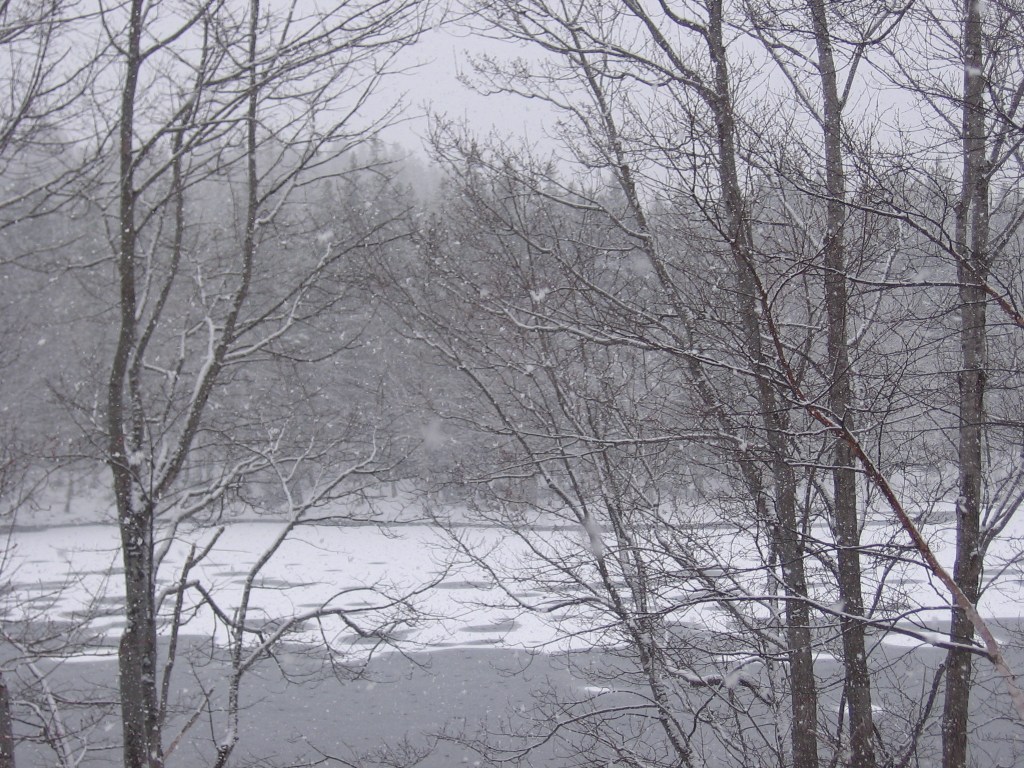
Winter Wonderland in April. We’ve had three-too-many of these this past week!

Twenty Years in the Holler

It was twenty years ago today
That I moved onto this land to stay

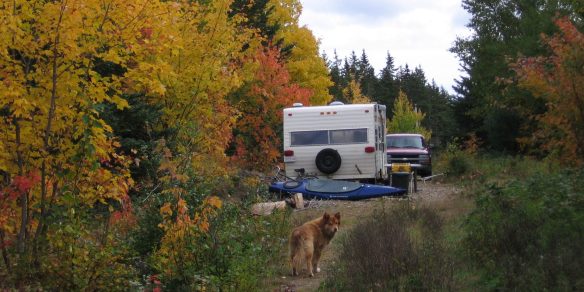
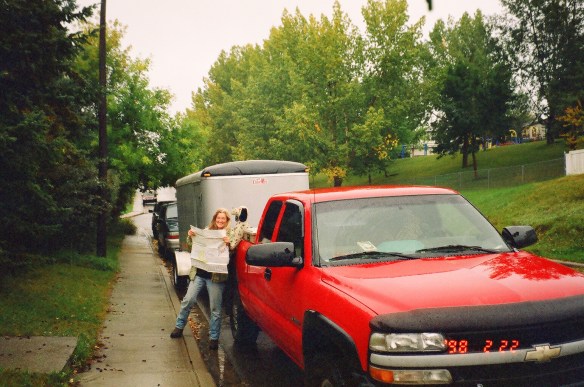
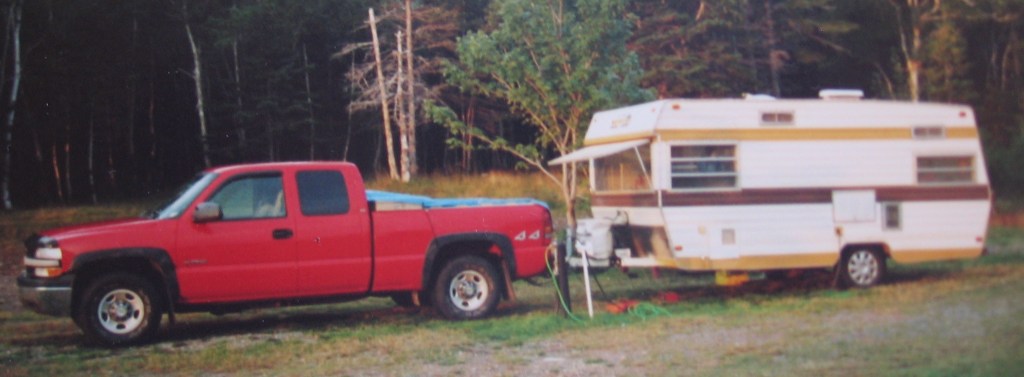
Ahem … my apologies to the Beatles. It was actually twenty years ago this year that I moved onto this land to stay. In 2004 I drove from Calgary to Cape Breton with an old travel trailer in tow and Tundra riding shotgun. I’d quit my job in April, but a car accident and subsequent complications delayed our departure. I finally hit the road in August and left the bright lights of the big city behind, driving over 5000 kms to the new land.

It was a big move: from Calgary to Cape Breton, from west to east, from city to country, from my old familiar hometown to my brand new land. So I’m going to do something a bit different with this blog and celebrate this anniversary with an overview of my first twenty years here in Highland Holler. It was so long ago that some of these photos are photos of snapshots, so please excuse the fuzzies. And click on the small pics to see full size.

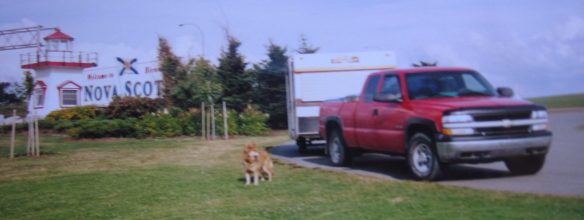
My Chevy Silverado ‘Roadeo’ and the travel trailer I hauled from Calgary to Cape Breton.

Tundra and I made our first home in the 15′ foot travel trailer I’d hauled out from Calgary. It was small but cozy and portable. The new land was on a back road with easy access to a gated field, so that’s where I first set up camp. My neighbours were kind and welcoming, but curious as to why I locked the field gate behind me every time I went anywhere. It took a while for this city kid a while to realize I could leave that gate wide open.

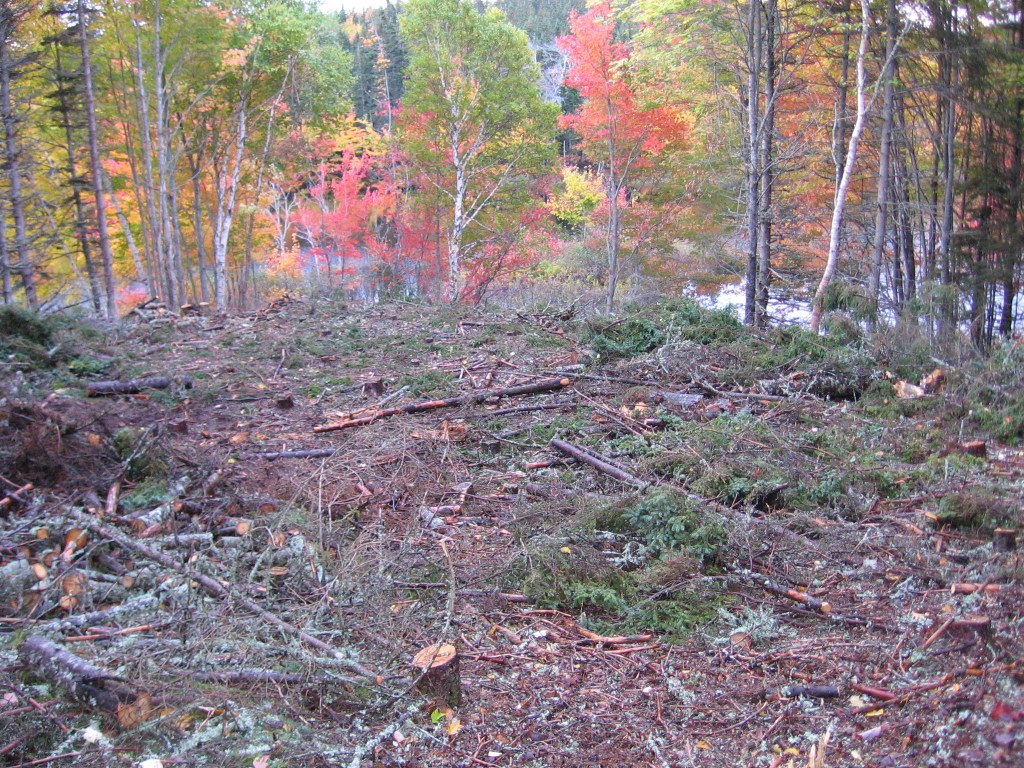
I bought myself a chainsaw and – very slowly but without losing any limbs – opened up a wood road blocked by piles of felled spruce meant to keep vehicles out. Then I shifted my trailer onto that road, moving deeper into the woods and closer to the pond.

Our travel trailer home after I moved it onto the old wood road. That’s my blue kayak in front.

It was a bit scary, giving up my comfortable, secure life to move so far away and into the unknown, but I recall some of the magic moments while we lived in that trailer. The thrill of seeing a young bull moose amble past my truck, or of glimpsing a coyote race past the trailer and, seconds later, a second coyote in hot pursuit. Of sitting out by my campfire and realizing that what sounded like a steady stream of traffic in the distance was actually the roll of the ocean, a mile away. Another night I was sitting outside after Tundra had gone to bed when I heard something large moving around in the forest right behind me. Yikes! I made a quick retreat into the trailer – visions of bears and bull moose prowling in my head.

Looking west to the highlands, where Tundra and I loved to explore.

When it rained for two days and two nights I sat at the table in the trailer and painted beach rocks – before that was a thing. The rain finally stopped and I emerged into a world transformed. The pond had risen into a vast lake and water was pouring in from a myriad of streams and freshets. This transformation has never ceased to thrill and amaze me.

The trailer wasn’t winterized, so come November 2004 I hooked it back up to Roadeo and Tundra and I headed down north, back to the hand-built house where I’d spent the winter of 2001/02 house and dog-sitting. I’d been on a year-long cross-country road trip, visiting all ten provinces and the Yukon. But that winter on Meat Cove Road was transformative. Cape Breton and her people captured my heart and my imagination. After I returned to Calgary I bought the piece of land I’d checked out a few times during my stay here. So while I had another great winter down north, reconnecting with old friends and making new ones, there was a tug on my heartstrings – Highland Holler was calling me.

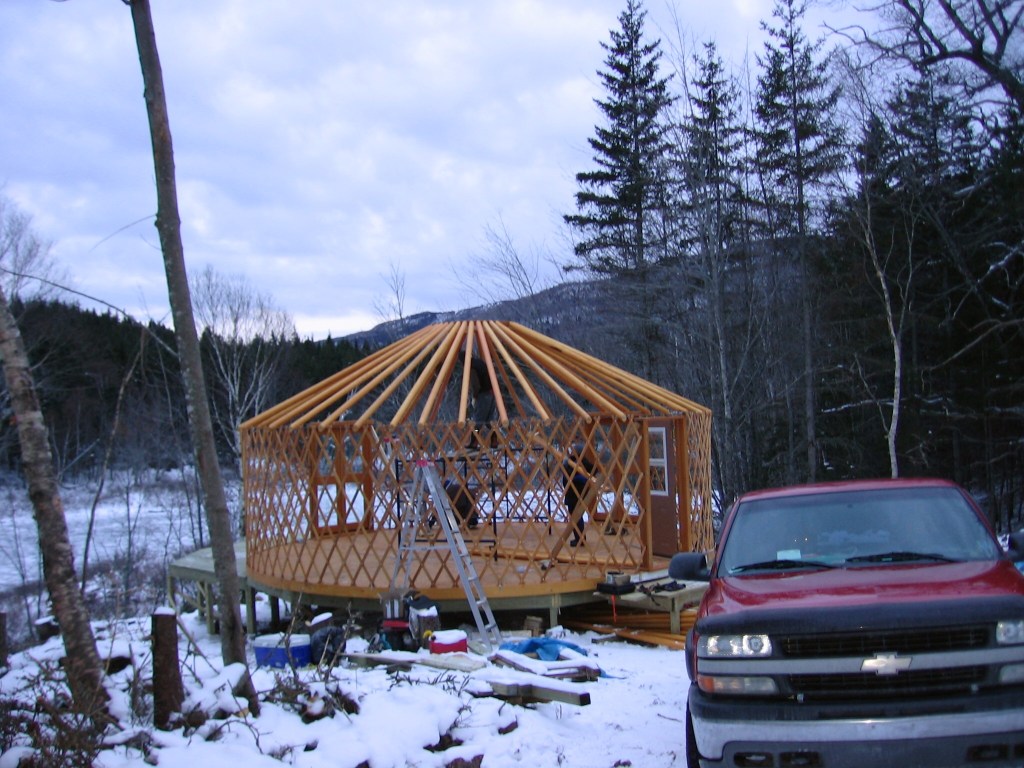
That winter I spent endless hours sketching house plans: funky off-grid hippie houses with rainwater cisterns and wood-fired saunas. But how big? One story or two? Basement foundation or slab or frost wall or sonotubes? Conventional frame or logs or cob (straw and mud) or cordwood? And where to put it? There was lots of land, plenty of options. In fact, there were altogether too many options. So I began to think about a yurt, a portable tent-like dwelling that would go up quickly and could be moved later if need be. It wouldn’t be cheap, but a yurt would allow me to live full-time on my land sooner rather than later. And it would buy me time to decide what and where to build.

In May 2005 I hitched up the trailer and hauled it back up and over Cape Smokey and parked it in the Holler. That summer I drove back to Calgary with Tundra, sold my house, bought a cargo trailer, and loaded up the last of my stuff. I also spent time with my son and his lady and told them about my plan to live in a yurt. “For how long?” my son asked. “Oh, one to five years,” I said, as if it were a prison sentence. In fact, it would turn out to be eight. Eight years in a yurt.

The truck, the cargo trailer, and ‘Spot’ on board, getting ready to leave Calgary and drive back with the rest of my stuff. ‘Which way is Cape Breton again?’

So back we came, Tundra and I, from Calgary to Cape Breton again, this time with a cargo trailer in tow. I shifted our travel trailer home off the driveway and work began. I’d found an ideal site for the yurt but there were trees to be cut and cleared, brush to burn, a platform to build. I hired a local carpenter to build the platform and assisted with my trusty power drill, dreamy visions of yurt life dancing in my head. The yurt kit was due to arrive from Vancouver in September. It did not. The temperatures dropped and I gratefully accepted an offer to housesit down the road while I waited.

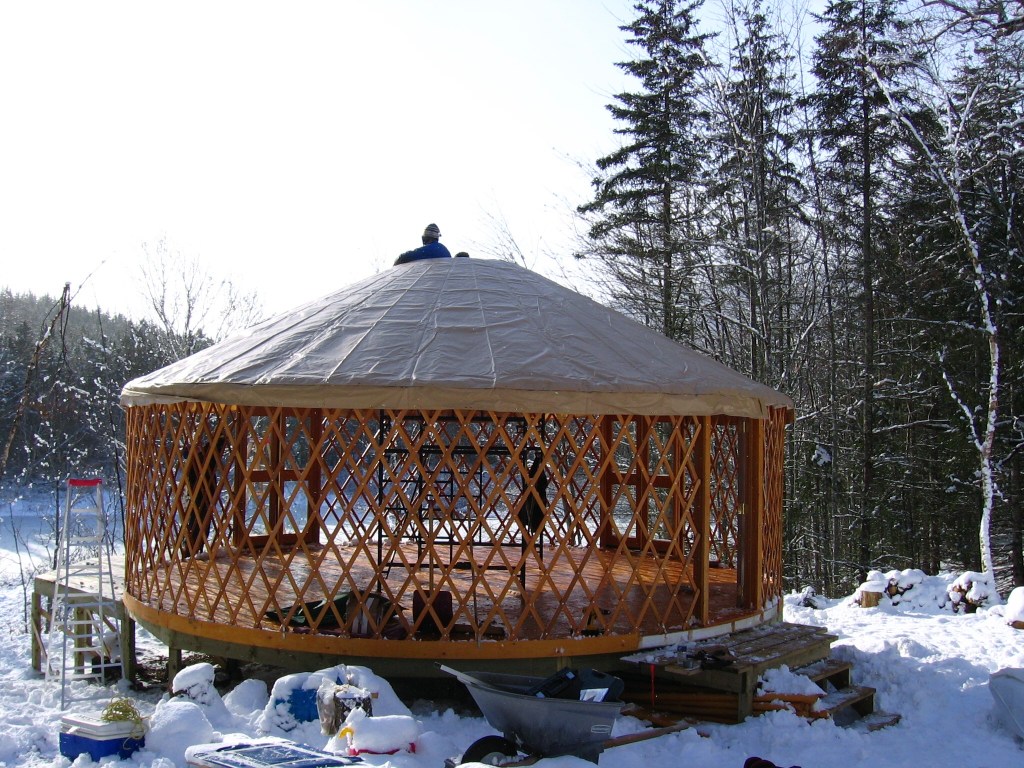
In the end it was snowing and blowing when friends and neighbours joined the carpenter and I in setting up the yurt. It was pretty deluxe – a 24′ diameter yurt with reflective insulation, canvas liner and a polyvinyl covering to keep the rain out. It had a 5′ diameter dome overhead for star gazing, moonbeam bathing, and cloud watching. I bought a wood-cook stove and a clever neighbour figured out how to attach the chimney to the soft-sided, vinyl-walled structure.

Yahoo! Me and Yurtle. Lots left to do but she’s up!

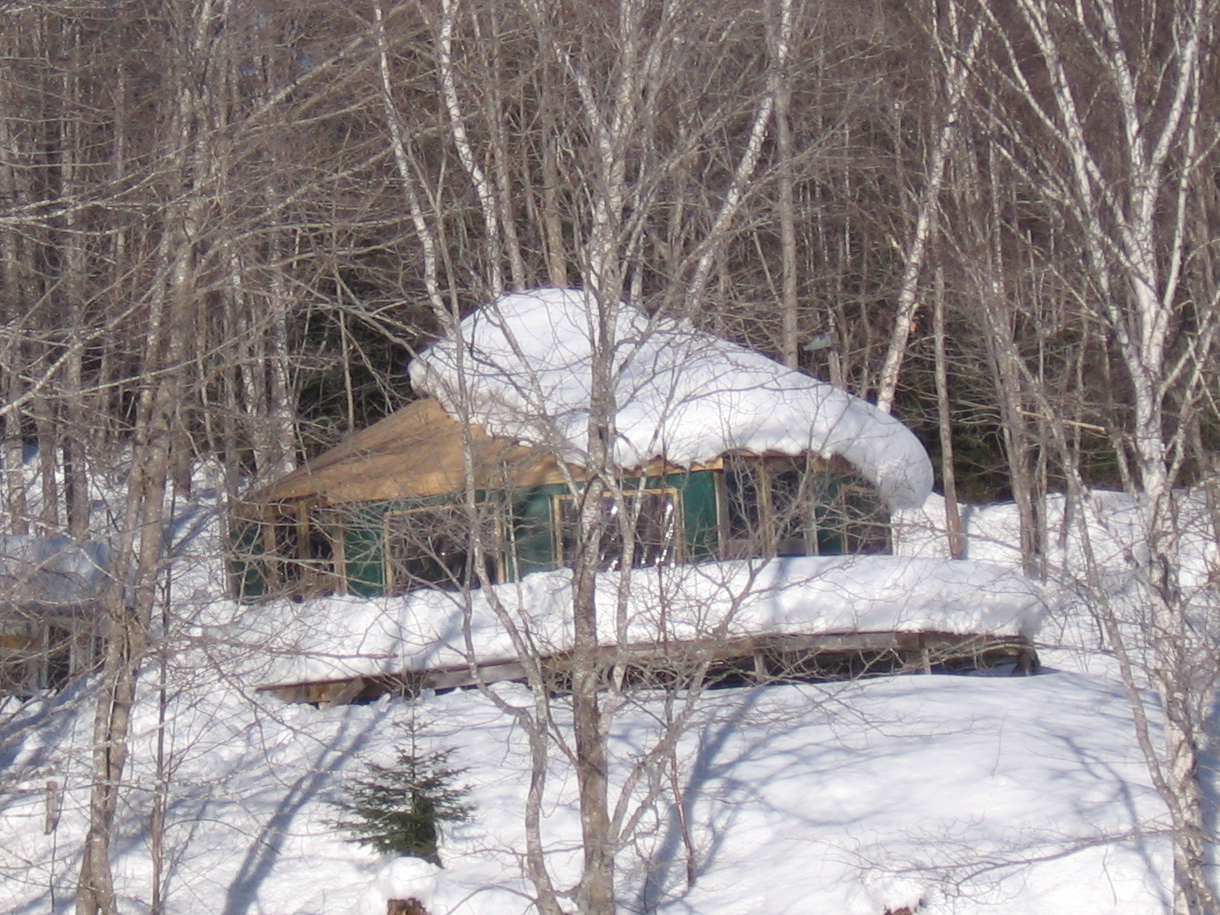
I finally moved in on December 28, 2005 and celebrated my 50th birthday in the yurt a couple of months later. Yurtle would be home for the next eight years, until February 7th, 2014.
Living in the yurt was like camping out in a big, luxurious tent. I was off-grid with no running water. I heated with wood and lit with kerosene lamps. I was too far back from the road to be plowed out, so I snowshoed in and out in winter, hauling in food and water. The yurt was easy enough to heat with the big wood-cook stove; but it didn’t hold the heat so it was bitterly cold on winter mornings. How cold? One morning my bedside water bottle was frozen solid. It was -10C inside. I learned to put the coffee water in the kettle the night before, since the spigot on the water jug would freeze overnight.

Tundra adored the yurt. It was just the right size and only one room so she could always keep an eye on me. It had three doors (the French doors did double-duty as windows) that opened onto a surrounding deck. She liked to ask me to let her out one door, then race around the deck to the door on the opposite side and ask to be let back in. Very funny, Tundra. She swam in the pond, explored the forest with me, romped in the snow, and rode alongside wherever I went. Tundra had a great few years here, but she was getting old and winding down. She died at age 16, a very ripe old age for a dog her size, but a hard loss for me.

Tundra’s cairn, usually well above the water line, but seen here with the pond in flood.

When I lived in the trailer, I dreamt of living in a yurt. While I lived in the yurt, I began dreaming of living in a cabin. I continued making sketches of my dreamhouse over the years, informed by my experiences in the yurt. The location shifted farther east, bit by bit. The funky hippie houses became more conventional as I accepted my own limitations. To wit, I am entirely useless at building anything. At all. I cannot build a bookshelf, let alone a house. So I would be paying someone else to build my house, and funky costs more.

The trailer, the yurt, a baseball dugout-turned-woodshed – and a whole mess of tarps!

But I knew that I liked one-room living and I loved living by the pond, in spite of the winter inconvenience. I also liked the simplicity of building from a kit, with all the materials and plans included. I finally settled on plan. What to build, where to build it, what material to build it from. A log-cabin kit on a basement foundation, above the high-water mark of the pond, facing south for winter sun, and a stone’s throw from the yurt.

Someone told me it would cost twice as much and take three times as long to build as I expected. ‘Hah! Not for me,’ I scoffed to myself. Well … it cost twice as much and took three times as long as I expected. There were obstacles, there were delays. I made decisions that added to the delays. I almost lost my mind over septic permits. I’d planned to stay off-grid but changed my mind and had to jump through endless hoops to bring power this far back into the woods. I almost froze after my big stove went into the house and my new small stove wasn’t sufficient to heat the yurt. But finally, on Feb. 7, 2014, I moved into my little log home.

The first few months I was startled by loud rifle-cracks in the night as the logs dried and checked (cracked) in the dry heat from the wood stove. For the first few years there were bolts to be tightened as the logs shrunk and settled. There was still lots of work to be done after I moved in, but it got done bit by bit over the years, and now, ten years later, the house is (mostly!) finished. It is a lovely abode in a marvelous location. It took a long time to make all those decisions, but I’m happy with my choices. I feel very lucky to live here, in this home, in this community, on this island.

I finally moved into my Home Sweet Home in Highland Holler!

This year, 2024, marks twenty years since I moved to Cape Breton and ten years since I moved into my log home. It’s been an amazing adventure so far, and now, on the cusp of the new year, I look back over those twenty years with gratitude. I don’t know how many more years I have ahead in this home or in this life, but every day is a gift.

Sue McKay Miller
December 30th, 2024

Happy New Year from Highland Holler!

Can’t See the Forest for the Dead Trees

Back In 2013 I entered a ‘CBC Writes’ contest called ‘Hyperlocal’. To enter, contestants had to write a short personal essay on their neighbourhood. Since I live in the woods, I submitted an essay entitled My Dying Neighbourhood. It wasn’t about urban decay or life in a ghost town, but rather the devastating impact of the spruce bark beetle on the surrounding forest and my neighbours, the trees.

I’m revisiting this topic over a decade later because things have changed since then. A forest is a living dynamic ecosystem. It is a place of continual birth, death, transformation, and regeneration. In this blog I revisit my dying neighbourhood and show what has happened since I first penned those words and took those photos. The essay is also posted on my website under Articles and Essays, but I’ve copied it here verbatim, including the preamble, so you don’t have to hop about.


My Dying Neighbourhood

I submitted this essay to the CBC Canada Writes contest called Hyperlocal. It was awarded a gold star as ‘Editors’ Pick’ of the day. In grade 2 I was in fierce competition with Cindy Egbert to get the most gold stars for spelling, so I was rather chuffed.

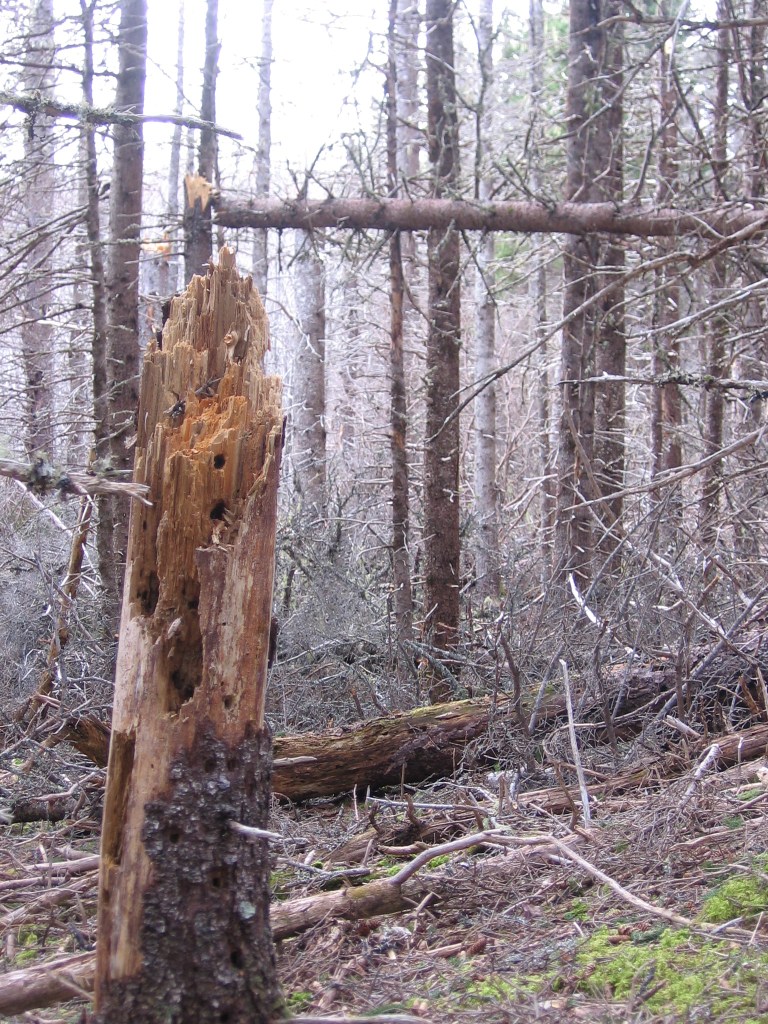
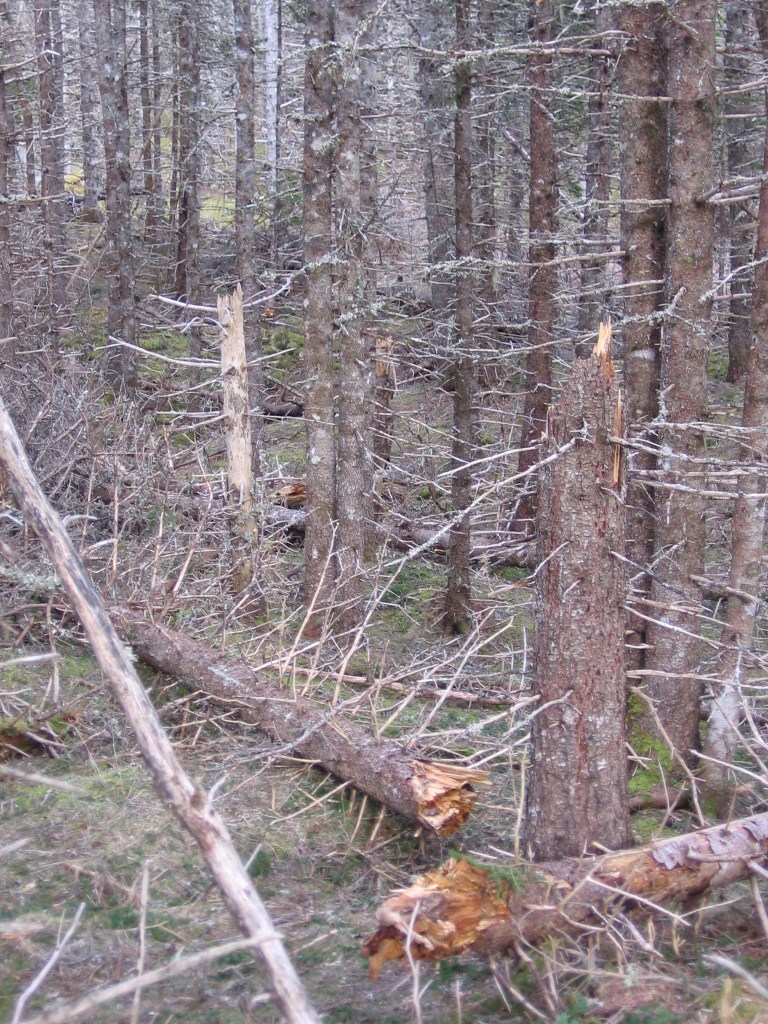
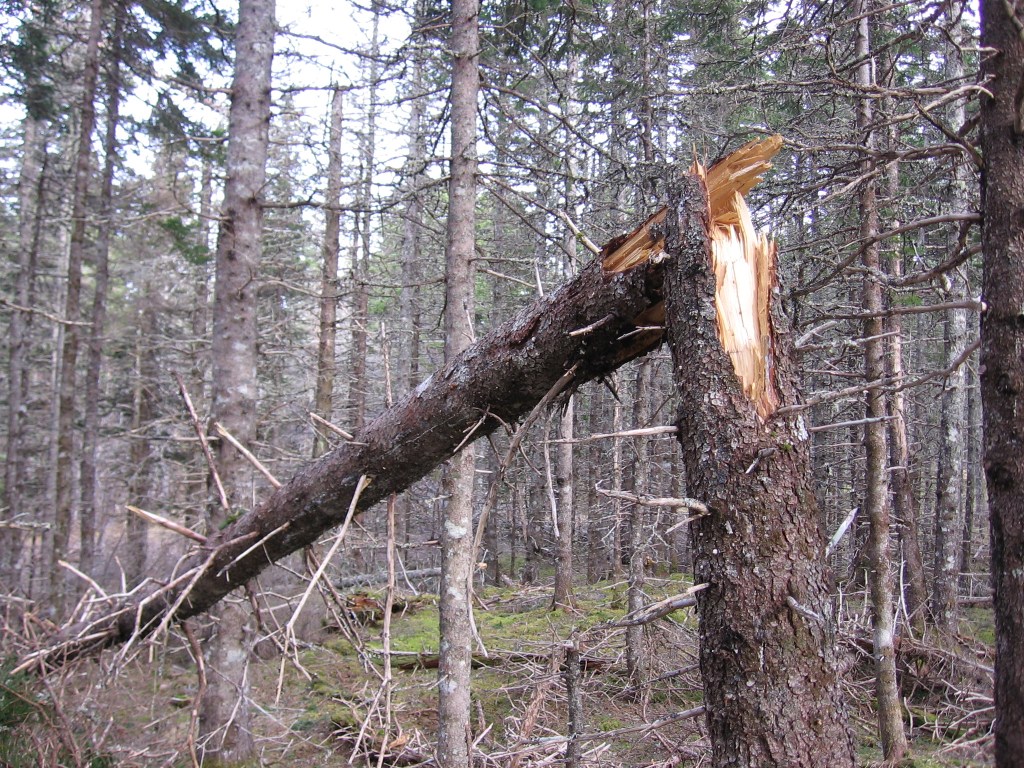
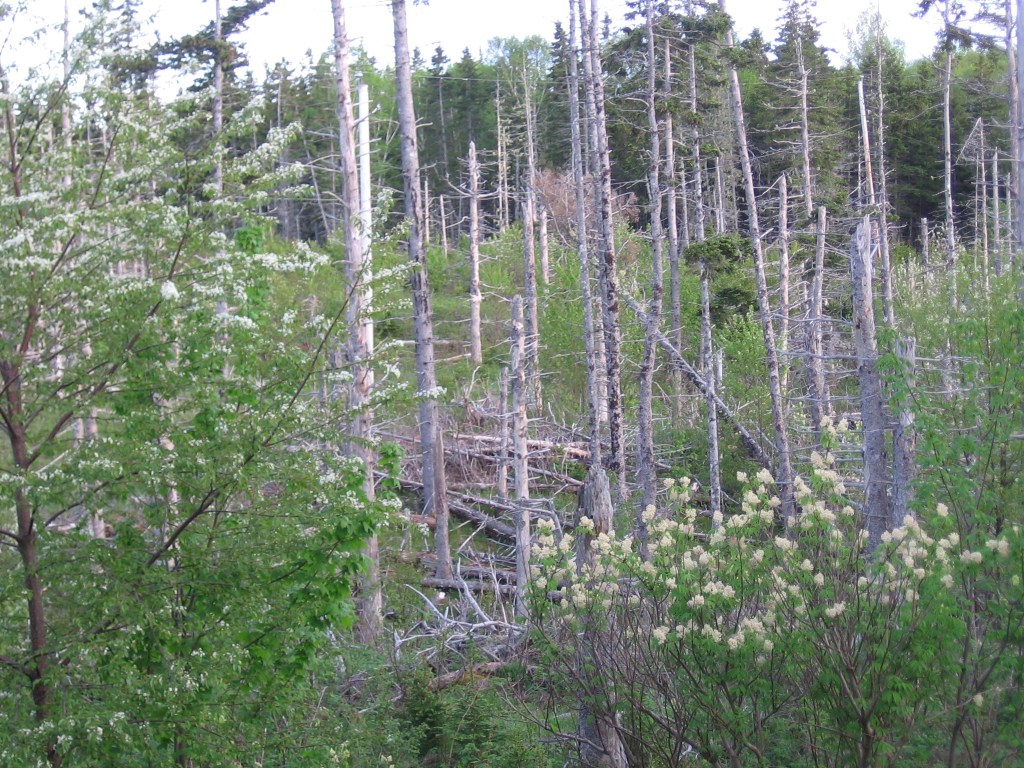
My neighbourhood is a forest on Cape Breton Island, and it is dying. The trees that are my nearest neighbours are dropping dead at an ever faster rate. A walk through the woods reveals the carnage – standing tree trunks ending in exposed jagged shards. The toppled crowns lie strewn on the forest floor or lean against ailing neighbours. When I first walked this trail a dozen years ago, the tall white spruce rising high overhead created a cool shaded passage that felt like a cathedral. Now my cathedral is a graveyard and deadfall blocks the trail used by moose, coyotes, bears and me. Each freshly fractured tree stabs at my heart. And sometimes, when a tree falls in the forest, I hear. A crack like a rifle shot, a thud bouncing off the Highlands and echoing across the pond.

When I look across the pond to the hill, deep conifer green is peppered with the stark grey of the standing dead. The pace of decimation is breathtaking. My towering neighbours are under attack by a bark beetle the size of grain of rice, and they are losing.

This is only the most recent change in my neighbourhood. When this land was reclaimed from the glaciers it gave rise to a mixed Acadian forest of birch and maple, hemlock and pine. Scottish settlers cleared the trees and tried to coax crops from the rocky glacial till, but some fifty years ago they abandoned the hard-scrabble farms for greener pastures. White spruce sprouted like weeds, surrounding old apple trees and concealing the stone root cellars that bear witness to a more domesticated past. Now the spruce trees are growing old, and are, like all the aged – be they tree or coyote, man or moose – more vulnerable to disease and death.

My deceased – and diseased – neighbours are being reclaimed by the forest floor that birthed them. Gravity gradually eases the trunk into the ground as insects and fungi go to work. Moss draws a soft green blanket over the log as it disintegrates into the soil, forming an undulating forest floor. Some seeds sprout on the sunny, well-drained tops of these hummocks while others thrive in the cool shady moisture below. Newly created gaps in the canopy let the sunshine peek in for the first time in decades and birch and maple saplings take root and reach for the sun. The forest succession back to a mixed Acadian forest is underway. But I, alas, will not be alive to see it. I see only this dying. By the time this forest is transformed, my own body, like the spruce, will have returned to the elements. My atoms will disperse into air, water and soil, nourishing new seedlings, inhabiting roots and bark and leaves, cycling through life and death and life again. My neighbourhood is a forest and it is dying. Long live the forest.

by Sue McKay Miller
May 2013


So there you have it. The last bit sums it up: the forest is dying; long live the forest. Because in truth, it isn’t the forest that is dying, it’s the white spruce trees that once dominated this forest that are dying. The individual plants, fungi, and animals that inhabit the forest die, but the forest itself changes and lives on.

When I bought this land in 2003 I was already in my late forties. I assumed that the forest would long outlive me, that it would stay the same, changing only slowly over the course of many human lifetimes. But within five years of my arrival the spruce bark beetle began decimating white spruce trees in our neck of the woods. Milder winters (allowing more beetles to survive) and aging trees contributed to this rapid die off. Not only was the forest changing in my lifetime, it was changing month by month, year by year as spruce trees toppled like dominoes.

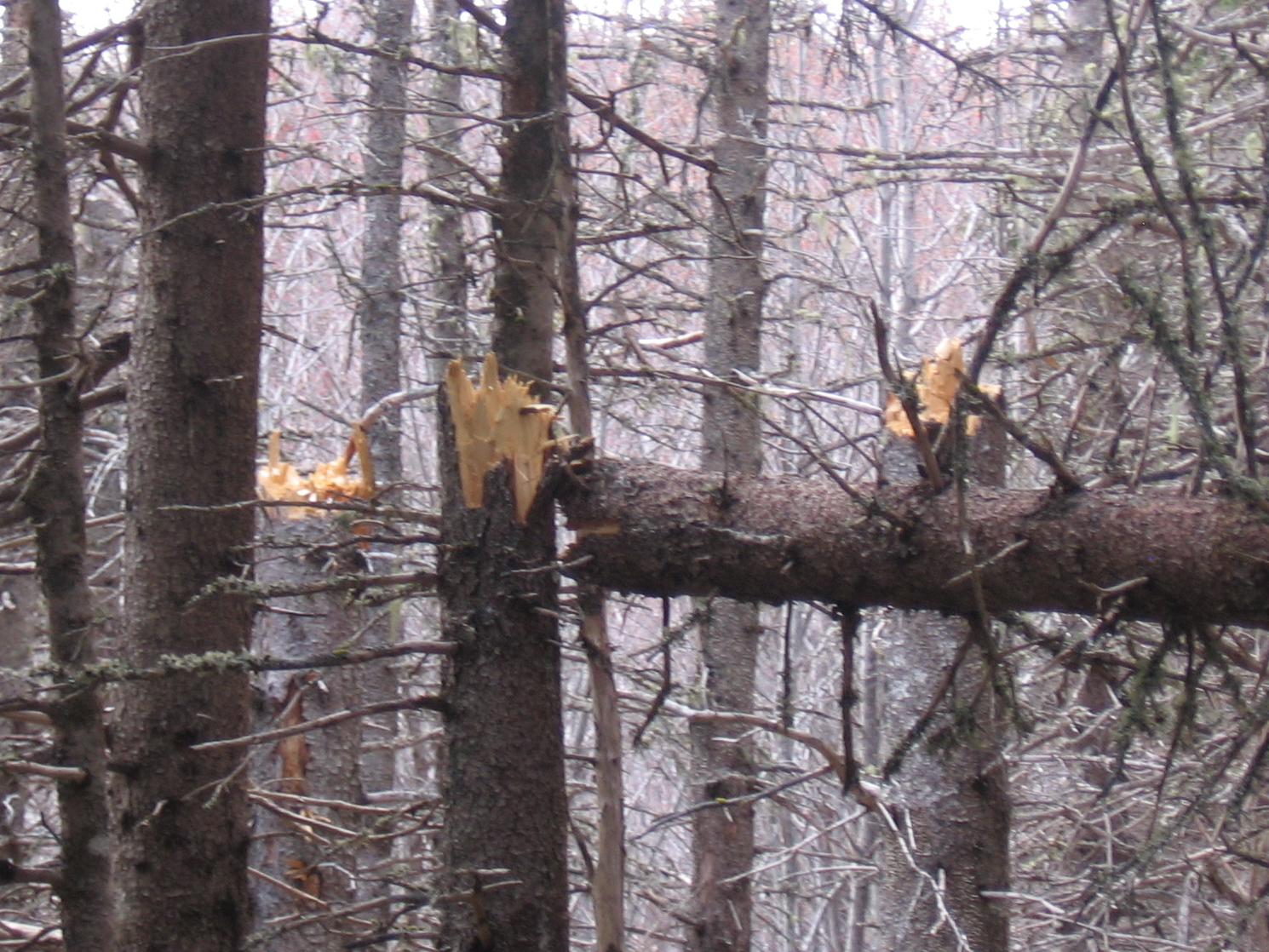
Bark beetles are small, the size of a grain of rice, and lay their eggs under the bark. The hatched larvae feed on the cambium, forming galleries that girdle the tree and cut off the flow of nutrients between leaves and roots, eventually killing the tree. The girdling can happen anywhere along the trunk, and trees break or even just bend at the point of infestation. Near the root, midway up, near the top. Spruce are shallow rooted and easily blow down in a fierce wind, but trees killed by the beetle have these tell-tale signs mid-trunk.

The dying spruce were falling across a path I named Tundra’s Trail after my dog. As I wrote in the essay, the trail once felt to me like a cathedral, with towering spruce shading a narrow dirt path. The path was well used, not just by Tundra and me, but by moose, bears, coyotes and other forest critters. Local coyotes routinely scent-marked a mossy mound and Tundra was always keen to check out the latest coyote news. But in 2008, shortly after my dear old dog died, I noticed the beginning of the spruce die-off. It accelerated rapidly thereafter.

Dying and rotting trees were breaking off and blocking the narrow trail, with no easy walk around. So when a tree-cutting crew came to clear the route for my power line, I asked them to also clean up the area around the path. After they were done I could walk Tundra’s Trail again, but the once-shady path was bare and exposed, surrounded by stumps and dead trees. It was a sorry sight.

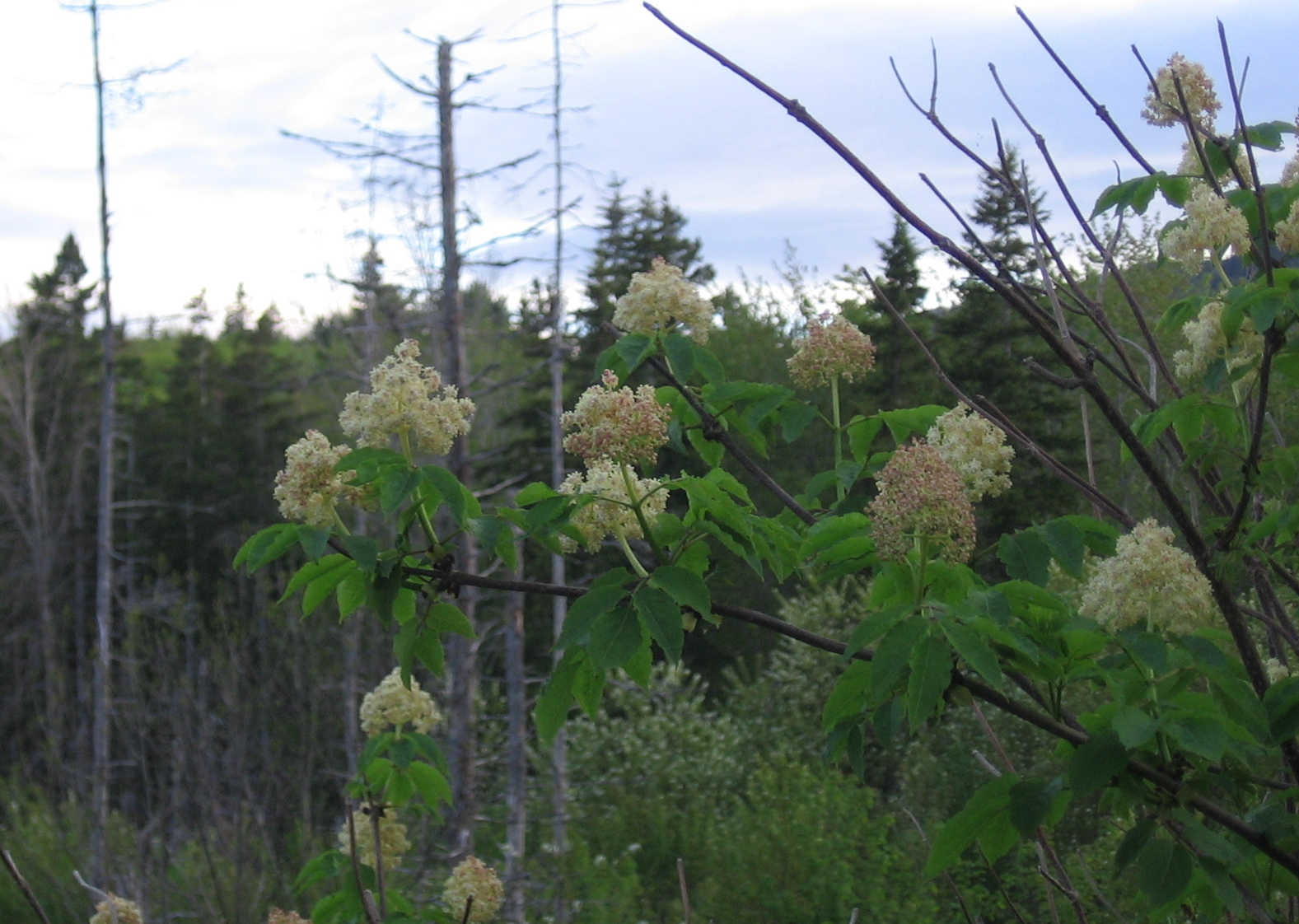
But nature abhors a vacuum and plants will pop up like … er … well, weeds as soon as there’s a patch of sunlight. Pioneering plants rushed in and rose up rapidly, and one of those pioneers was the red elderberry. This fast-growing shrub grows up on disturbed land. Unlike black elderberry the raw fruit is not edible for humans, but it is enjoyed by birds, who return the favour by spreading the seeds in their droppings. The flowers begin as a tight purplish cluster that blossoms into a white cone and fills the air with a delicious scent. The flowers are enjoyed by butterflies, hummingbirds and humans alike.

Red elderberry flowers in bloom.

When I first saw the elderberries blossoming alongside Tundra’s Trail, I felt a rush of joy at the regenerative power of plants. A delicious scent filled the air, carrying with it a whiff of nostalgia. I was reminded of the scent of lilacs filling the spring air in Calgary, my hometown. The scent isn’t the same but both permeate the air with perfume. And although I prefer purple lilacs (or should I say lilac lilacs?), they can also be white, and those look similar to elderberry flowers. It was such a sweet gift from nature, these lovely fragrant flowering shrubs thriving in the sun, renewing the dying forest, reminding me of my childhood.

The dead and the living stand side by side in the ever-changing forest.

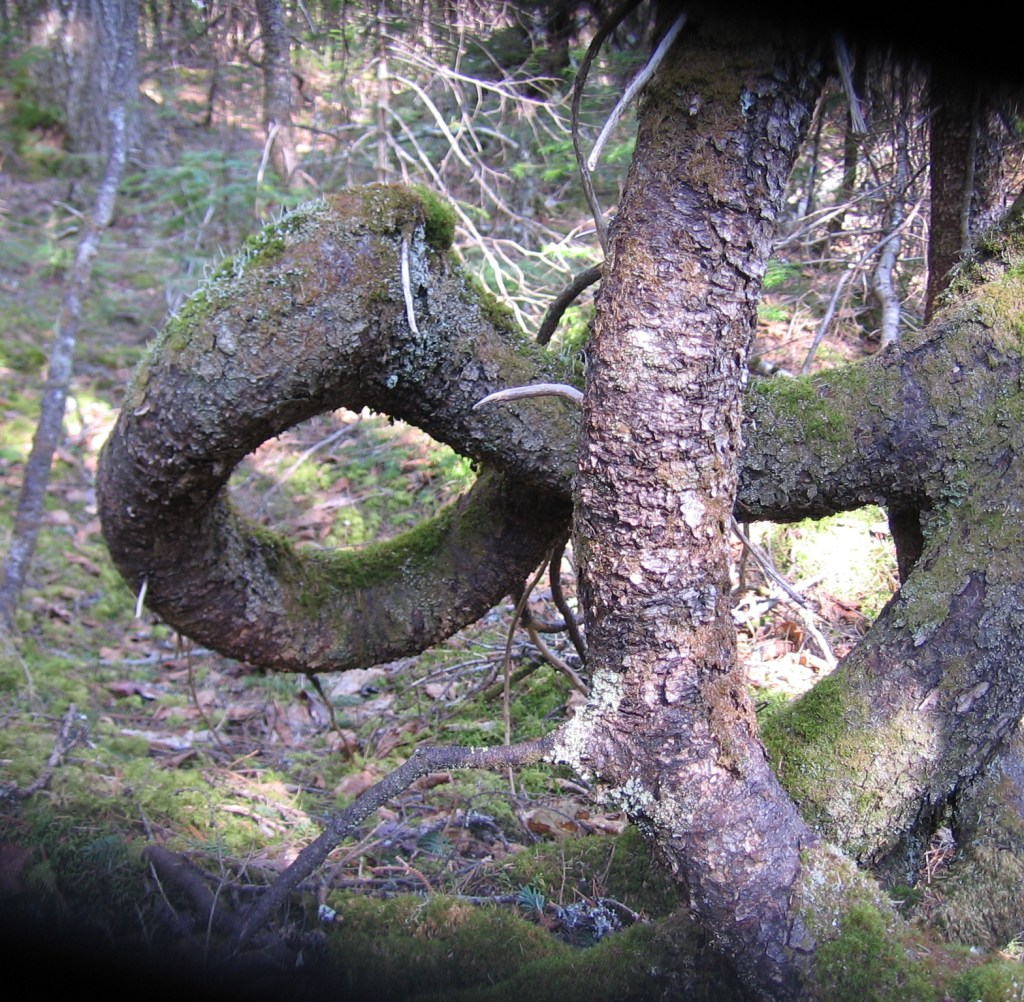
As the forest continues to evolve, other plants will grow up. Taller trees will seed the soil and sprout under the sun or in the shade. Birch and maple will thrive in the open gaps created by fallen spruce. Plants are persistent, survivors, relentless (just try to get rid of an unwanted plant – good luck!). As I wrote in Which Way is Up, a plant will do whatever it takes to reach the sun, even if that means growing down or sideways or in a crazy loop-de-loop.

Now we are past the summer solstice and the spring flowers have faded and died. But as we swing into a new season, fruits and berries are forming, bearing within them the seeds of new life. The circle continues. Have a happy summer!

Sue McKay Miller
June 27, 2024


The Great Groundhog Day Dump

This is the first time I’ve written two blogs in one month, but it’s Leap Day, so why not? I posted Fabulous February on Groundhog Day, a celebration of this much-maligned month. It was an idea I’d tossed around for a while, and 2024 seemed like a good year to finally do it. This is a leap year, plus the Chinese Year of the Dragon began in February. As I was working on the the blog I had no idea that February 2024 would turn out to be memorable for another reason altogether. The month would begin with a huge snowstorm I dubbed the Great Groundhog Day Dump.

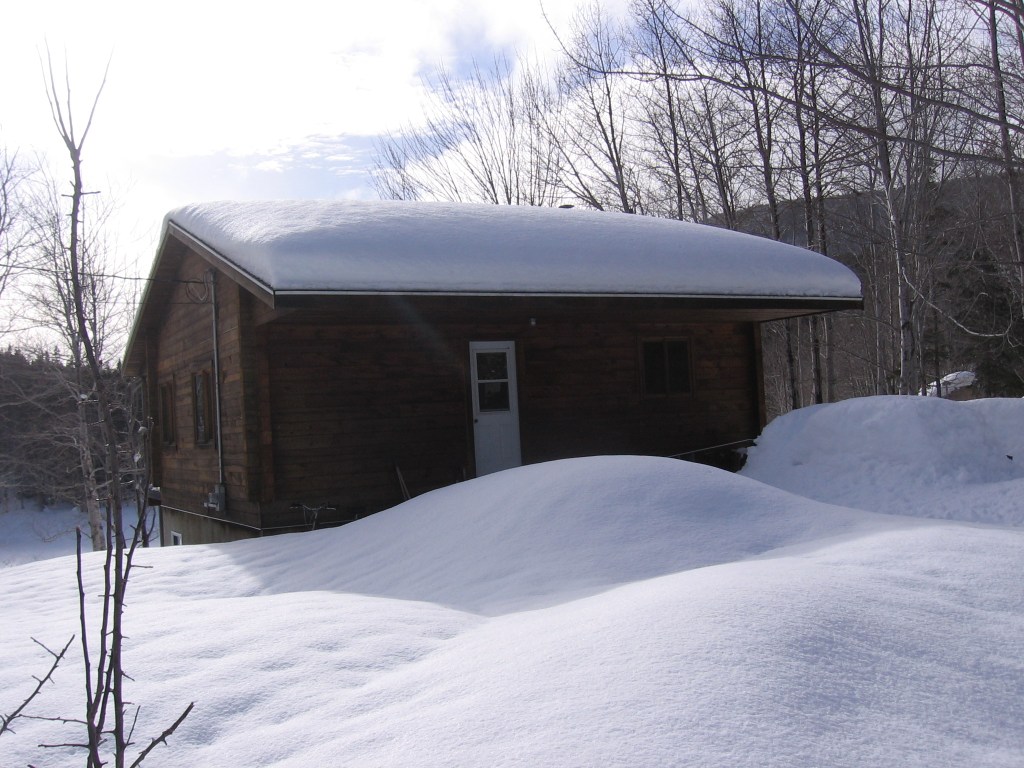
On February 2nd a nor’easter stalled offshore and began dumping heavy, wet snow on Cape Breton. And it kept dumping heavy, wet snow on Cape Breton for the next three days. We were buried. This is not the light fluffy flakes that powder skiers dream of – it is very fine, wet, and so densely packed it’s hard to move. It is also hard to measure.

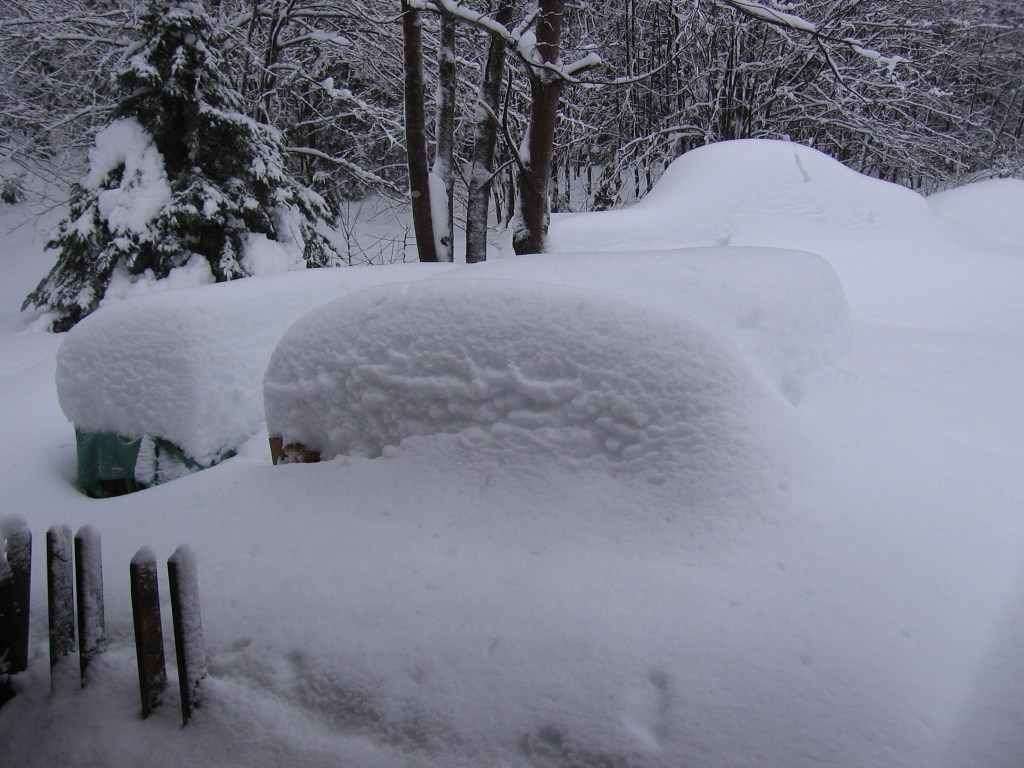
I kept shoveling my deck throughout the storm, finding it hard to move even 20 cm of the white stuff. I record our weather, including snowfall and rainfall amounts, so I measured snow depth every time I shoveled. I also left a couple of blocks untouched so I could verify the accumulation. But the snow was compacting so rapidly under its own weight that those blocks were shrinking even while it was still snowing. I estimate I got 90 cm, or 3 ft, of snow (on top of ~18″ already on the ground). It was wet and finely textured and temperatures were mild, so it compacted into a dense 2′ deep layer covering everything. (Like many a Canuck of a certain age, I switch between metric and imperial units somewhat randomly.)

Those lumps are 4′ tall wood stacks buried in snow. My old truck is the bump at the back.

And we got off lucky. Sydney and environs got a whopping 5 ft (1.5 m) of snow in places. Short people and children could vanish! Drifts were double that and more, not to mention massive plow banks. Chaos ensued. Cape Breton shut down for the week. No school, no transit, and many stores stayed closed. The police begged people to stay home. Those who ventured out got stuck and left their vehicles strewn along the road, hindering clearing efforts. Even snowplows were getting stuck. Or breaking down. Or both.

Cape Breton is a snowy place and it’s not unusual to have deep snow in February, but it is unusual for so much to fall all at once. We get a lot of our snow from nor’easters: low-pressure systems formed when cold continental air carried on the jet stream meets warm Gulf-stream air off the east coast. The moisture-laden system tracks northeasterly and counter-clockwise winds dump copious amounts of precipitation on the eastern seaboard. Once the system arrives southeast of Cape Breton, we get lots of heavy snow – often 1-2 feet. Then the system continues on its merry northeast trajectory and dumps on Newfoundland. But this particular nor’easter got derailed. It somehow slipped off the jet stream and stalled just offshore. It kept churning in circles and dumping snow for days.

This is off the NOAA website and focuses on New England, but Cape Breton is the green blob in the upper right. Once the storm is southeast of Nova Scotia we get northeast winds and wet snow – lots of it.

A historic winter storm deserves a name, but nothing really stuck. Snowmaggedon and its counterpart, Snowpocalypse, were invoked and certainly fit, but neither is original. I heard Frigid Fiona (after Hurricane Fiona) but that’s not quite right because it wasn’t very cold – which was part of the problem. I dubbed it the Great Groundhog Day Dump, which makes the date easy to remember, but that’s not quite right either. Yes, the storm started on Groundhog Day, but it lasted much longer than a day, which was also part of the problem.

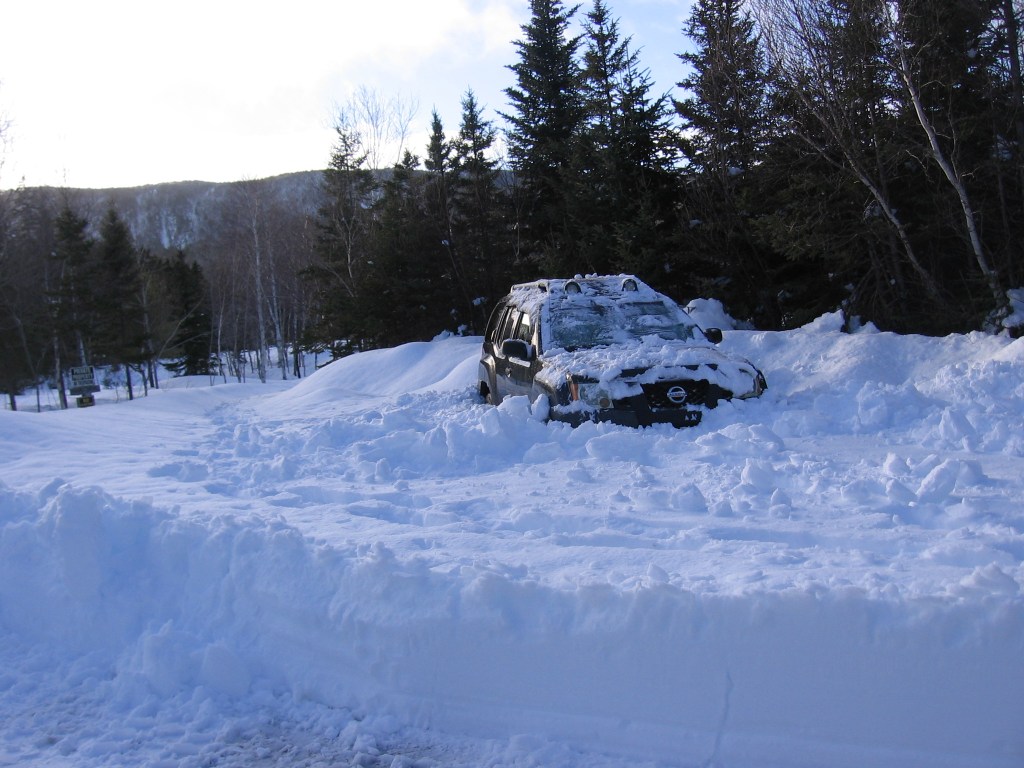
The snow finally eased up on February 5th, but we still had to dig out. I was snowbound for a week. Not trapped inside my house (although this happened to a number of people whose doors were blocked by snow) because I (cleverly) have doors that open in and are protected by overhangs. But my vehicle was trapped for a week, even though I had (again, cleverly) parked down at the road ahead of the storm. I have a long driveway, some 350 m., so once the snow gets deep I snowshoe in and out rather than trying to keep it plowed.

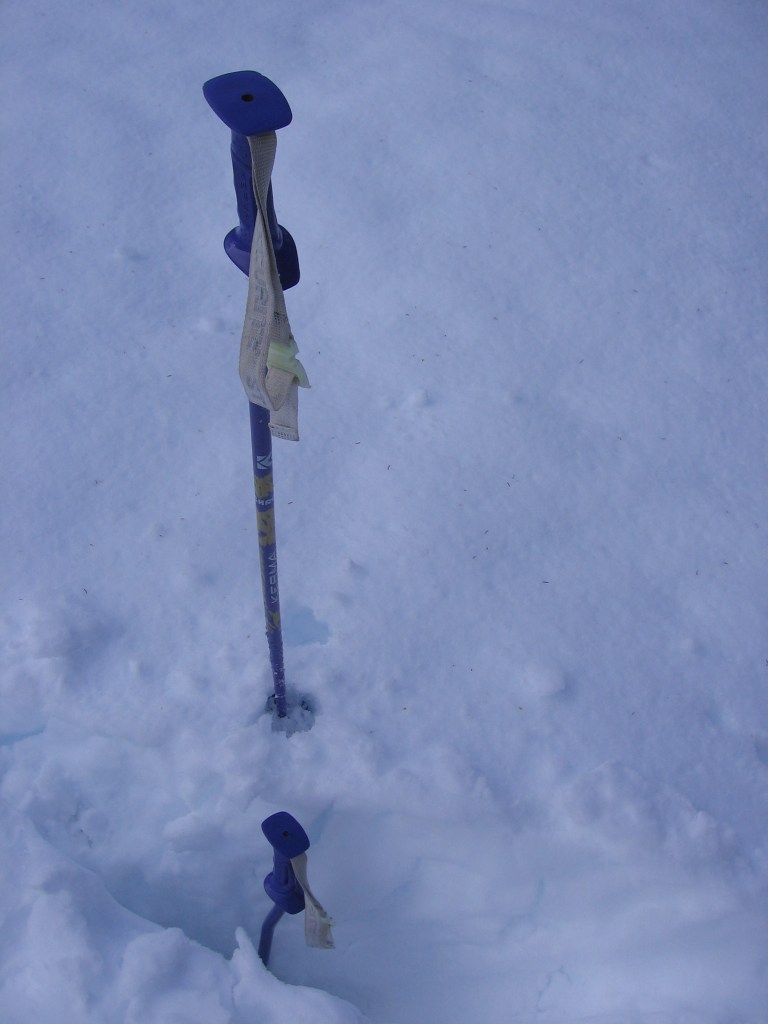
With so much snow I feared I’d sink in to my thighs if I waited to break trail so I started while it was still snowing on Saturday. The snow was an odd consistency and I was bogging down unevenly. Down to my knees and then to my ankles and then to my shins, leaving tracks of all different depths instead of a level trail. I didn’t get far before I retreated.

Sunday I was too busy shoveling to snowshoe, but on Monday I tried again. A moose had plowed through the snowbank onto my driveway and punched a meandering set of deep holes into the drive. I was skirting moose holes and my own uneven tracks and still sinking in to different depths. My poles would be there for balance and then vanish into the void. I made it about 1/4 of the way to the road before I gave up. Between the moose and me my trail was an utter mess of uneven holes.

Tuesday came and try, try again. My driveway was dreadful so I climbed 2 feet up onto the bank. I was still sinking in but evenly – better! Moose had plowed a few trenches through the bank so I had to leap across the gaps – exciting! I got halfway to the road – progress!

Later that day I was outside fetching firewood and heard the beep-beep-beep of a reversing vehicle. It sounded like it was right at the bottom of my driveway. Could someone be clearing around my vehicle? Intrigued and motivated, I set out yet again, maneuvering through the obstacle course of pitfalls. And so, four days in and on my fourth attempt, I finally made it to the road. My vehicle was encased in snow, barely visible. But the road in front of it had been cleared – exciting!

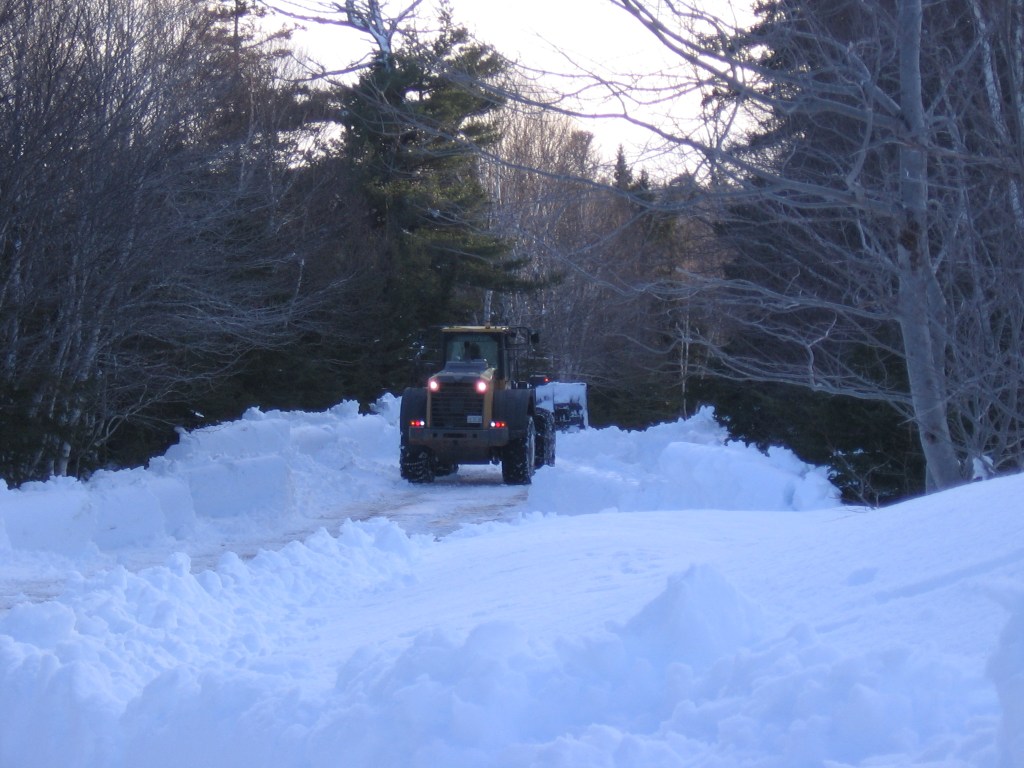
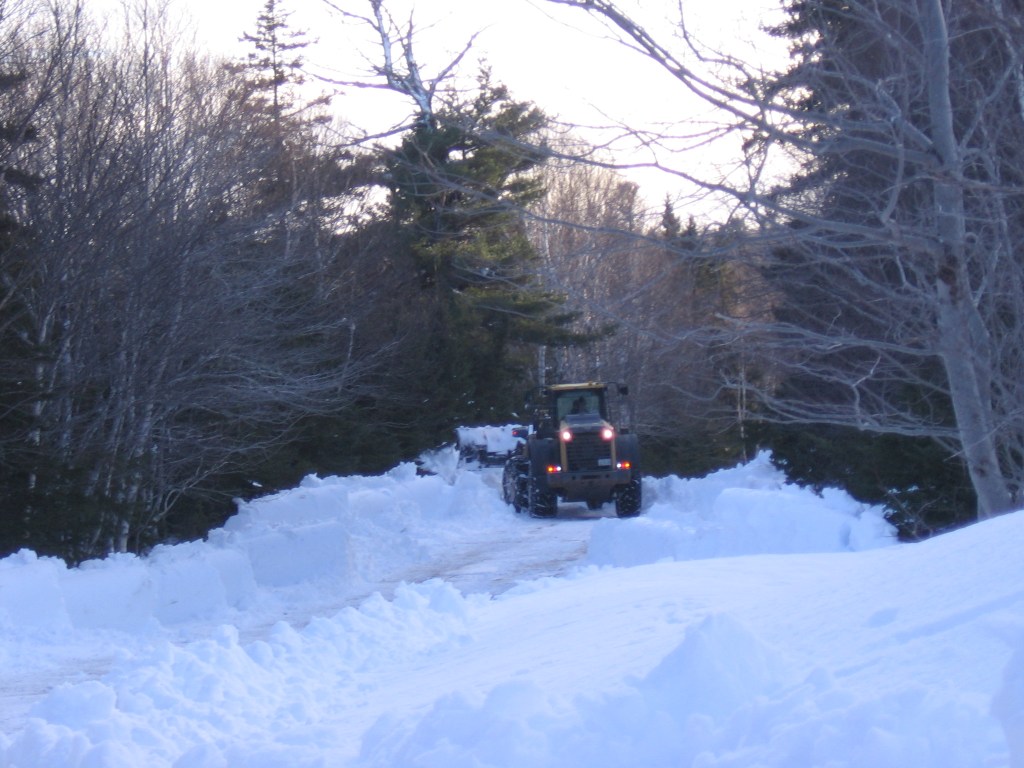
The beeping machine had moved farther down the road. It was a front loader, clearing a lane along our side road four days after the storm began. Usually the county plow gets to us within a day or two of a snowfall, but this time the plows skipped side roads. It was a Herculean effort just to keep one lane passable on main roads like the Cabot Trail. So our little road filled with snow until it was too deep and heavy to be plowed. It took a front loader to do the job. Push snow with the bucket, lift and roll the load against the side of the road. Reverse – beep-beep-beep – and repeat. It was very slow going, but buddy was getting ‘er done, one bucket-load at a time.

I was strangely elated to see that front loader slowly clearing our road. I wished I’d arrived a few minutes earlier so I could wave and grin and shout my thanks to the driver. But I doubted he’d appreciate an idiotic pedestrian standing behind him when he went beep-beep-beep into reverse.

On Wednesday the temperatures plummeted. My driveway, a mess of uneven holes, turned into a frozen mess of uneven holes. I realized that my earlier forays had been folly. Had I just waited I could’ve snowshoed out on top of the snow. Sometimes procrastination pays. And hindsight is always 20/20.

My own rig was still encased in snow, almost invisible. I’d parked as far back as I could to accommodate plowing, so there was some 15 feet of 2′ deep compacted snow between my rig and the road. On the plus side, standing atop that snow in my snowshoes meant I could actually reach the roof of my vehicle. It still took over half an hour to clear the roof and hood. Then I took off my snowshoes and walked down the road to visit my neighbour and share storm stories.

A couple of days later I got a call from that same neighbour. Unasked and unbeknownst to me, he spent almost 3 hours clearing the snow around my vehicle by hand, using a scoop. My back hurt just thinking about it. So, eight days after I’d parked at the road, I was free! I snowshoed out and went for a drive. Not far, just a kilometre down the road to thank my neighbour for his hard work and kindness.

And that’s Cape Breton all over. Weather can be challenging here, but people step up and help out. This storm was especially difficult. The snow was too deep and heavy to move with a regular truck-plow setup – it required tractors with snow-blower attachments, bulldozers, front loaders – heavy equipment. Operators, public and private, went non-stop trying to clear roads and driveways, but couldn’t keep up. And equipment kept breaking down. Or getting stuck.

But people pulled together. Hats off to the people who worked endless hours to clear snow. Neighbours helped neighbours, digging out doorways blocked by deep snow, clearing driveways and cars, snowshoeing or snowmobiling in to the housebound with food, medicine, and company. Local CBC radio programs gave us information and a feeling of connection, even in our individual isolation.

Cape Bretoners are renowned for their hospitality, hard work and helpfulness. I have always been helped out my neighbours, from my first winter house-sitting ‘down north’ near Bay St. Lawrence to my years here in the Holler. I didn’t ask my neighbour for help, but he saw a need and got ‘er done.


After freeze up the snowshoeing was great. I did a few fun forays and discovered that Yellowbird, a ramshackle cabin that was on my land when I bought it, had finally collapsed under the weight of the snow. I also saw 3′ deep trenches through the snowy woods, plowed by meandering moose. Snow this deep is a challenge even for these long-legged beasts.

In the end I was storm-stayed for a week but that was fine. I’m a somewhat solitary animal anyhow and had plenty of food because I always stock up for winter. The less I have to haul in by sled, the better. During the yurt years I had to haul everything in, including drinking water. I didn’t have running water or storage space, and the yurt would freeze on cold nights. I wonder how I did it. Winter in my cabin is comparatively easier, but still a challenge. Of course, I’m also older. In fact, it seems I am getting older every year.

I marked a birthday in February, one of the reasons I’m fond of this month. And now, writing on Leap Day, I must say that February 2024 was a doozy. It started with the Great Groundhog Day Dump. We were still digging out when it warmed up and dumped 84 mm of rain on all that snow, followed by a hard freeze. One day I was snowshoeing on and around the banks of the pond. The next day everywhere I’d been was under water as the pond rose to flood levels. And today, on Leap Day, we mark the exit of this marvelous month with crazy mild temperatures, rapid melting, rain and gusty south winds – all to be followed by a rapid hard freeze and then snow squalls to welcome in the month of March. Never a dull moment here in the Holler.

Sue McKay Miller
February 29th, 2024

p.s. I wrote this on Leap Day but didn’t post it until March 1st. Happy St. David’s Day! (It’s a Welsh thing.)

Rain and melt and a hard freeze in one day – the pond is way up and the icicles are way down.

Fabulous February

Okay, I’m biased. February is my birth month. I liked being a February baby, maybe because it’s an oddball, quirky month and I was an oddball quirky kid – a left-handed, redheaded tomboy. It’s a short month that gets the longest mention in that familiar rhyme.

Thirty days has September,
April, June, and November,
All the rest have thirty one
Save February at twenty eight
But leap year, coming once in four
February then has one day more.

‘I am a groundhog. Hear me squeak.’

And guess what? 2024 is a Leap Year, so we get to enjoy a whole extra day of this fabulous month. My birth month takes a lot of flack. People complain because it’s cold and snowy. They even complain about its name. Granted, it is a bit awkward. Feb-RU-ary? The hosts of ‘As It Happens’ on CBC always make fun of the ‘RU’ part. And I always mean to write a letter explaining that, according to Webster, Feb-yoo-wary is also an acceptable pronunciation. Me? I usually blend it together and mumble something like Feb-oo-ary.

Given how many times I’ve hear people dis February, I am dedicating this blog to celebrating February – however you say it. I usually try to use my own photos, but I’m making an exception for this exceptional month. Credits at the end of the blog.

Groundhog Day. What other month boasts such a silly ritual? It makes no sense. Especially in Canada where, except on the west coast, the idea of only six more weeks of winter in February is as hilarious as the idea that a rodent’s shadow can forecast the weather. And now it’s a movie. A movie that repeats. And repeats. Every Groundhog Day.

Chinese New Year is based on the lunar calendar and shifts around, but in 2024 it’s on February 10th. This is the Year of the Dragon and should be a colourful celebration. My son has Welsh blood, and the Welsh are also big on dragons. In fact, they like them so much they put one on their flag.

February is the month for the Winter Olympics. No Winter Olympics this year, but Calgary hosted the 1988 Winter Olympics and it was a whole lotta fun. My young son and I went to see the ski jumping and witnessed the debut of Eddie the Eagle. No one could appreciate the true distance these athletes flew until Eddie from England landed so far short that we were all astonished. Then we applauded and cheered. Eddie was dubbed ‘the Eagle’ and became a popular favourite. We admire winners, but we love underdogs. And speaking of underdogs, that was also the year of the Jamaican Bobsleigh team. Another February movie was born.

This is not Eddie the Eagle.

In 1990 Alberta became the first province to declare a statutory holiday in February. And it just so happened that it fell on my birthday that year. I was pretty chuffed. Don’t we all feel like we should have a holiday on our birthday? Since then many other provinces have followed suit. Now we have Heritage Day in Nova Scotia, and, as it happens, it falls on my birthday this year. Somehow it’s not quite as exciting now that I’m retired.

Celebrating my 50th in the yurt, complete with fiddlers, step dancers and (maybe a bit too much) Irish whiskey. That’s Tundra in the bottom left.

Valentine’s Day, on February 14th, is also less exciting for me now, at least in terms of getting cards and flowers and such. (Ah, there was a day …) But this day is very special for another reason – it’s the anniversary of my two favourite people. This day of love marks the years of love between them. And as anniversaries go, it’s an easy one to remember.

February has a few other anniversaries that are personally meaningful. Back in 2003, after a few months of negotiation, I finally bought my land in Cape Breton. By chance, the deal closed on my birthday – and what a fantastic birthday present it was! I moved onto the land in the summer of 2004. Ten years later, on Feb 7, 2014, I moved from my yurt into my comfy log home. Hard to believe that 2024 marks 10 years in my cozy cabin.

For winter haters, February can be abysmal. It can be the coldest and snowiest month of the year. But for winter lovers, February is the time to enjoy skiing, skating, sledding or snowshoeing, followed by a warm drink by a cozy fire. My favourite winter activity is tracking animals on snowshoes. I wrote about this in The Secret Lives of Animals. The snow reveals who is out and about. Snowshoes allow me to bushwhack through the forest following those tracks and find out where those animals came from and where they are going.

Like most children, I loved winter and had tons of fun in the snow. I also had the great good fortune to grow up skiing. My English father took up the sport and took my older brother and me skiing in the Rocky Mountains every Sunday, from opening day until the last of the spring skiing. Other kids had to go to church, we worshiped at the alter of the mountains. The highlight of the ski season was in February, when schools closed for Teachers Convention, giving us a four-day break. We’d meet up with my dad’s friend and his daughter and spend all four days skiing. We’d start in Kimberley, BC, and then drive down to Whitefish, Montana, to ski amongst the towering snow ghosts on Big White. In the evenings my friend Ann and I felt very sophisticated as we sipped our Shirley Temples.

The Miller family at Sunshine Village in Banff National Park, in the mid-’60’s. We weren’t quite as fuzzy and faded as this old photo suggests.

But winter isn’t all fun and games. It can be difficult and challenging. When the third nor’easter in a week dumps a load of wet heavy snow, when we get weary of toting firewood to keep the stove going, when vehicles are buried and roads are treacherous. And then there’s the short days and those long nights. That’s where February, while it may be cold and snowy, has a special pick-me-up for winter-weary folk – we reach the midpoint between winter solstice and spring equinox.

The Gaels celebrate this occasion on February 1st with the traditional festival of Imbolc, also known as St. Brigid’s Day. In 2024 the midpoint falls on February 3rd. And while it’s true that the days start getting a wee bit longer after winter solstice, it’s in February that I really notice the days stretching out and the sun getting higher. In my yurt I would mark the day when the sun would get high enough to shine through the overhead dome. The yurt was like a mini Stonehenge, marking seasonal changes within its circle. I still track the northward progression of the sun by watching where it sets behind the highlands. This photo was taken the eve of February 1st.

The sun sets a little farther north each day as we head towards the spring equinox.

On clear nights in February I see the winter constellation Orion heading for the hills in the west as Leo rises in the east, heralding the news that spring, while not here yet, is coming. I once read this phrase about February in the Farmer’s Almanac: ‘Winter’s back is broken‘. That’s how it feels to me. It may be the month of the full Snow Moon, but the days are longer, the sun is higher, and while there is almost certainly a lot more than six weeks of winter to go, it’s time to embrace the winter wonderland knowing that it won’t last forever.

So strap on your snowshoes or skates, or maybe just bundle up for a bracing walk. Then enjoy a hot toddy or hot chocolate by the fire and immerse yourself in that big fat book you’ve been meaning to read. Put on a pot of soup or start a jigsaw puzzle or kiss a groundhog. February is fabulous, but it’s short – so don’t miss a minute!

Sue McKay Miller
February 2nd, 2024

p.s. What did I forget? Let me know a few of your favourite things about February in the comments below.

My driveway in February 2019. Sometimes the road looks long, but we’ll get there in the end!

Photos from pixel.com: Groundhog by Oleg Mikhailenko; Chinese dragon by Vlad Vasnetsov; Welsh flag by Lisa Fotios; Ski jumper by Todd Trapani.

Which Way is Up?

When I get too wrapped up in my head and my thoughts start going in circles, a walk in the woods helps straighten me out. As readers of my blog will know, I like to bushwhack through the forest that surrounds my home. Out there I have to focus on my route through the trees and on my footing, one careful step at a time. And at every step I am surrounded by the sights, sounds, and smells of nature. There are old friends: familiar trees and rocks that serve as waymarkers. Like the glacial erratic boulder I described in Stones I have Known, or certain trees that are so distinctive that they stand out in a land full of trees.

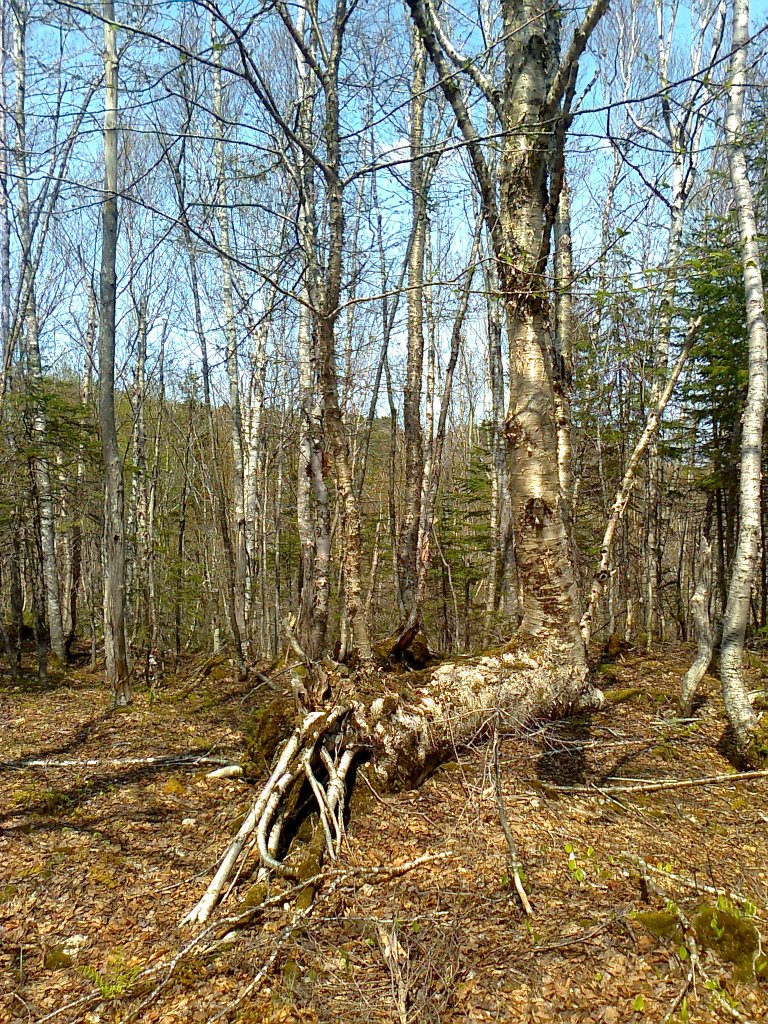
Some trees stand out because they don’t stand up. We think of trees as having roots below ground, a vertical woody trunk, and branches. The branch configuration varies depending on the type of tree (see Bared Trees and Barred Owls) but will also be affected by environment. Trees need sunlight on their leaves (or needles) for photosynthesis and that light may be more or less available depending on where a tree finds itself living.

This beech tree, with its graceful curve and mossy gown, is a helpful guide when I’m up on the highland slopes.
This landmark tree is hard to miss with that inviting mossy lounge chair.

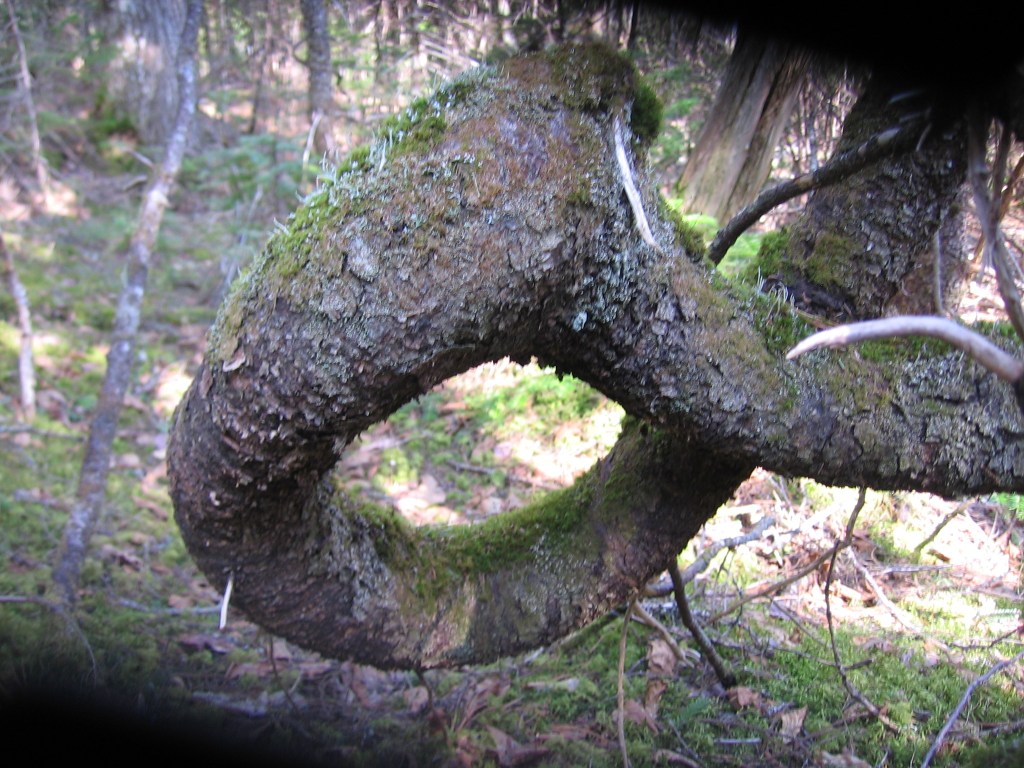
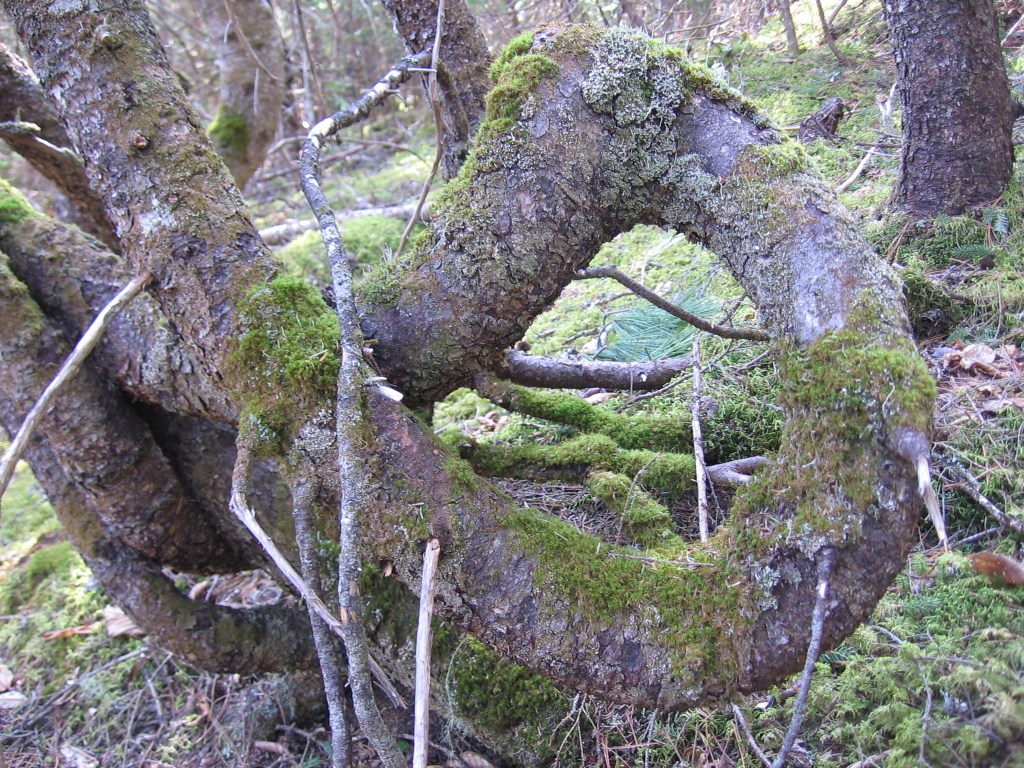
But seeds don’t get to choose where they land. It’s a crap shoot, the luck of the draw. So trees evolved a strategy to release lots of seeds in an effort to beat the odds. I’m amazed at how often seeds that were dealt a bad hand – like, say, landing on a boulder or a steep cliff – sprout anyhow and just keep on growing. And it astounds me just how tenacious a tree can be. Here are a few trees that defied the odds and survived, even if that meant growing sideways or bending over or even going around in a circle to reach the life-giving sunlight.

Why do some trees grow horizontally? Imagine a young tree, merrily growing vertically as nature intended, when wham! A big old tree beside it topples on top of the young tree, bending it sideways. This is a bad break indeed – a make-or-break moment you might say. But if the tree is flexible enough to keep growing – albeit sideways – it can survive and eventually find vertical again. Meanwhile, all evidence of the fallen tree goes back into the earth, nourishing the very tree it collapsed on.

One thing is for certain, whenever and wherever a seed lands, if it sprouts, sets down roots and sends out leaves, it will grow any which way it has to as it searches for the sun.

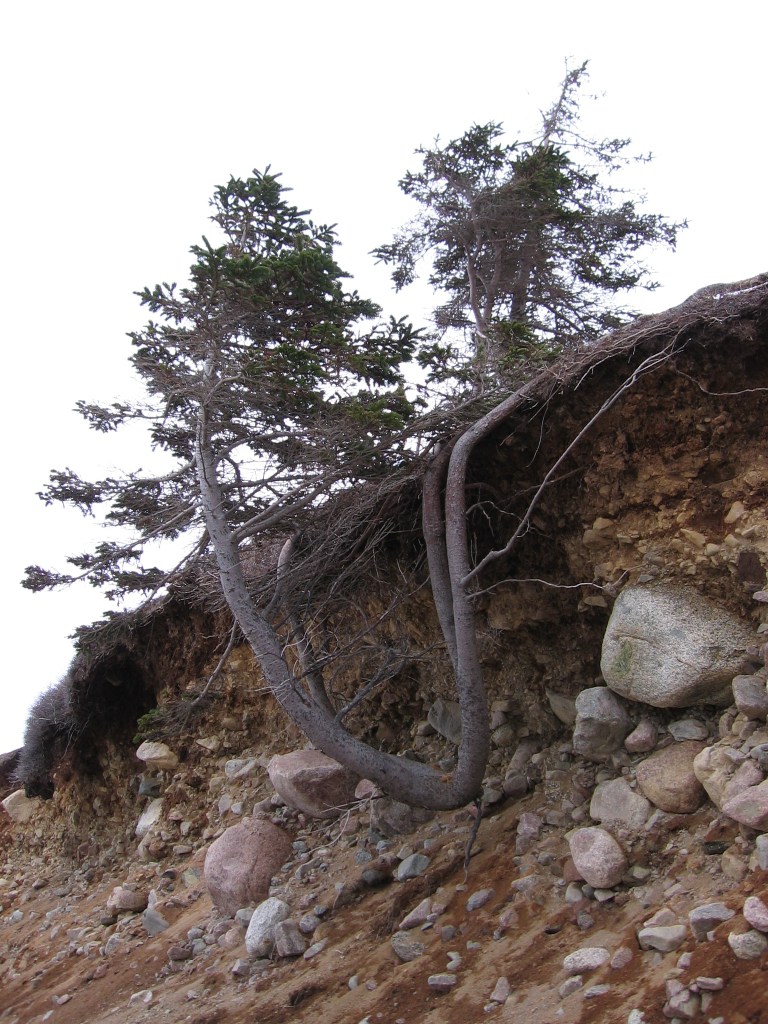
This tree along the shore was incredible. The bank of glacial till where it was growing kept eroding year after year. I’ve watched many trees topple over the edge as the ocean washes away the ground beneath them, but this spruce hung on, clinging to the barest of soil with its root tips. It was heading down for a time but made a u-turn and found its way back up. It lived like this for many years before finally succumbing to gravity. Bravo!

There are some trees whose contortions defy explanation – at least to me. The tree below is so unobtrusive, quietly growing among the other spruce, that it’s easy to miss this little forest miracle.


Sometimes, as I’m making my way through the woods, the way ahead seems clear and I feel confident and sure of my direction. Other times I really can’t see the forest for the trees and I feel uncertain of the way forward. I might have to double-back or detour or even give up and turn back, as described in The Humbled Hiker. These experiences are a reflection of life itself, for me, for these trees, for all of us.

Robert Hunter described it best in his lyrics for the Grateful Dead song Truckin’. Trees can’t go truckin’, but the words could have been written for them as well as for you and me.

Sometimes the light’s all shining on me
Other times I can barely see
Lately it occurs to me …
What a long strange trip it’s been

There are times on our life journey when we feel confident of the way ahead, even if it’s difficult and challenging. But there are other times when we feel lost and confused and don’t know which way is up, let alone how to move forward. It’s during troubled times we can learn a life lesson from these remarkable trees.

So if life’s got you down and you don’t know which way is up, hang in there and keep on going. It may take a while, but eventually you will find your way back up into the sunlight.

Sue McKay Miller
December 19, 2023

And it’s so hard to figure what it’s all about
When your outside’s in (inside out)
And your downside’s up (upside down)
And your upside’s right (right side up)
Don’t it make you wanna twist and shout
When you’re inside out

     – The Traveling Wilburys

Ma Nature’s Seaside Art Gallery

Well, that’s a wrap. Earth just passed the autumnal Equinox on her annual journey around Old Sol. It’s time to rinse out all my salty beach gear and stow it away for yet another year. It was a soggy summer here in Cape Breton and beach days were few and far between, but all the more special for that. And, as always, every visit to the shore yielded up its own treasures.

I wrote about the beach creations people leave behind in At the End of the Day. People of all ages create for the simple joy of creating, knowing that their sand castles, stone towers and driftwood sculptures will vanish with the tide. But in this blog I’m focusing on a different type of beach art: The random beauty of shells and stones and seaweed, of jellyfish and driftwood washed ashore. So take a stroll with me through Mother Nature’s Seaside Gallery, an accidental art display that is ever-changing and never fails to delight.

Natural shell necklace strung along a strand of seaweed.

Jellyfish Jewels

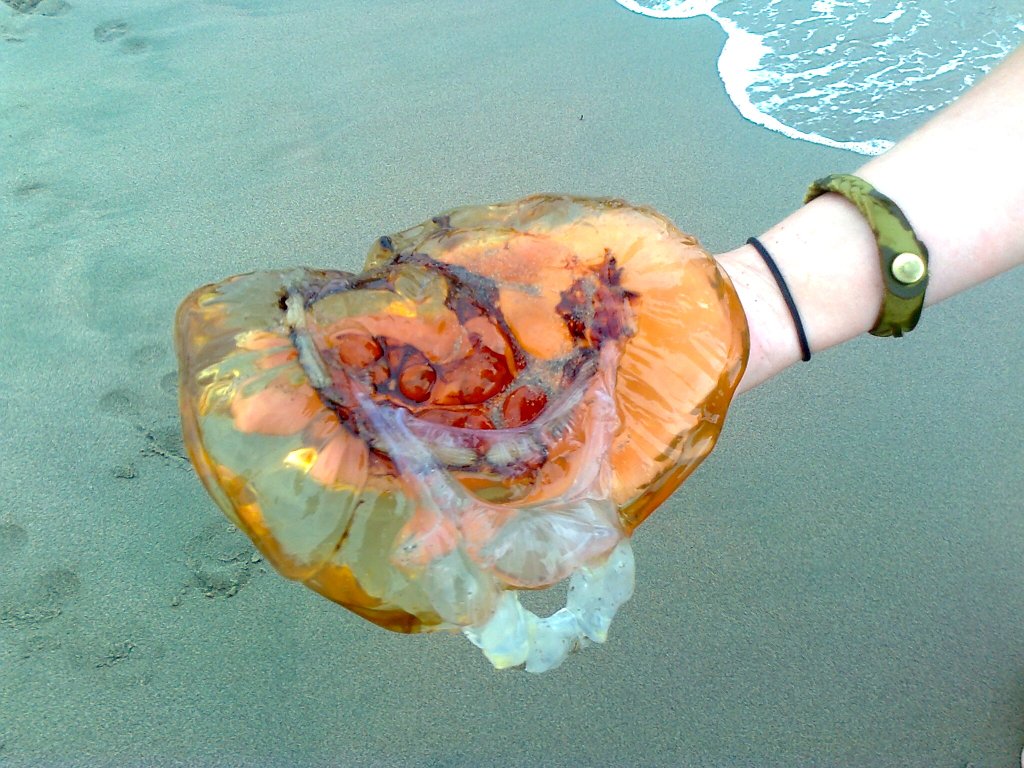
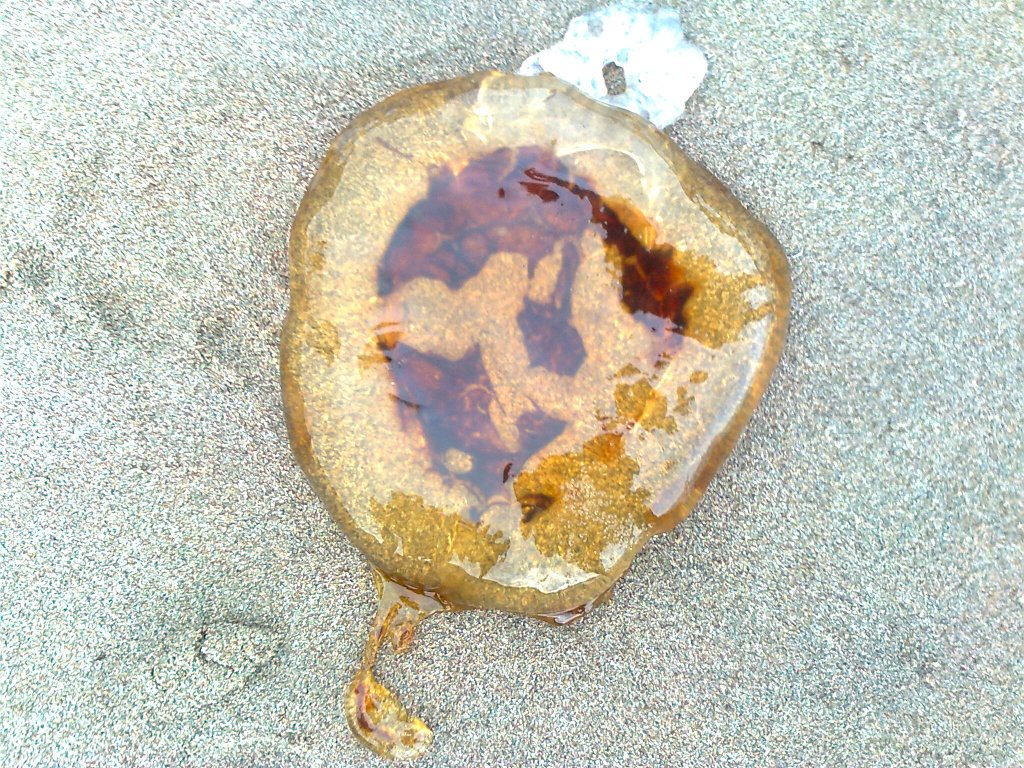
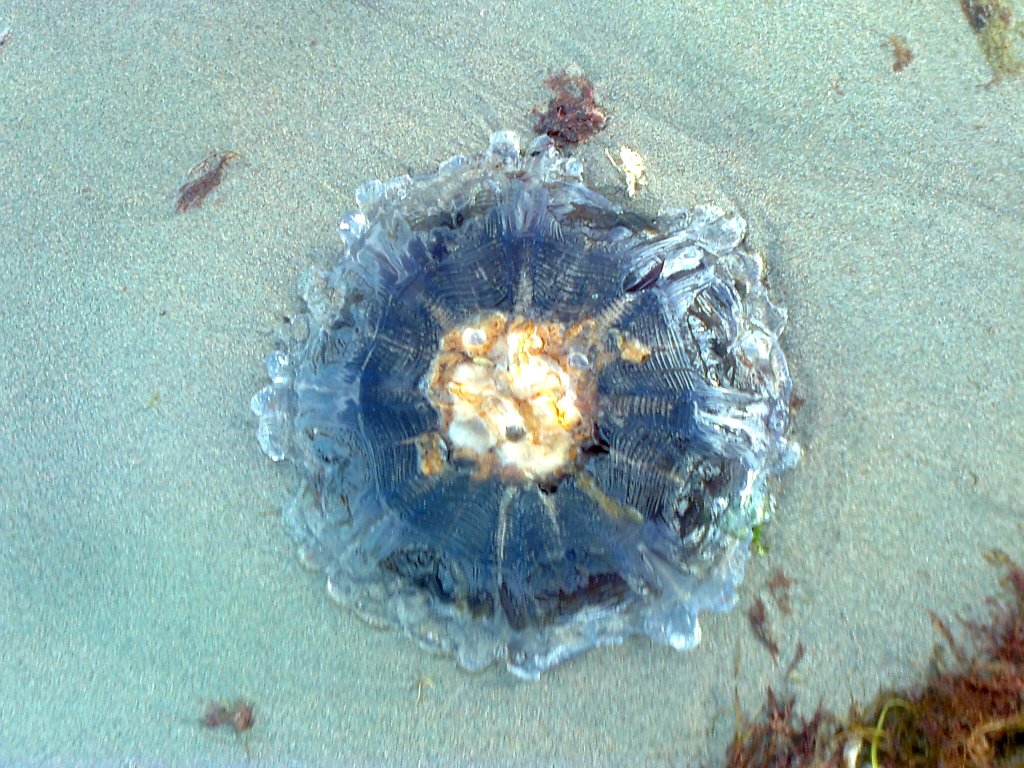
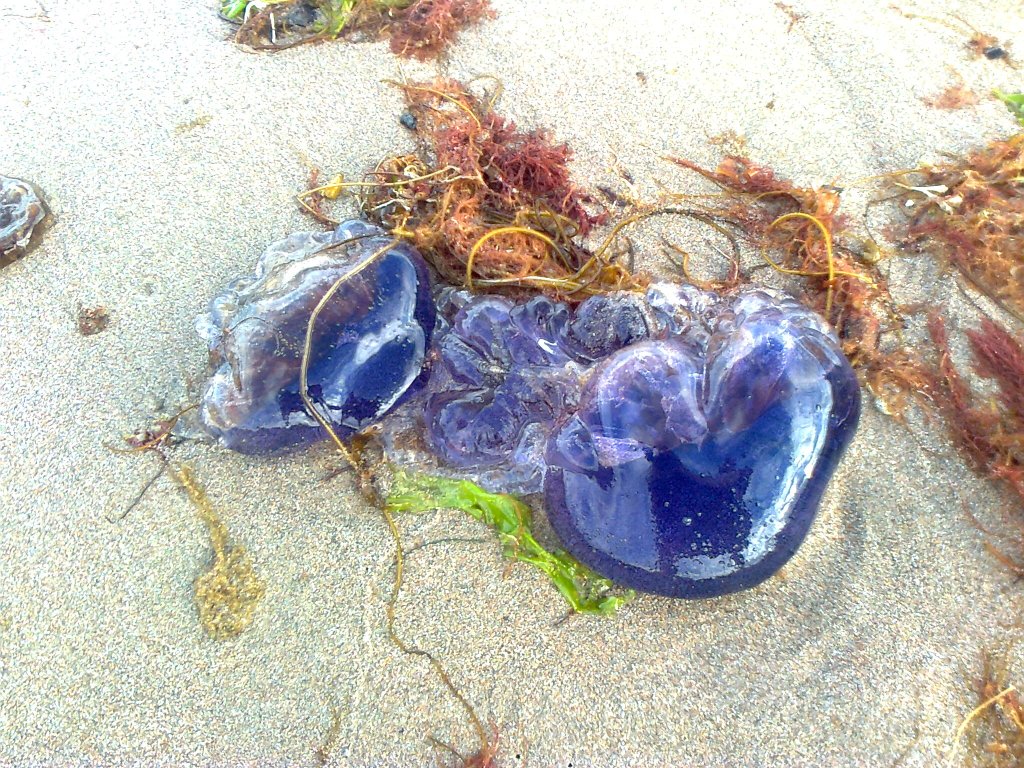
We don’t love jellyfish at the local shores. There are some that are benign, like moon jellyfish, but it’s chiefly the lion’s mane jellyfish that arrive here in July, wafted along on warm ocean currents. They are graceful and otherworldly as they swim, opening and closing their maroon bells, long tentacles streaming behind. But watch out – there’s a sting in that tentacle! Swimmer beware when you spot dark red blobs bobbing in the waves.

Luckily the jellyfish invasion doesn’t last long, and we humans can enjoy swimming in the sea sting free. As the jellies die and wash ashore, they transform through a tantalizing array of jewel-like colours: amber, amethyst, sapphire and topaz. Click on the little photos to see these jelly gems full size.

Tapestry and Lace

We also aren’t overly fond of seaweed. It can wash ashore in huge piles that get a wee bit ripe as they rot, not to mention spawning flies. But a little clump of seaweed can be a thing of beauty. Purple dulse, vivid green sea lettuce, and the browns, greens and golds of kelp, are woven by waves into a tangled tapestry.

A jelly jewel accents this tangle of colour and texture.
A lovely lacy view of sea and sky!

Seaweed Scribbles

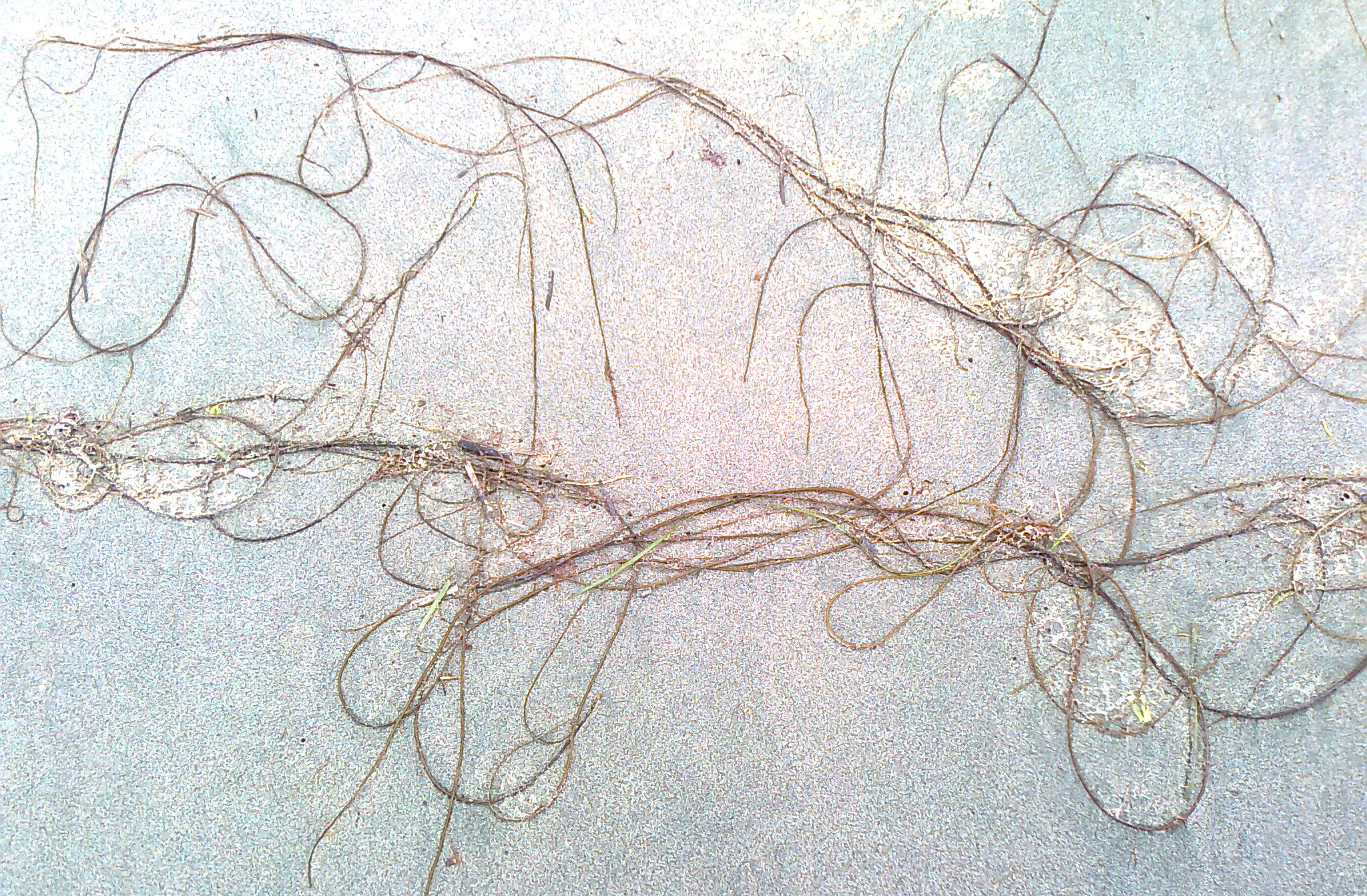
Sometime the sea writes in a cursive script, a mysterious message to be decoded by the curious beach walker.

Is this some secret script?
… or a fanciful line drawing?

Sea Monsters

Some seaside gallery creations are beautiful, some are suggestive, but some are downright spooky. Humans have always imagined that monsters dwell in the deeps, and sometimes they crawl out of the sea and onto the shore.

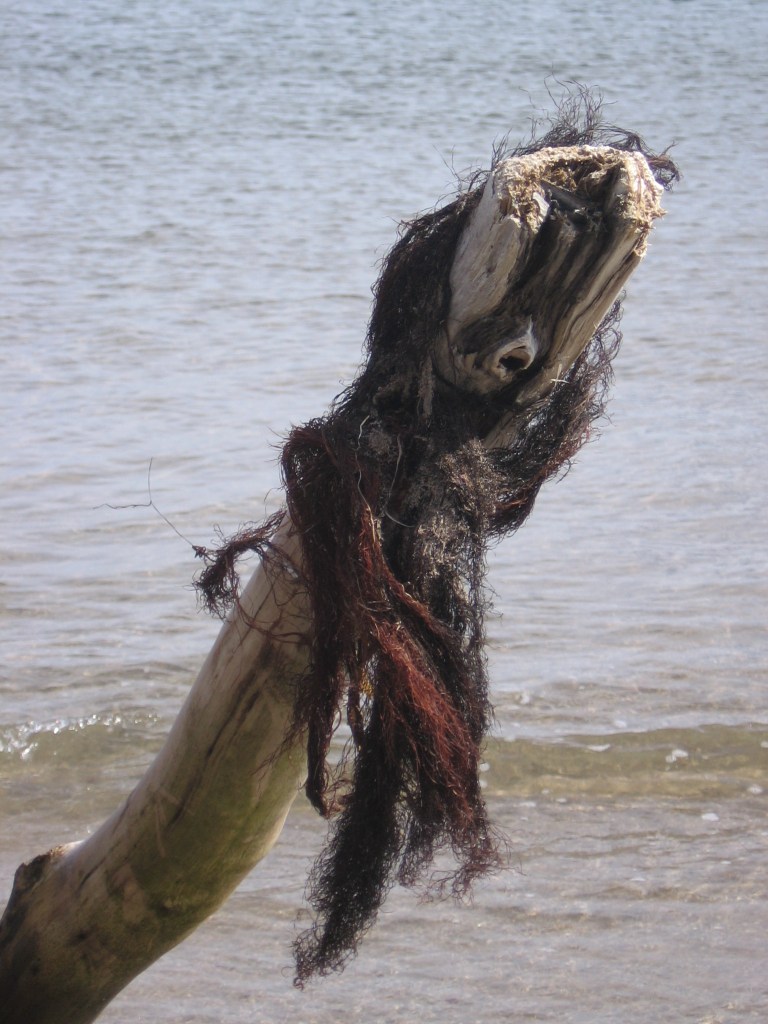
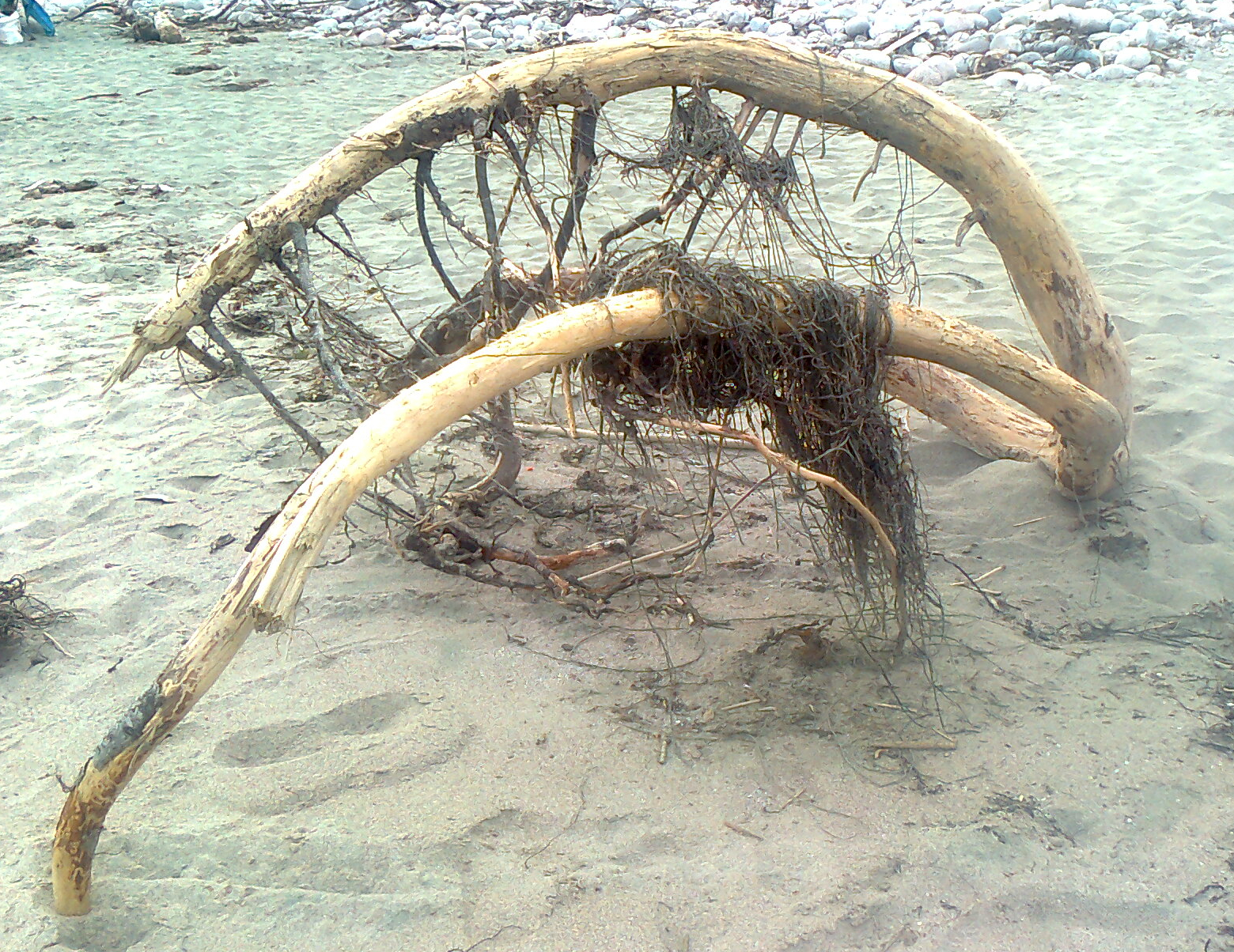
When seaweed wrapped itself around a semi-submerged tree trunk, it reminded me of the wooden masks I saw in Bali – frightening faces draped with coarse black hair. Could this be Ranga, the demon queen?

What sea creature is this, rising from the waves?

Big mounds of seaweed get washed ashore and then are eroded away by waves and tides into creepy shapes.

What body lies buried here?
This monster looks like it’s trying to crawl back into the sea …

Rock Art

There are so many wonderful rocks in Cape Breton that I wrote a whole blog about them in Stones I have Known. So I’ll try not to get too carried away here, but I just had to include a few arty rocks in this seaside gallery.

These rocks are all dressed up with nowhere to go. Gypsum is a soft rock, easily carved by the sea. The crevasses and creases in this gypsum boulder have been draped in seaweed to create a striking sculpture in black and white.

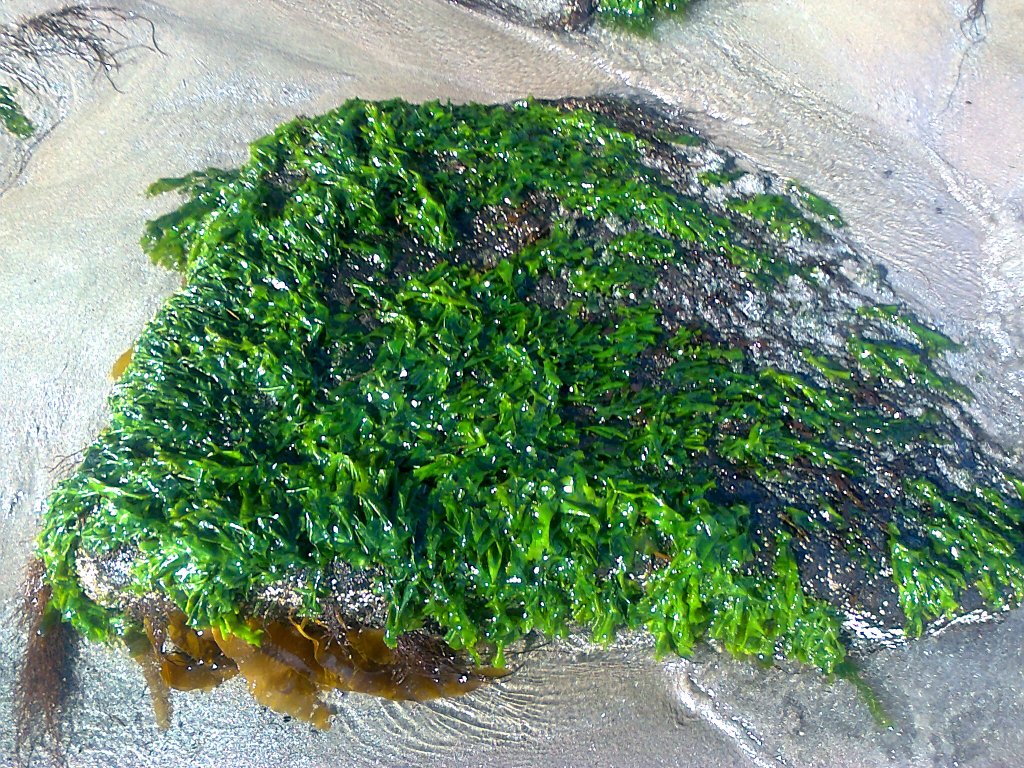
Living sea lettuce is attached to this intertidal boulder. Not only is it a gorgeous green, it’s actually quite yummy.


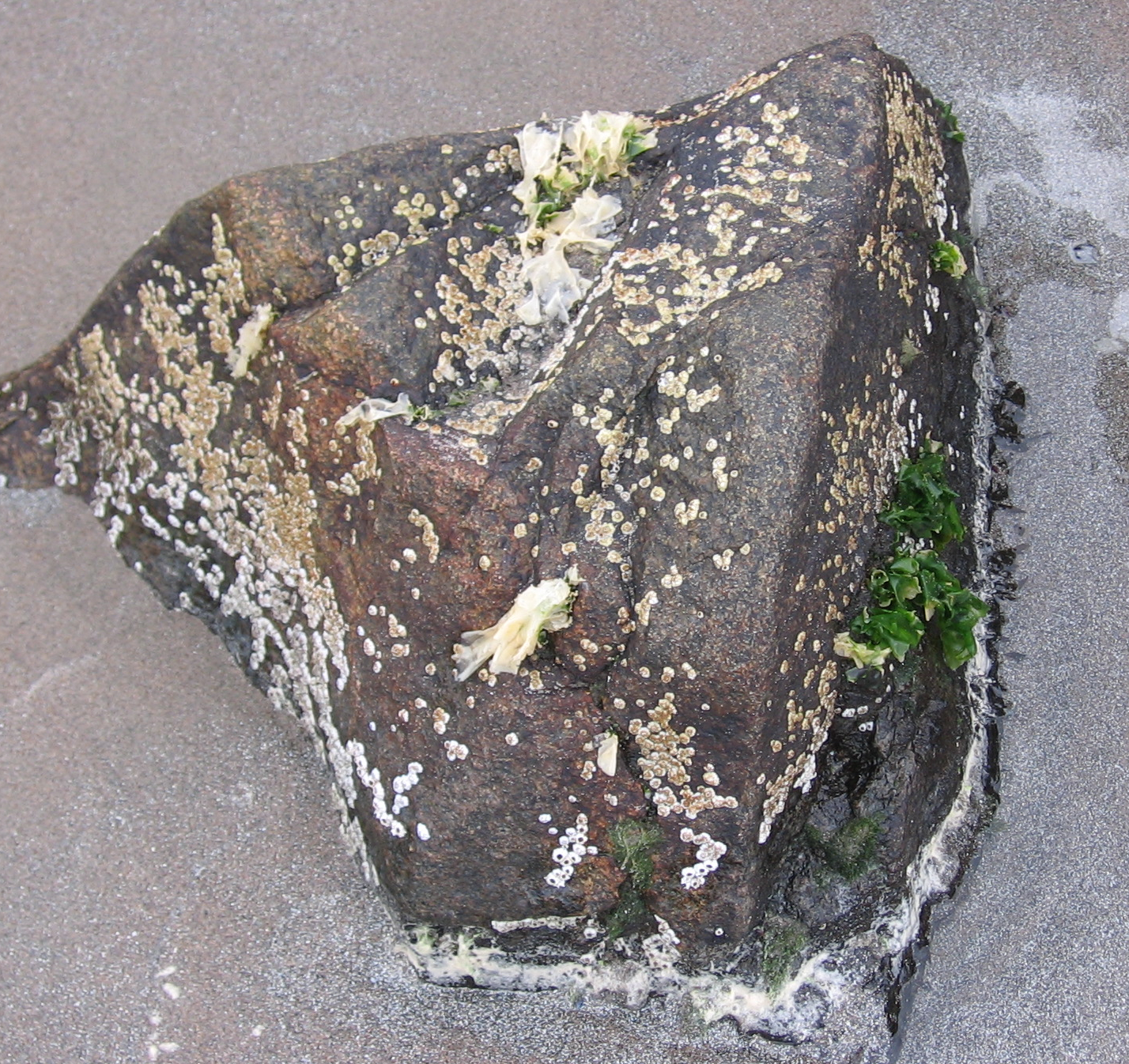
Barnacles are little crustaceans that find something they like and then stick to it. The wee animals add a touch of pointillism to the pink and green rocky canvas on the left, but they took over the whole show on the right.

A few more mixed-media pieces. This finely sculpted rock on the left sports a smattering of seaweed fronds as well as artfully applied dashes of barnacles. On the right, lichens and periwinkles combine in a tidal puddle to create an image of … something.

Rock Paintings

Like many people, I am in awe of the cave art created by our early ancestors. Somehow the patterns and colours on these boulders remind me of those ancient masterpieces. Nature paints with minerals and chemistry to create abstract art that endures.

Is that ‘N‘ Ma Nature’s signature on this arrow rock? Onward and upward we go!

Driftwood Creatures

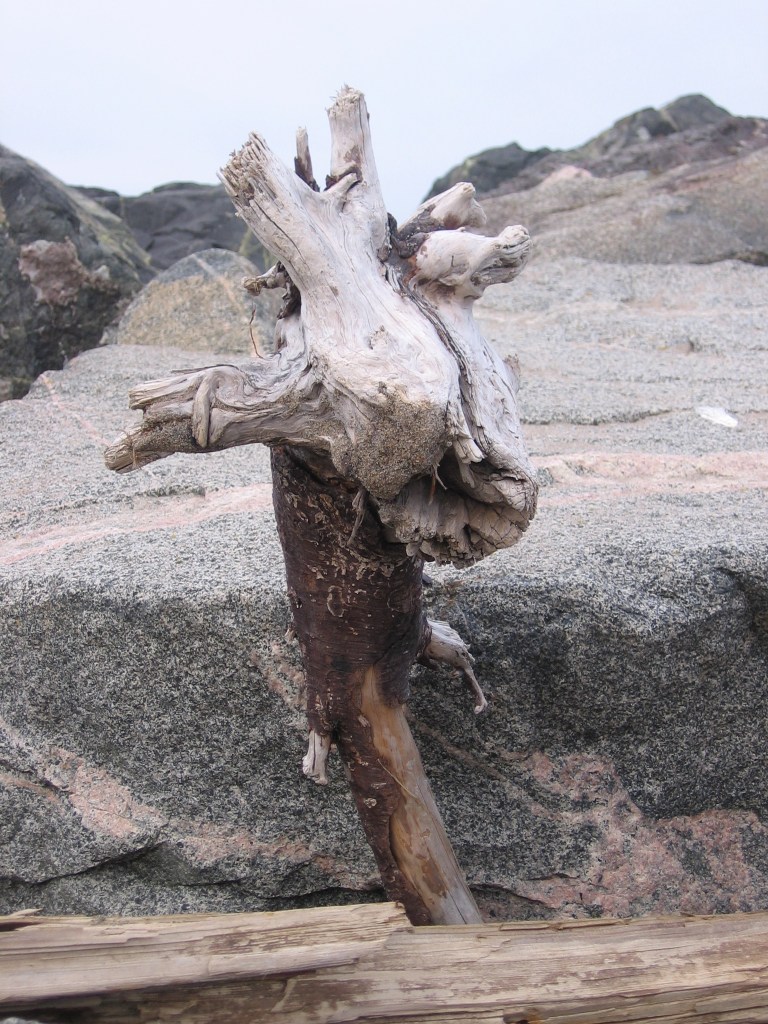
Wood that finds its way into the ocean is sculpted by the sea. Branches and even whole trees are carried down rivers during floods and out into the waves where they are tossed and tumbled, smoothed and shaped, before they drift back ashore, transformed. Like pictures we see in clouds or rocks, driftwood can become all manner of things in our mind’s eye.

A sea horse? I set this piece up against the boulder – so nice with those lovely pink stripes!

Patterns in the Sand

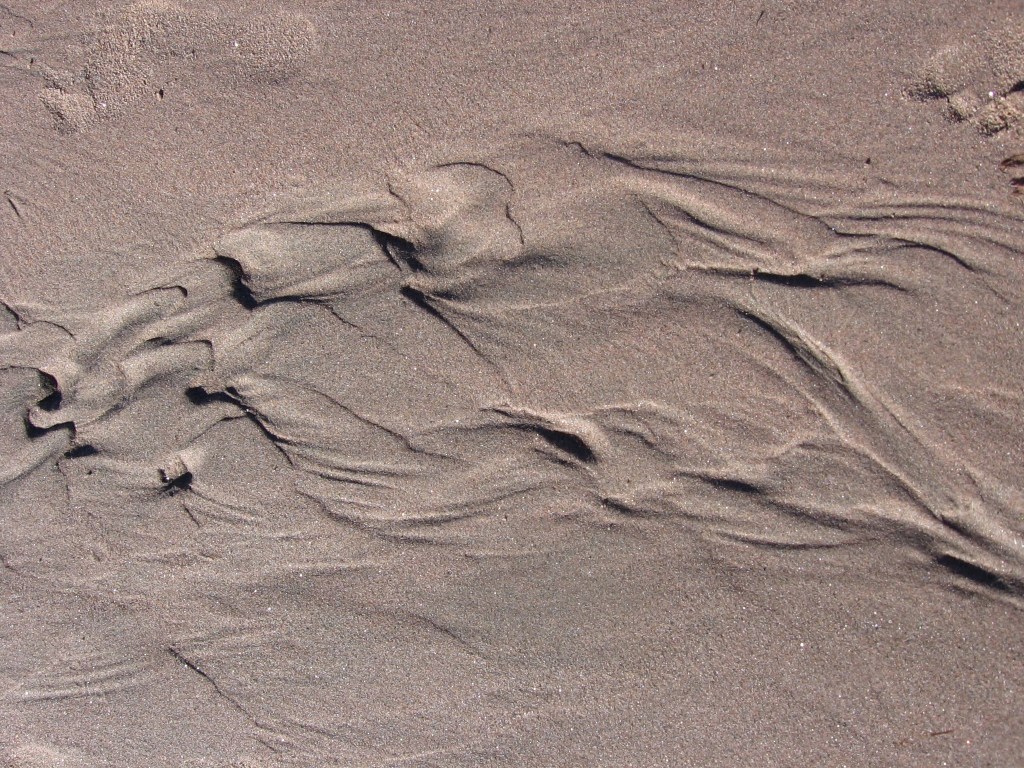
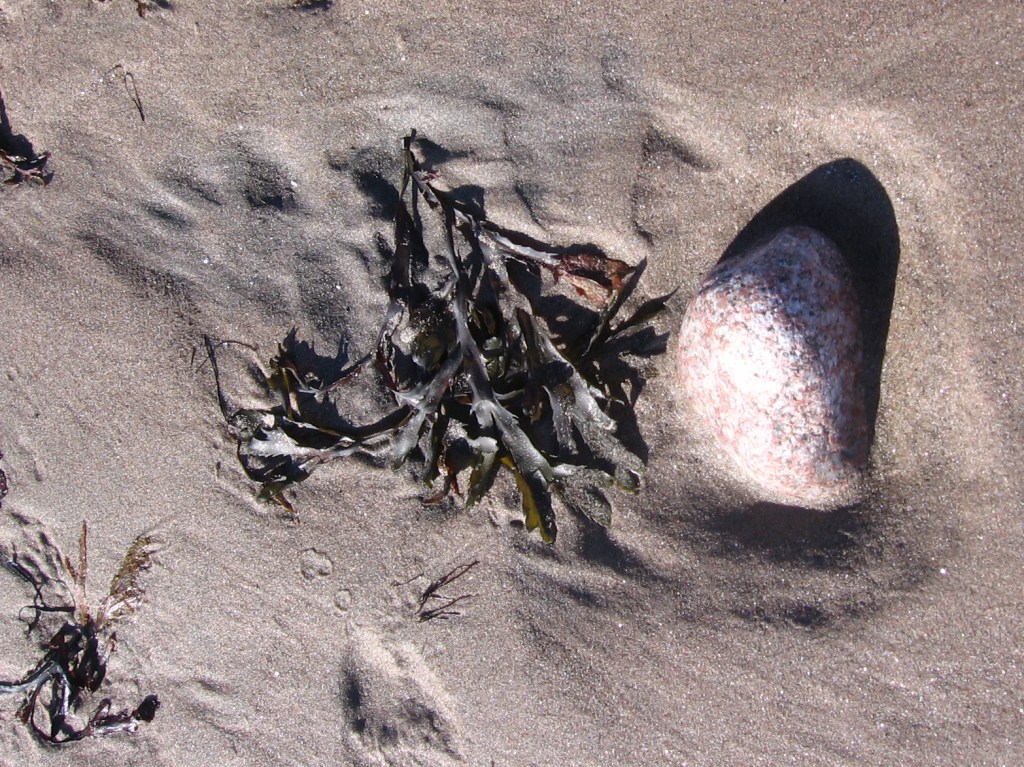
In my blog Winter’s Art Gallery I marveled at the patterns and textures nature creates with ice and snow. Sand is also sculpted, by wind and wave and tide, into elaborate patterns as beautiful as they are transient.

Alas, like ripples in the sand, summer is all too transient. It’s always hard to let go of the seaside season. It’s so short and so very sweet. But here in the Holler the last hummingbird has headed south and the first leaves are turning scarlet. The forest begins to beckon, a place full of more natural treasures to be discovered and savoured. Happy Autumn!

Sue McKay Miller
September 30th, 2023

To everything, turn turn turn
There is a season, turn turn turn


– The Byrds, riffing on Ecclesiastes

To everything, tern tern tern
There is a season, tern tern tern


– Me, riffing on the Byrds, whenever I see a tern

p.s. After a soggy summer we are enjoying a sunny fall, so I’m back at the beach after all!

April – Awful or Awesome?

‘April is the cruelest month.’

Thus wrote TS Eliot, and many a Cape Bretoner would agree, choosing this time to travel off the island. But I love April. Well, I kind of love it. I certainly wouldn’t want to miss it. Because April is the month of transformation. It is a month of many firsts but also many lasts. April in Cape Breton is not quite winter anymore but it is not yet spring. It is the time of transition, when there is something new every day. Beginnings and endings – sometimes all in one day.

I was snowshoeing along the riverbank in mid-April and saw an eagle soaring and circling overhead. She (or he) alit atop a lone white pine, high up on a cliff above the river, carrying a stick in her talon. It was the same tree where I’d seen a pair of eagles mating the year before. (I think I was more excited than she was!) Was she building a nest? And me without my binos. (An admission that, while I like to watch and identify birds, I am not a bona fide birdwatcher).

Two days later I returned, binos in hand. But what a change. There were bare patches here, slushy snow there, and other places with deep snow going ‘rotten’. I kept breaking through – a sure sign that snowshoe season is over. Time to admit it and put the snowshoes away. Still, I made my awkward way to the river’s edge. No eagle in sight and from my vantage point far below I still couldn’t tell if the pine bough was supporting a nest. I’d risked a twisted ankle for nothing. But no. Because a cluster of coltsfoot was growing out of the bank across the river. So the last snowshoe and the first flowers, all in an afternoon. From Awkward to Awesome – that’s April all over.

April is Amazing. Every year I marvel as I watch the Albedo effect in action. One morning I looked out the window and saw a snowy slope with a few bare patches around the trees. The next day – literally – I looked out the same window and saw a bare slope with a few snowy patches. I wrote about this runaway process in April and the Albedo Effect. It happens on land, speeding up the snow melt, and on the pond, speeding up the ice melt as the darker water absorbs more heat that the snowy ice.

April is the sound of rushing water. Highland snowmelt roars down cascading waterfalls and turns tame rivers into raging torrents. Water fills freshets and swells brooks that babble down the hillsides. Water pours into L’il Pond, over the ice and the snowy banks, lifting and encircling the ice as I described last month in The Colours of Winter. I love to hear the sound of rushing water because it is the sound of life. Life returning, life reviving, life renewing.

This year the transition was amazingly abrupt. One day I was snowshoeing all around the edge of the frozen pond, up and down over the hummocks of ice-covered bushes. Two days later the spot where I was standing when I took the photo on the right was under water. Three days later everywhere I’d been that day was under water and only a thin slab of floating ice remained. That process here is natural and normal, but it’s a reminder of just how quickly things can change when they pass a certain tipping point.

But the melt reveals the not-so-awesome aspect of April. That beautiful white blanket of snow is whisked away, revealing all the messiness beneath. Broken branches, old stumps and rotting logs, bare bramble bushes. The colours are drab: the greys and browns of bare trees and shrubs, of dead grass strewn with dead leaves and dead weeds. Only the dark green conifers, bright green mosses, and red maple buds add colour to the landscape.

Until … I actually yelped with delight when I stepped outside one day and saw the bright sunny faces of coltsfoot below the house, early bloomers that were immediately visited by the first bees. And while April may look unappealing to my eye, those rotting logs and stumps and leaf litter are actually nature’s nurseries for emerging life.

April is the time of Arrival. I see the first dark-eyed juncos and the first robin redbreast. The first birds fill the air with the first bird songs. As I sing in my Spring Ditty, ‘some ducks dabble and some ducks dive, but it means it’s spring when the ducks arrive.‘ And arrive they do, as soon as there is open water on the pond. I looked out one morning last week and saw a pair of goldeneye ducks diving and a pair of black ducks dabbling around in the submerged bushes. The male goldeneye was wooing his partner with courtship displays. Love is in the air in April.

Some animals head south for the winter and return in spring, but other just slumber the winter months away. For them, April is the time of Awakening. Squirrels never sleep (or so it seems) but hibernating chipmunks come out from down under and scamper around. Frogs that were literally frozen are thawing out. I heard a few tentative wood frogs the other evening, and the spring peepers are never far behind. (For more on frozen frogs and how Froggy goes a-courting, check out Funky Frogs.)

So April is Audible. After the deep silence of winter, the sounds of spring begin to fill the air. The roar of rushing water, the first bird songs and first frog calls, the first buzzing bees in search of the first flowers.

April is the month after the Vernal Equinox in March, the official start of spring. But it is the month before spring really arrives in Cape Breton. We won’t be going green until Mid-May, when the trees will leaf and many more wildflowers will burst into bloom. May is when we hear fishing boats in the bay as lobster season gets underway, and the shops that were shuttered will open as we emerge from our winter hibernation. But that is May. Not now, not yet.

So April is the month of Anticipation. This time of transition, of melting snow and vanishing ice, of budding trees and pussy willows, marks the end of one season and the beginning of another. April isn’t quite spring in Cape Breton, but it is the promise of spring. And I’d say that’s pretty awesome.

Sue McKay Miller
April 30, 2023

p.s. I posted this Spring Ditty in April 2021 with photos and a bit of commentary, but I’m tucking it in here because it really sums up April in the Holler. I sing it every year – with gusto!

Spring Ditty

Dark-eyed juncos jumping all around
picking up tidbits off the ground.
Red-breasted robin sings a cheerful song
and winter’s snow
is almost gone.
And it feels like spring is coming to the Holler
Don’t you think that we should sing and holler?

Well the other night I heard a little frog peep.
No one replied so he went back to sleep.
But the ice is melting and it won’t be long
’til that froggy pond
is filled with song.
And it feels like spring is coming to the Holler
Don’t you think that we should sing and holler?

Well hey there buddy budding on a tree,
thanks for the things that you do for me.
And to every little shoot and every little sprout
I’m so glad
that you’re coming out.
And it feels like spring is coming to the Holler
Don’t you think that we should sing and holler?

Well some ducks dabble and some ducks dive
but it feels like spring when the ducks arrive.
And the snow melt grows the pond into a lake
as the sleepy Holler
starts to awake.
And it feels like spring is coming to the Holler
Don’t you think that we should sing and holler?
Don’t you think that we should scream and holler?

Maple flowers in April.

The Colours of Winter

Cape Breton boasts a coat of many colours. From the bright greens and colourful wild flowers of spring, deepening into the mature greens and late bloomers of summer, and climaxing with the spectacular flaming foliage of fall. This glorious palette is set against the brilliant blues of sea and sky.

Winter has its own special beauty, featuring wind-sculpted snow drifts, lace spun from ice, and abundant patterns and textures illuminated by light and shadow. I explored this aspect of winter in Winter’s Art Gallery. But for all its icy beauty, Winter seems to specialize in monochrome, like a photographer who works in black and white, or a blue-period Picasso.

This is a colour photo but you wouldn’t know it.

And yet there is colour in winter, all the more special because it stands out against winter’s white. So here is another wintry art gallery, this time focusing on the colours of winter, captured over the years here in the Holler. I hope these colours brighten your day as we make our way toward Spring Equinox. And remember, you can click on small pics to see them full size.

Digging the Winter Blues

Winter days are not always grey, and on sunny days those blues really pop when contrasted with bright snow white. What makes that sky so blue?

The short answer is Rayleigh scattering. We know that visible (white) light is composed of a spectrum of colours, displayed in rainbows and light refracted (bent) by a prism. Light has wave-like properties, and the red end of the spectrum has longer wavelengths while the blue and violet light have the shortest wavelengths. As yellow-white sunlight enters our atmosphere it interacts with air molecules and the waves are scattered. Short wavelengths are scattered the most and thus give the sky its blue colour. (Violet is the shortest wavelength, but there is more blue in sunlight and our eyes are more sensitive to blue.) At sunrise and and sunset, the light travels through more atmosphere. The blue light is scattered away, leaving the longer wavelength reds and oranges to delight our eyes.

Drift ice on the deep blue sea.

Why is the Ocean Blue?

Of course water reflects light like a mirror, as in this photo from Dogs and Drift Ice. But water also filters sunlight. Water molecules absorb more long-wavelength reds and oranges and leave behind the shorter-wavelength blues and blue-greens. So while a glass of water appears colourless, water does have a blue hue that we can see when looking into deep bodies of water like the ocean. Divers observe this blue light because it penetrates deeper into the water than long-wavelength red light.

Winter’s Pond Art

I feel very lucky to live above a pond that offers something for every season. I’ve written about L’il pond and its various inhabitants a number of times, but winter is a surprisingly dynamic season for this little body of water. It goes something like this: Ice forms on the surface as temperatures drop. Snow blankets the ice. Under the ice, just as in summer, (see Ups and Downs in the Holler) water continues to drain out through the permeable soil. As water levels drop the ice eventually collapses under its own weight, sometimes cracking like a rifle shot, other times slumping with a whump.

Pond ice collapses as water levels drop

But of course, this being Cape Breton, sooner or later everything changes. It rains buckets. Or we get a warm spell and a big snowmelt. Or both. Rain water and snowmelt from the highlands pour into the pond, raising the water level. Some ice may be frozen to the ground, but most of the ice surface will be lifted by the rising water. This is one of the miracles of water – most matter is denser in solid form, but ice is less dense than liquid water and thus floats, enabling aquatic life to survive winter’s deep freeze.

So the ice rises along with the rising water, but the ice surface is now smaller than the expanding pond perimeter. Water flows around the edge of the ice, over grounded ice, and collects in low-lying melt-water pools. And it is in these places where water and light do their magic dance.

Over the years I have enjoyed a gorgeous array of colours. The three photos below are all of the same place, just below the yurt where I lived for eight years.

A pool like an
ammonite,
a spiral
shining with the
nacre sheen of
mother-of-pearl.

Oh wait!
Now that same
pool is an aquamarine gemstone!

And now, transformed yet again, it’s like an amulet for a giant,
carved from jade.

So if water is true blue, why does it display such a kaleidoscope of colours?

This is a multi-coloured question with a multi-faceted answer. I’m no expert on optics – you could even say I’m walking on thin ice – but here is my best shot. (As always, I welcome your comments and corrections.) Water can take on a variety of colours due to light being reflected, filtered, or scattered; by suspended particles like silt or clay; by dissolved substances like iron or copper; or by microorganisms like bacteria or algae. Or, just to keep things interesting, by some combination of the above.

Take mountain lakes, like Moraine Lake in Alberta, featured on older $20 bills. These lakes are famously turquoise from ‘glacial flour’, finely-ground rock particles suspended in the water column. The rock particles scatter light in the blue-green part of the spectrum, and some is scattered back to the surface to our appreciative eyes. So, suspended particles + light scattering = turquoise lake photo op.

Rivers can be muddy brown or reddish from suspended silt or clay (like ‘The Big Muddy’ Missouri River). If the silt or clay settles out, the water will become clear. Conversely, substances that dissolve in water give it intrinsic colour. Think of rushing rivers in spring, tawny with the dissolved tannins released by decaying organic matter. Water with high iron content may look pale yellow or rust-coloured. Dissolved copper from corroding pipes will give water a blue/green tinge.

Reflections on a Pond

When light shines on still water, some rays penetrate the water and are refracted (bent) while others are reflected back off the surface. Depending on your viewing angle, the water may act like a mirror, echoing the world above its surface. In winter these watery pond mirrors are neatly framed by ice and snow.

You could say this pool of water is sky blue.
And you could say this water is ‘cloudy’.
And you could say … Wait. Spruce trees are green but not that green – and a green sky?

Why is the Water Green?

I posted the photos below on Facebook and they sparked a question: ‘Why is the water so green?’ I’d always attributed the pond’s wintry colours to light reflecting and refracting and scattering, but that question got me thinking more ‘deeply’ about that vivid green.

L’il Pond is a lively place all summer, teeming with aquatic plants, including its namesake lilies, that die off each fall. Eutrophic bodies of water like the pond are rich in nutrients, like nitrogen and phosphorous, that allow phytoplankton to thrive. Apparently some of these single-celled algae can survive all winter, feeding from that rich nutrient bath and giving off oxygen that benefits the aquatic organisms beneath the ice. These suspended microscopic algae contain chlorophyll that can give water a green colour. Decaying organic matter consumes oxygen and releases dissolved tannins that dye the water a tawny gold or sepia brown.

Like an artist mixing paint on a palette, winter blends these watercolours to achieve a rich array of hues, from earthy ochres and warm olive greens, to gem-like emeralds, peridots, and the many shades of jade.

Why is the Water Green and Blue?

I’ve ‘reflected’ on this and here’s my best guess. The green water at the top is last year’s pond water that escaped to the surface as the ice contracted. It has that rich olive-green colour from suspended and dissolved organic matter as described above. The water on the bottom is fresh from the highlands and relatively pure. It has a crisp minty-blue colour from reflected and scattered light. As the fresh water mixes with the older pond water, winter will blend yet more watercolours to enrich its paintings on the snow-white canvas.


The Colours of Ice

When water retains its colour after freezing, the colour must be due to dissolved or suspended matter that remains captured in the ice lattice. This gorgeous green ice supports the idea that those watery greens were not just a trick of the light.


Delving Deeper into the Blues

I’ve been lucky enough to see glaciers out west and icebergs off the east coast. Both glaciers and icebergs can display striking blues within the white. As with liquid water, both ice and snow filter white sunlight. The surface reflects almost all the light and is a blinding white, but as the light penetrates deeper, the long-wavelength reds are absorbed and the blue and blue-green wavelengths are scattered, some finding their way back to our eyes.

There haven’t been any glaciers in Cape Breton for about 10,000 years, and although we do get smaller ice floes, you have to hop on the ferry to Newfoundland to see the really big bergs. But dig a hole in a snowbank, or look into a crack in the ice, and you might detect a hint of blue.

It was more obvious to the eye, but can you see a hint of blue in this mini-crevasse on the pond?
Leaf: ‘Help! I’ve fallen into a crevasse and I can’t get out!’

Like liquid water, ice can also reflect light for subtle displays of colour, as seen here.


The Colours of Snow – the Shadow Knows (but I don’t)

Next time you’re looking at snow, take a gander at the colour of the shadows. When the sun is low in the morning sky, shadows on snow are a beautiful blue. When the sun is high overhead, they tend to fade to grey, but as the sun drops to the western horizon, the shadows stretch out and shift back to blue.

The length of these tree shadows is an indication of how low the morning sun is.
Later in the afternoon, these beautiful draped shadows are almost as blue as the sky.

Shadows occur when light is blocked – a shadow is the absence of light. When the sun is high a shadow is the absence of white light. That should make shadows black, but often there is enough reflected light bouncing into the shadow zone that they tend to shades of grey. As I described earlier, there are more long-wavelength reds and oranges when the sun is lower in the sky. When this light is blocked, the absence of red and orange light results in a blue shadow, visible on the snow-white backdrop. I think. Maybe.

But it’s more complicated than that. I’ve seen both blue and grey shadows at different times of day. What’s going on? There are a handful of differing opinions on the cause of blue shadows on the web, but which, if any, is correct? I have my own ideas, but I’m not sure if they’re correct either. This is the kind of conundrum my science-geek buddies and I use to discuss over pints at the pub. So if any of you want to join me in puzzling over snow shadows, I’ll buy the beer.

Okay, ‘nuf of dem blues – it’s time to get in the pink. There is a lovely phenomenon known as ‘alpenglow’ when snowy mountain peaks glow rosy pink at sunrise or sunset. But pink snow can be more than just a transient reflection. Algae can lend their colour to snow as well as to water, as shown in the photo below from Dogs and Drift Ice.

Feeling in the pink with watermelon snow.

Our drift ice often displays this red-pink tinge. I’d always heard the colour came from the red soils of PEI hitching a ride, but then why is the red on top of the floe? While writing that blog I learned that pink snow is caused by Chlamydomonas nivalis, a unicellular green alga that contains a red carotenoid pigment called astaxanthin. That’s a mouthful, but it goes by the wonderful moniker ‘watermelon snow’ and can also be seen in the mountains.

And just a final word of caution about the colour of snow: If it’s yellow? Don’t eat it!

Coyote calling card.

More Colourful Signs of Life

Winter snows cover grass, shrubs, mosses and such with a soft white blanket. Amphibians burrow into mud. Critters go underground or even hibernate. Many of our colourful birds fly south. All those formerly brilliant leafy trees are now bared to their buff. But life goes on in winter and sometimes brings a bit colour into our lives.

Leafy trees are winter bare but here in the mixed forest there is still greenery. Conifers may lack the pizzazz of deciduous trees most of the year, but they are indeed ‘evergreen’ and wear their subdued colours all year round. Many of our aging white spruce are draped with ‘old man’s beard’, a sage-green lichen (genus Usnea). Last year’s bird’s nest is suspended high above the snow and made mostly from this lichen. This year we’ve had barely any snow, so green things normally hidden are making a rare winter appearance.


And, of course, there are still animals out and about. While many birds head south, blue jays stay and brighten our day. Most mammals wear coats of grey or brown, but there are a few more colourful characters in the neighbourhood.

Not a fox! Our red dog Tundra also stood out as she walked across the frozen pond back in 2006.

Sunrise, Sunset

It seems fitting to end this post with sunset and its spectacular colours. Back in Calgary I used to ride my bicycle to work along the Bow River bike path. I loved those mornings when the river glowed red and rose just before sunrise. Here in the Holler I marvel at the sunset colours captured by the pond and framed by white snow and ice. I’ll leave you with these final reflections on the Colours of Winter.

Nature always wears the colors of the spirit.” – Ralph Waldo Emerson

Sue McKay Miller
March 16, 2023

p.s. Phew! Just under the wire to get this winter blog posted before we swing into spring.

Have a Happy Spring Equinox!