One Too Many

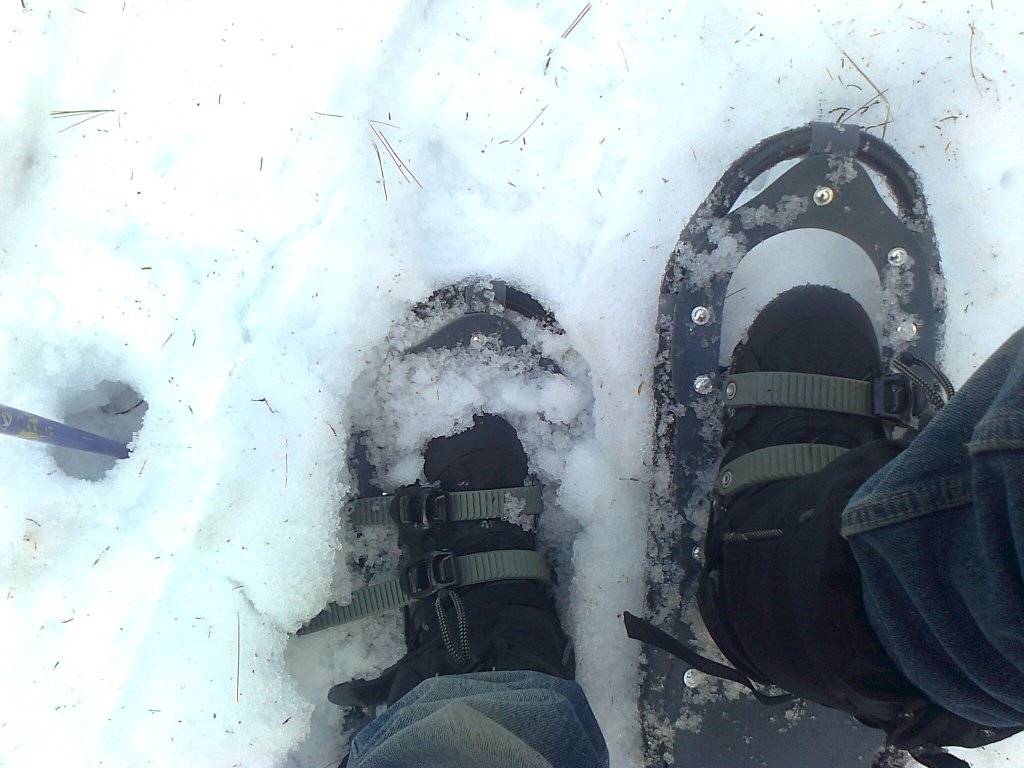
No, not that type of one too many. One too many drinks or donuts is never a good thing and usually fits under the category ‘it seemed like a good idea at the time’. No, I mean pushing a season just a bit past its best-before date. In my case, going out just one more time after that perfect hike, swim, or snowshoe at the end of the season.

Snowshoe Season

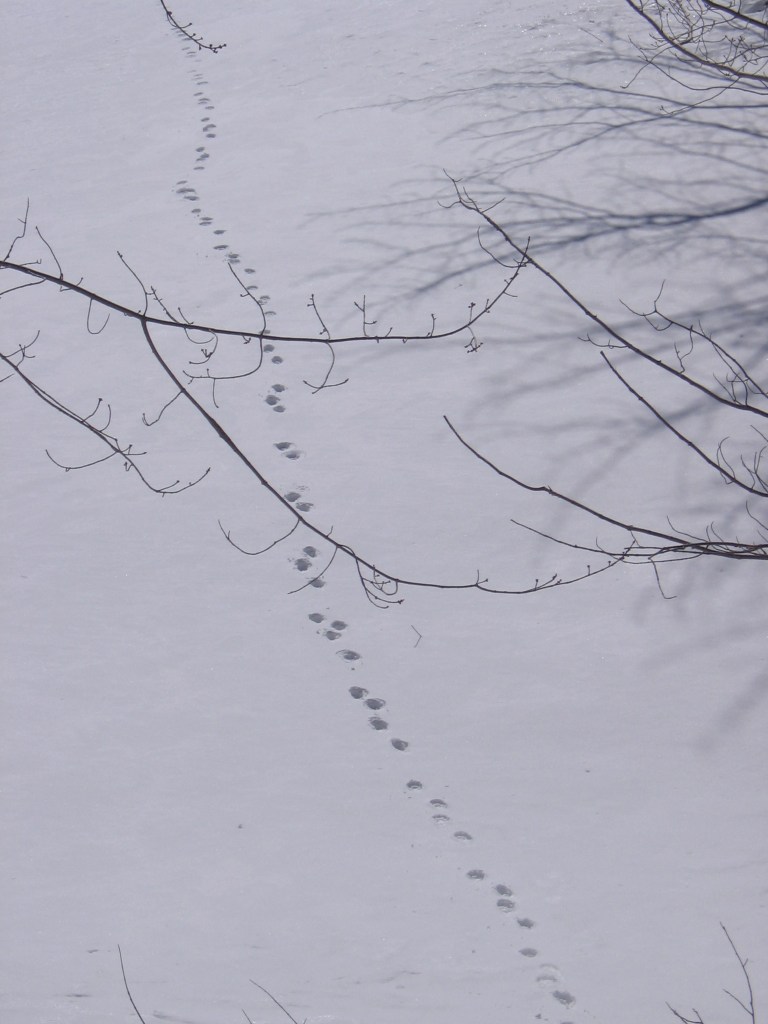
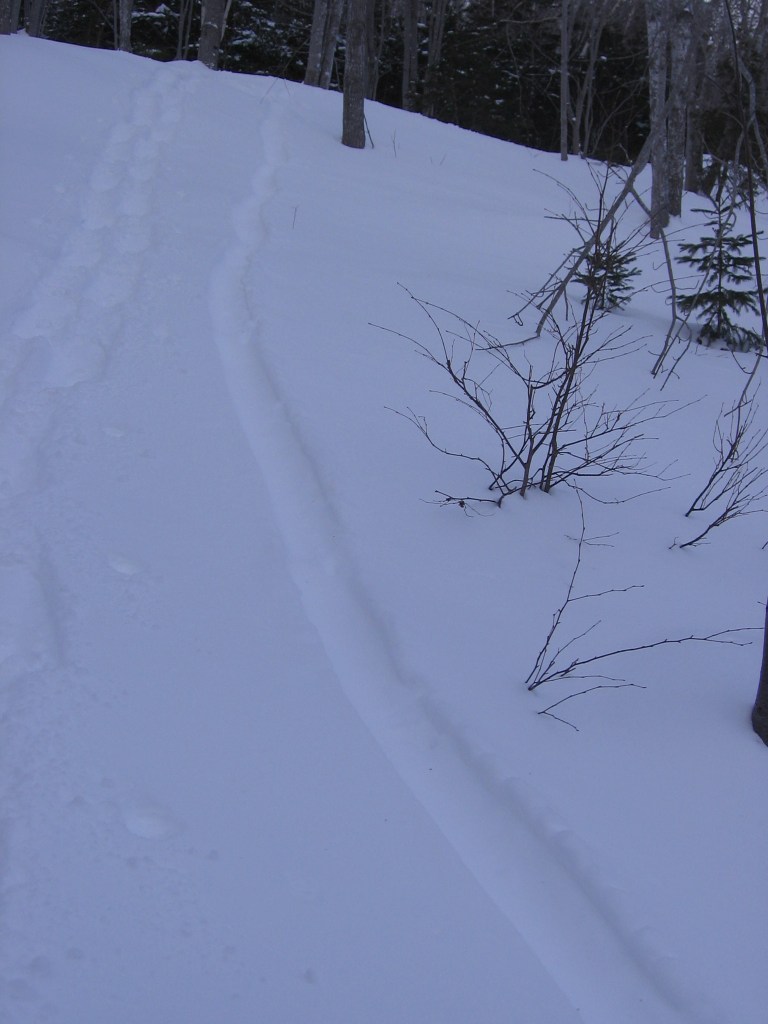
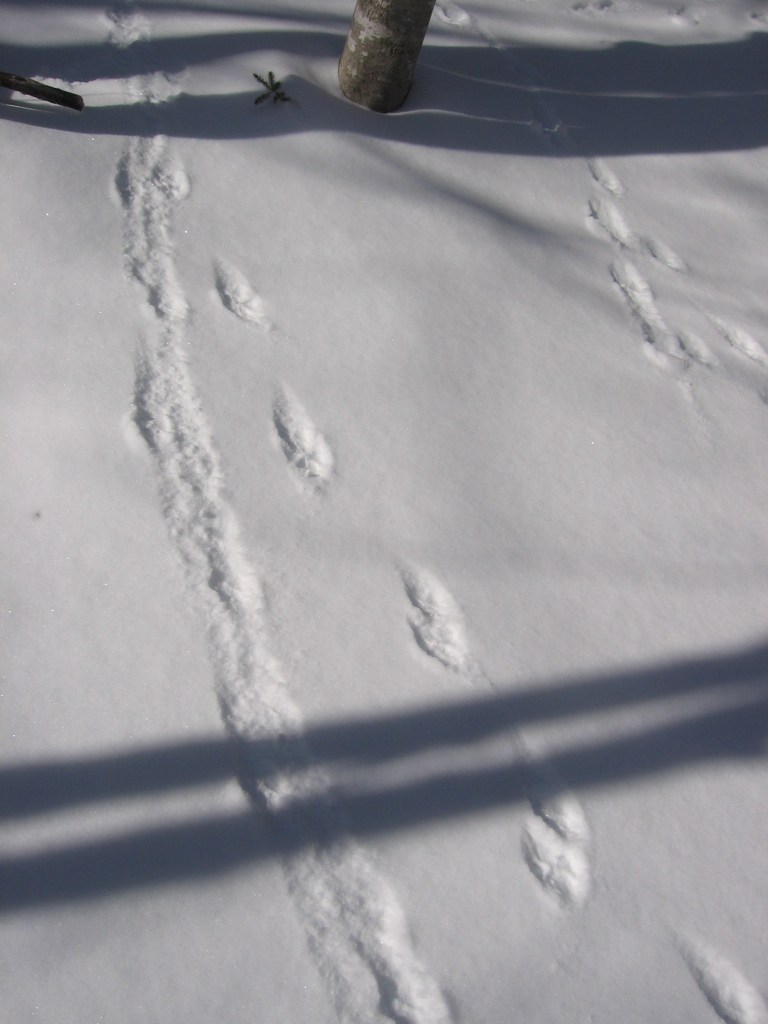
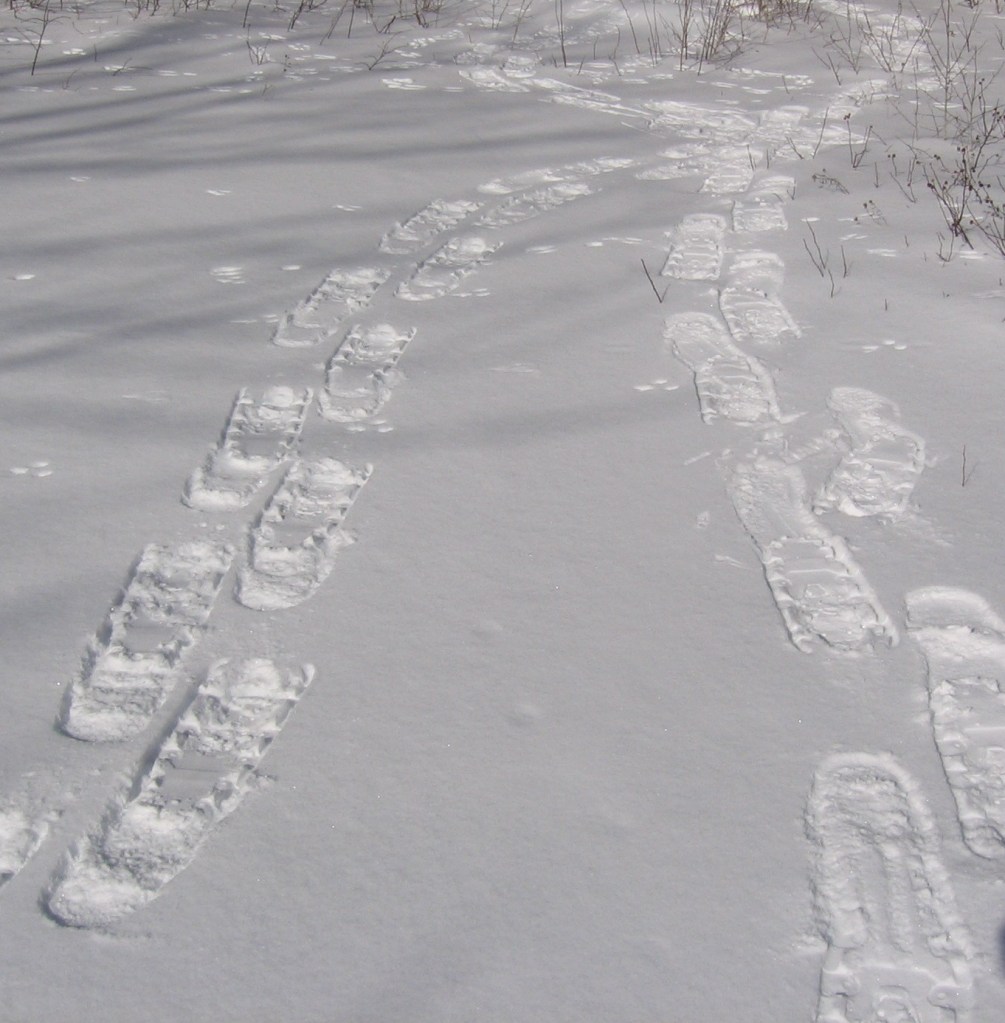
We haven’t had much snow this year, but as I wrote in The Secret Lives of Animals, my winter joy is strapping on my snowshoes and following animal tracks. With warm weather on the way I took advantage of a sunny afternoon in mid-March and went snowshoeing up the hill behind my house along an old wood road. I hadn’t gone far when I saw fresh tracks – first a pair of coyotes, then a moose. I followed the tracks up until they all fed into a narrow trail I’d cut through new growth blocking the road. I was pretty chuffed that the critters were using my trail, but it was too narrow for snowshoes, so I headed back down, past some grouse tracks. (These photos were taken a couple of days later, hence not-so-fresh or clear, and with human tracks alongside. They’re a bit better full size.)

Ruffed grouse (aka partridge) tracks in the snow.

I crossed the slope over to a trail, then went down, down, down to Little River. The river was beautiful. The boulders wore icy skullcaps and stranded branches were festooned with fairy goblets and lacy necklaces of glittering ice. I paused to admire Winter’s Art Gallery, then snowshoed downstream. Before long I spotted small tracks emerging from the open water, up a steep slope, and along the riverbank. It was a mink, I think. Next came the tracks of a coyote who’d crossed the river, and, farther along, a second coyote who’d crossed over.

By chance I found myself following in the footsteps, so to speak, of these two coyotes on my way back home. We all took the same route away from the river and through the woods, but I parted ways when their tracks went straight up a very steep slope. I was almost home when I crossed their paths again. The coyote tracks went up the hill through the forest – and then out onto the old wood road above my house. This was the same coyote pair I’d started tracking when I first set out. I’d come full circle. Perfect! It was the best snowshoe I’d had in a couple of winters.
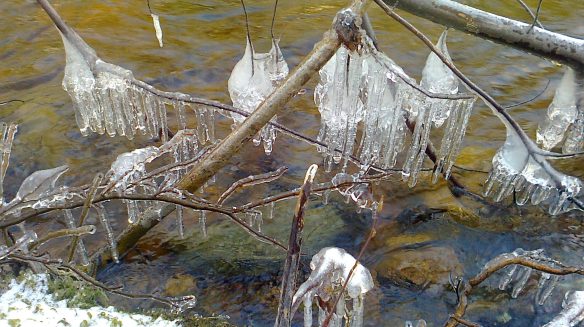
Little River ice art.

One Too Many Snowshoes

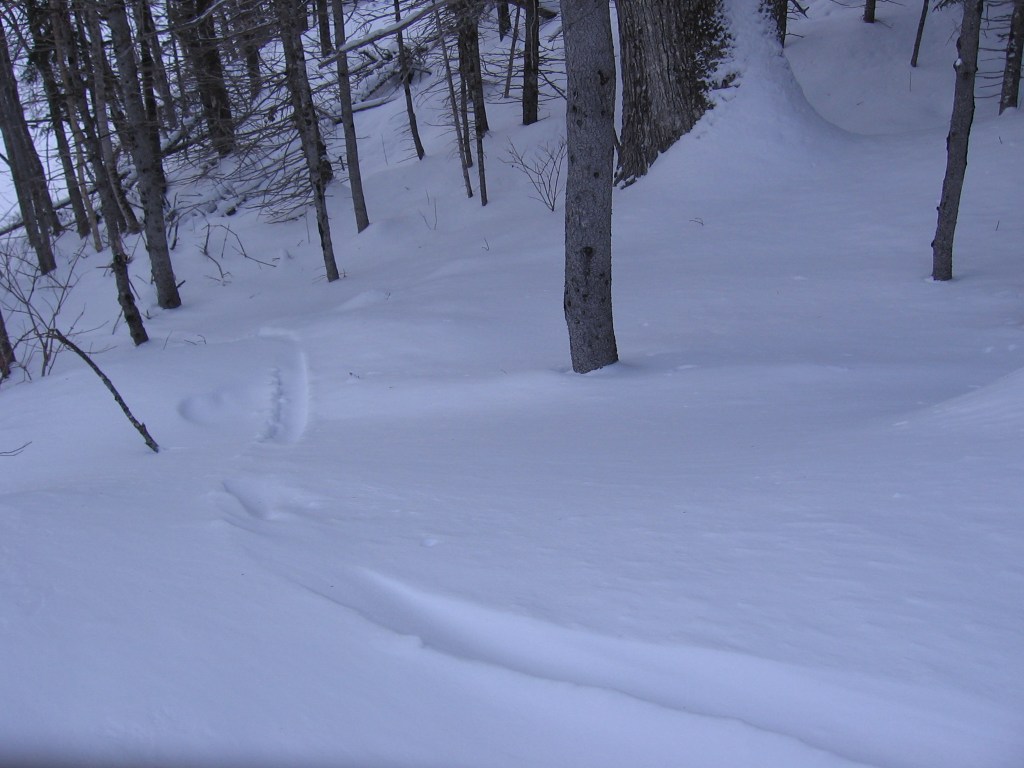
What a great way to finish up the season, right? Wrong. Of course I had to try to squeeze in just one more snowshoe before the snow disappeared. A couple of days later I set off with hope in my heart, detouring to take the track photos before heading off in the opposite direction, away from the river. It wasn’t a complete loss. I did see the tracks of a mother moose with her yearling, and a depression left by a sleeping moose. But I also had to snowshoe across moss and grass, jump over streams of snow-melt, and detour around puddles to get back onto the icy snow crust. April and the Albedo Effect was in full swing, even though it was only mid-March. It was my one-too-many snowshoe hike.

Dark late-day photo, but Moose had a snooze here.

I’ve done ‘one-too-many’ snowshoe hikes so often that it has become a Rite of Spring. A fantastic snowshoe must be followed by a rotten one. Sometime literally. When deep snow rots from below, I might break through up to my knees, as described in April – Awful or Awesome?

So why do it? Why not end on that perfect note, that ideal snowshoe? I can trace the whole one-too-many business back to 2019. I had a sublime snowshoe one brilliant blue-sky afternoon at the end of March. I’d seen lots of animal signs and enjoyed views of two waterfalls. I paused on a hilltop and looked back across the expanse of pristine white snow, shining under the sun and stretching to the next hill. I felt a deep sense of belonging, of being in the exact right time and place in the universe.

The snow had started to rot in the woods, but I couldn’t resist going again the next day, trying for just one more day of bliss. Hardly bliss. The conditions were atrocious. I tried an old wood road to the ocean, I tried through the woods to the river, but everywhere I went I kept breaking through the rotting snow. It was all frustration and no fun. I cursed myself for not having the sense to finish the season on a high note. But later I realized that ending on a sour note wasn’t all bad. It meant that I had pushed the season to its limit and a bit beyond. There was no second-guessing if I coulda/woulda/shoulda gone out one more time. And the one-too-many didn’t tarnish my memory of that perfect, penultimate snowshoe.

After my one-too-many snowshoe this year, I washed the mud off my snowshoes (no lie!) and stored them away. Why so reluctant to call it quits? Partly because now there is a pause. There is too little snow to snowshoe, but too much to bushwhack through the forest. So now I wait. And wait. Until the snow melts enough to swing into – spring hiking!

Spring Hiking Season

I don’t really ‘hike’ so much as mosey through the forest, bushwhacking up and down the highland slopes. I follow freshets and brooks flowing from the highland plateau, linger in hemlock stands, and watch waterfalls tumble down. I explore new places and revisit to my special spots, as described in The Humbled Hiker.

I head for the hills as soon as the snow melts. I live and play in a mixed forest, so there is a time before the trees leaf out at the end of May that is ideal for exploring. The lack of leaves allows for more open vistas, better ocean views, and easier route-finding. But before the veil of leaves appears, a spring scourge drops the curtain on my spring hikes. I jotted down these notes a few years ago:

One Too Many Spring Hikes

“I went on ‘one too many’ hikes the other day. I realized it as I was beating off black flies during one of my Highland explorations. The black flies won this bout, and even the dreadful DEET didn’t stop their frenzy. The plan had been to climb part way up a ridge to a hemlock stand, and see how far I could traverse along that slope. I aborted my plan once I reached the hemlock stand. I just wasn’t having fun anymore.

I enjoyed the ocean view – briefly – and the towering hemlocks – briefly – and then made my way down slope and out onto the cutline where the gusty southwest winds kept the little buggers at bay. I set out on this walk somewhat tentatively. The flies had exploded a week earlier and were annoying on a couple of previous treks, but not enough to spoil the walk.

In fact, my previous walk to a waterfall had been delightful. There were flies, here and there, and it wasn’t a good time to linger by the water, but it was worthwhile. So why not end on that high note? Because fomo. Fear of missing out on one more wonderful walk in the woods. I didn’t regret my last bushwhack, even though I had to flee from the blackflies. That one-too-many hike confirmed what I had suspected: Time to stash away the hiking gear.”

So there you have it. If a lack of snow marks the end of snowshoe season, an abundance of black flies has me fleeing the forest each spring. They breed in fresh running water – abundant on the highland slopes – and usually emerge in mid-May. I find the wee pests so distracting that it’s hard to focus on my footing, which is dangerous as well as frustrating. As my notes suggest, I’d had a wonderful walk to a waterfall that would have made for a grand finale, but I just had to push my luck.

As with the end of snowshoe season, there is a hiatus after spring hiking. The black flies are biting but the ocean is still frigid – and it takes a long, long time to warm up. So I must bide my time before I can dive into …. swim season!

Swim Season

Ah, summer in Cape Breton. We are blessed with an abundance of places to swim: lakes, rivers, and ponds galore – including my own L’il Pond (Swimming with Frogs). But my favourite place to swim is the ocean. And by ‘swim’ I mean being immersed in water. I might swim a few strokes, then roll over and float on my back and gaze at the clouds bobbing by above. Or I might do a little bobbing myself, gently rocked by the waves while I watch the terns and gulls and gannets. I’m a prairie girl who fell in love with the ocean and I feel happiest when I’m held in her briny embrace.
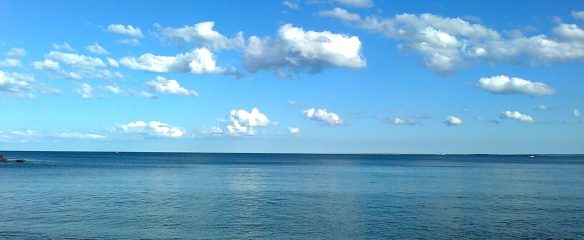
Dive into blue bliss!

Summer is sun, suds, sand, swimming in the salty sea, and a smiling Sue. The perfect beach day is hanging out with friends, going for a swim, drying off in the hot sun with a cold drink, then diving back into water. Repeat.

One Too Many Swims

Unlike snowshoeing or hiking, there can be one-too-many swims in a single day as well as a season. The water is so tempting and the air so warm, but that last swim of the day can be a bit risky. The air temperature drops abruptly when the sun drops behind the highlands. One swim too many and I might get … the dreaded chill. Cold that gets so deep into my bones that there’s only one cure. I have to go home and get immersed again – in a nice hot bath.

Swim season in Cape Breton is sweet but vanishingly short, which is why I try to get in the water every day that the weather allows. That’s also why I push the season and end up diving in one-too-many (or even two-too-many or three-too-many) times, because it’s a long while before beach season rolls back around. Here’s a (lightly-edited) passage from my diary dated Sept. 15th, 2023. (Mervi is my beach buddy (pictured above) who is a glass blower, which is very hot work.)

“Went for a beach walk and to see waves ahead of (tropical storm) Lee. Wore tights and a cotton shirt but threw in my swimsuit and towel in at last minute. After walking in the tidal wash I felt quite warm and a couple of tourists were in the waves. It was cloudy but warm and humid. Tourists said they felt fine getting out, so after they left I put on my swimsuit – still damp from previous swim – and immediately felt chilly. Considered putting clothes back on but opted to wait for Mervi. She was hot from glass blowing and went right in. I waded out but a biggish wave soaked me almost to my neck so, after hesitating, I dove under and floated a bit cuz probably final swim.

Got out and brrr – cold. Needed to get out of wet swimsuit. Tried to wrap a towel around and change back into dry clothes but skin so clammy I couldn’t really get really dry … everything sticking and icky … I felt all chilly and clammy and sticky. Yuck! Wished I hadn’t gone in. But it was okay, I told Mervi, because this had been my one-too-many swim.”

Swim season is the hardest one of all for me to let go. And sometimes we do get a surprise blast of heat late in the season. But there comes a time when the heat has gone out of the air and the ocean is cooling down. A time to rinse out of all my beach gear and store it away, to accept that swim season is over for another year.

Just as a day at the beach must end, so swim season must come to an end.

The consolation is that there isn’t any waiting around for the next fun activity to begin. Just as the ocean turns grey and cold, the forest begins to glow with red, gold, yellow, and orange. The autumn woods are warm and welcoming, blazing with colour and fecund with fungi. Fall hiking season begins when swim season ends, and carries on through November, as I wrote in my very first (and very short) blog Bared Trees and Barred Owls. But one day the snow will fall and stay put, hiding all the hazards underfoot. Then it’s that in-between time again – too much snow to bushwhack but not enough to form a good base for snowshoeing. It’s time to wait for more snow so the seasonal cycle can start all over again.

One Too Many and Me

This one-too-many thing is a sign of my reluctance to switch gears. Even if that means shifting into neutral and idling until I can start my next fun outdoor activity. But doing something one-too-many times is also a strategy of sorts. It’s a way of forcing me to face the facts, ma’am – this season is over.

If the ideal snowshoe, hike, or beach day is a perfectly-crafted sentence, the one-too-many day is the period that ends the sentence and closes out that chapter. For me, one too many is just about right. Happy April everyone!

Sue McKay Miller
April 6th, 2025
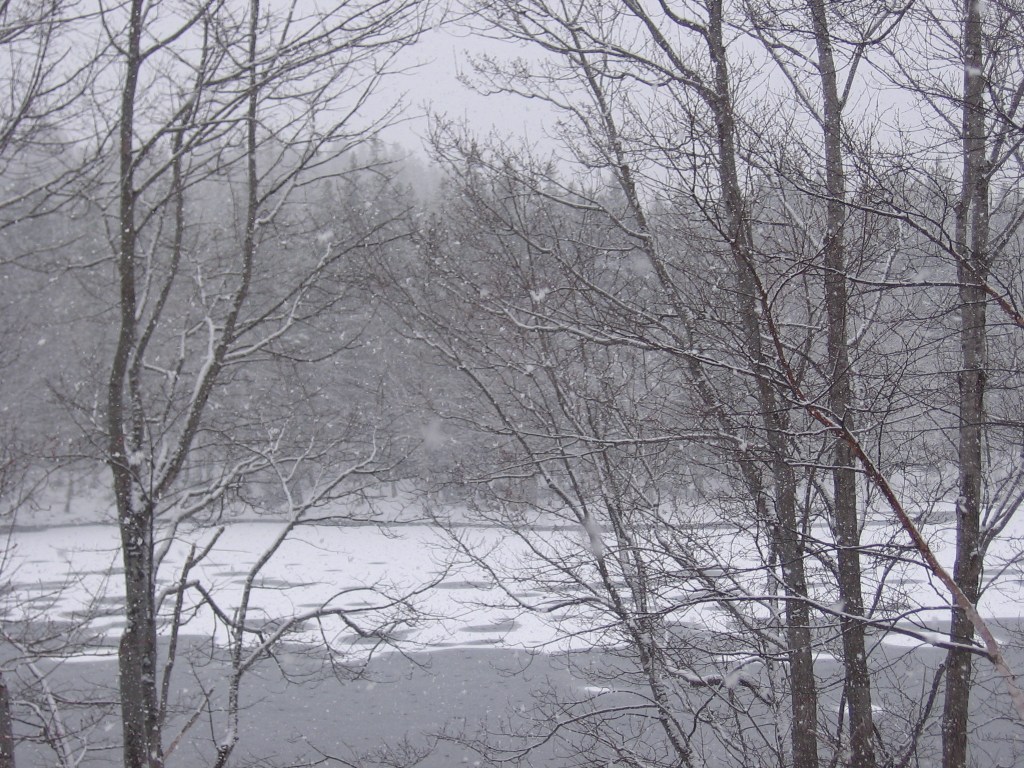
Winter Wonderland in April. We’ve had three-too-many of these this past week!

Meet the Mystery Mammal

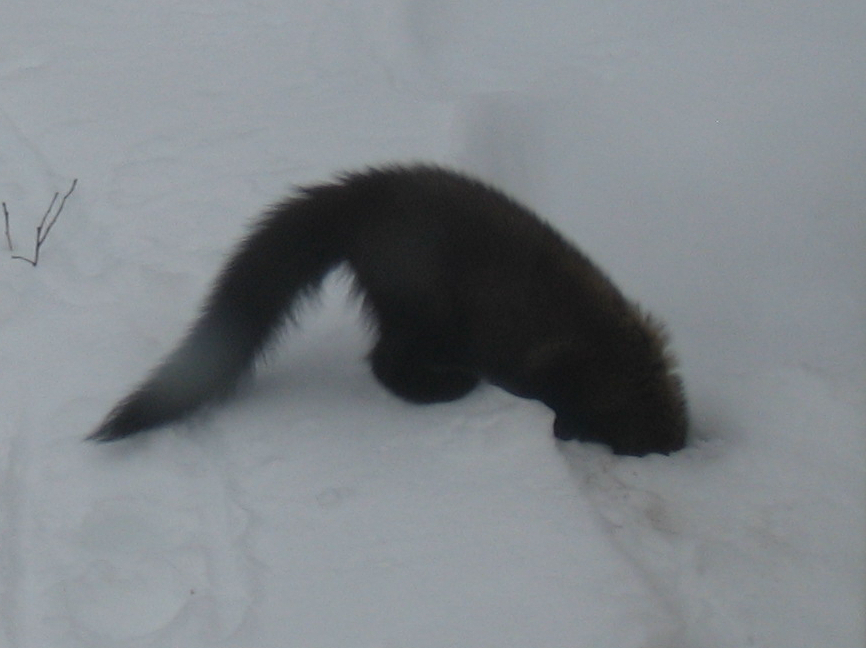
Last October I introduced you to a few of My Wild Neighbours. This month I want to focus on a newcomer to the neighbourhood, first encountered in April 2020. The tale begins with a tail: a long, round tail attached to a long-bodied, short-legged critter diving over a roadside snowbank. I only saw the backside of the furry animal, but the size and shape and that long round tail suggested an otter from the nearby river.

A few days later I was snowshoeing through old spruce forest and saw some unusual tracks. In The Secret Lives of Animals I wrote about my favourite winter activity: following animal tracks on snowshoe. Tracks tell me who is out and about and where they go on this land we share. I’d been following tracks for some 15 years at that point, so I was familiar with the usual suspects. And these weren’t any of those.

Hmm … Who have we here?

I recalled the otter-like animal I’d diving over the snowbank. Otters are water weasels. When they visit, they slide along on their bellies, leaving distinctive grooves, and head straight for the pond, dipping under the ice into the frigid water. These strange tracks were in a dense stand of trees up beyond the pond. And not a belly-slide in sight. I began to wonder if there was a new kid on the block.

Otters like water!

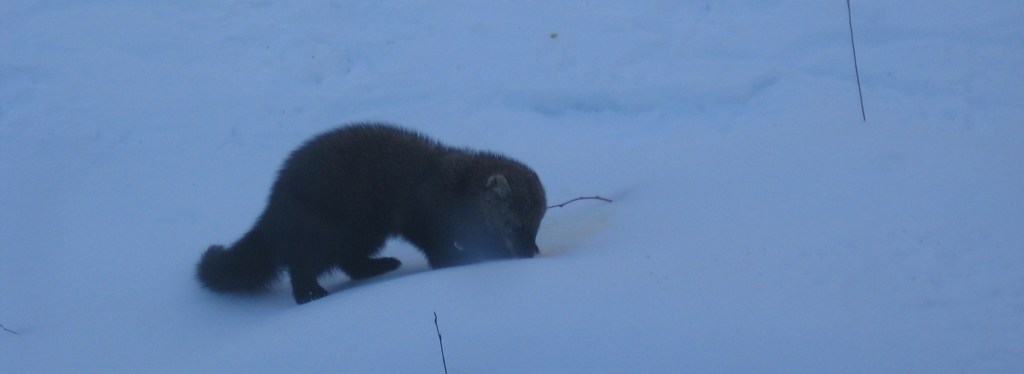
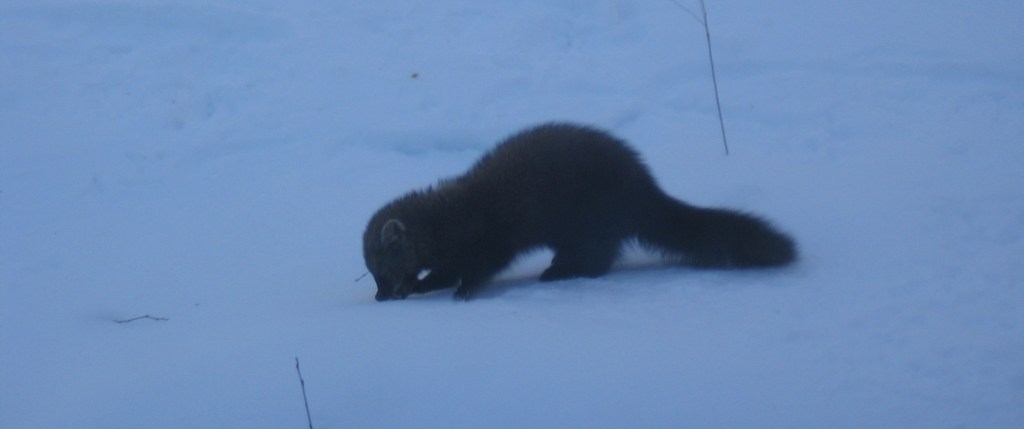
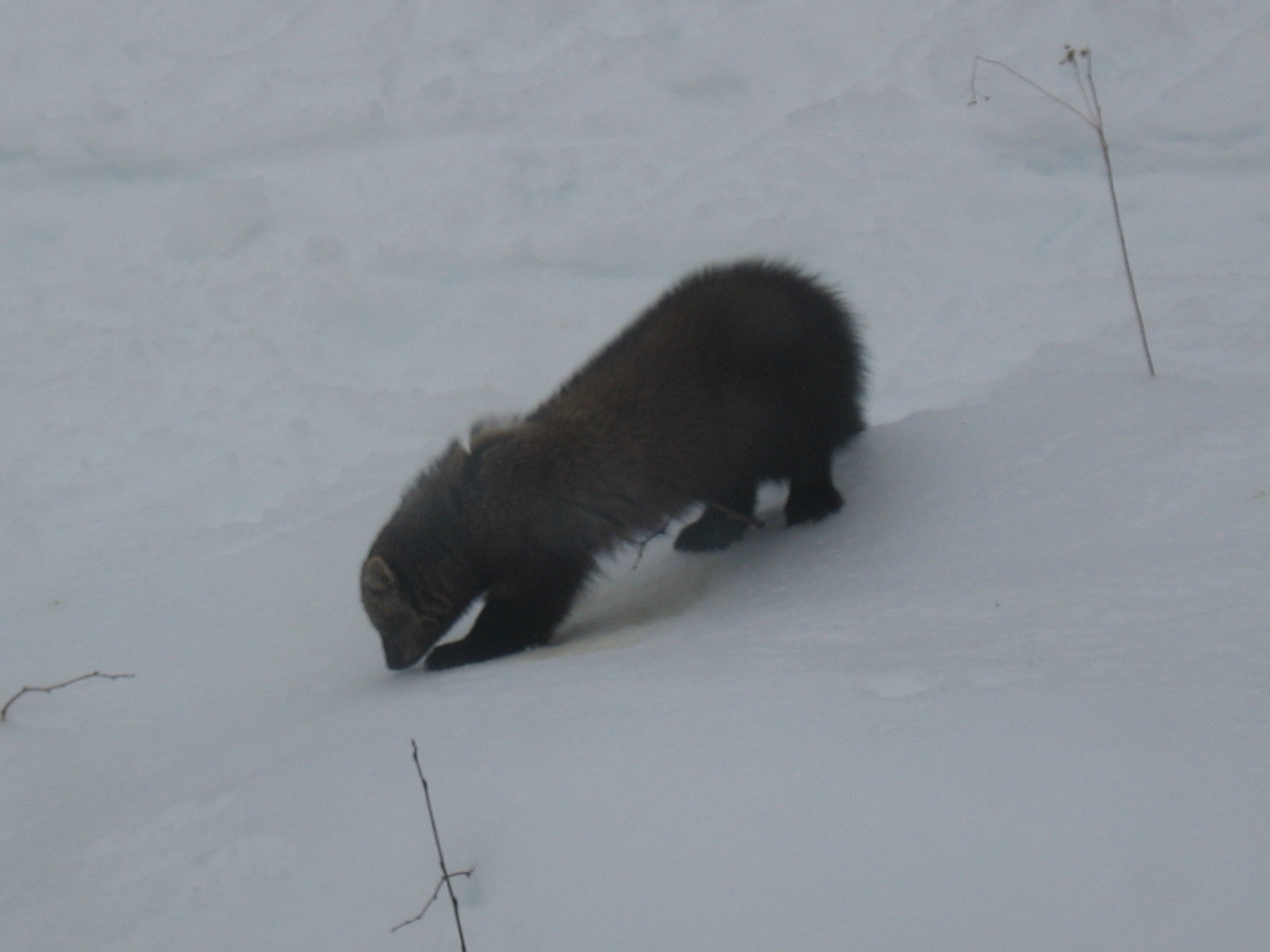
I soon found out. I was lingering over coffee on a sunny Easter morning and looked out the window. An animal was loping along on the far side of the frozen pond, very dark against the brilliant white snow. I grabbed my binoculars and got a good look. My suspicions were correct: It was a fisher! He – or she – did a circuit all the way around the pond before heading up into the woods.

Now this was exciting! I’d seen a wide variety of mammals in the Holler over the years, but this was the first time I’d seen a fisher. What a thrill, after so many years, to see a critter for the first time! Later that afternoon I was bundled up, sitting outside. I heard the strangest sounds coming from the woods on the far side of the pond. My go-to animals when I hear weird noises are crows – they have an astonishing repertoire of vocalizations – but this didn’t quite fit the usual cacophony of a crow mob.

Mystery solved a moment later. A fisher came barrelling out of the woods onto the ice with a second fisher hot on its heels and making those bizarre growly sounds. Growly chased the other fisher across the pond and up into the woods. A minute later he came back down, loped back across the pond and headed back up into the forest. A very exciting Easter Sunday here in the boonies!

(Above photos taken in 2021)

Fishers are members of the weasel family (Mustelidae) which includes otters, minks, martens, and ermines, plus off-island species such as skunks, badgers, wolverines and other weasels. The name fisher is misleading. Unlike their water-weasel cousins, otters and minks, fishers rarely fish. These carnivores feed mainly on hares, rodents, grouse, and, alas, the occasional small pet. We don’t have porcupines on Cape Breton Island, but mainland fishers hunt these prickly prey. Fishers prefer mature forest habitat and are remarkably adept tree climbers. Like all members of the weasel family, fishers are fierce and punch well above their weight.

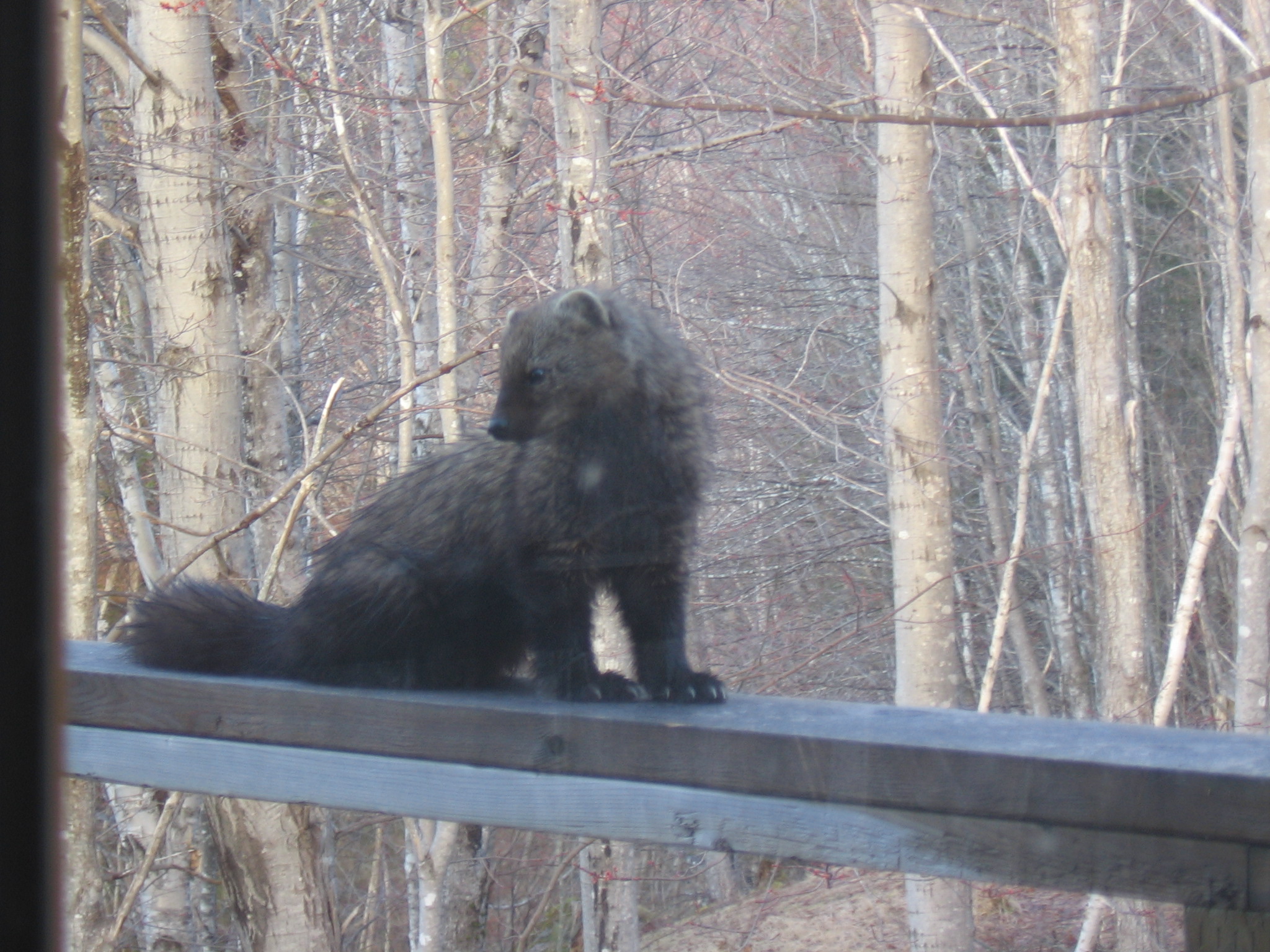
Don’t mess with this character!

Those first sightings were in April, 2020. Fast forward to winter 2021 and once again I strapped on the snowshoes and began checking out local animal tracks. In February I posted a photo of some mystery tracks in The Secret Lives of Animals. The snow was too soft to form a clear impression, but I found other mystery tracks soon after, possibly from the same creature. After that I started seeing these new tracks all over the place – near the house and through the woods and all over the pond. As you can imagine, I had my suspicions as to the likely culprit.

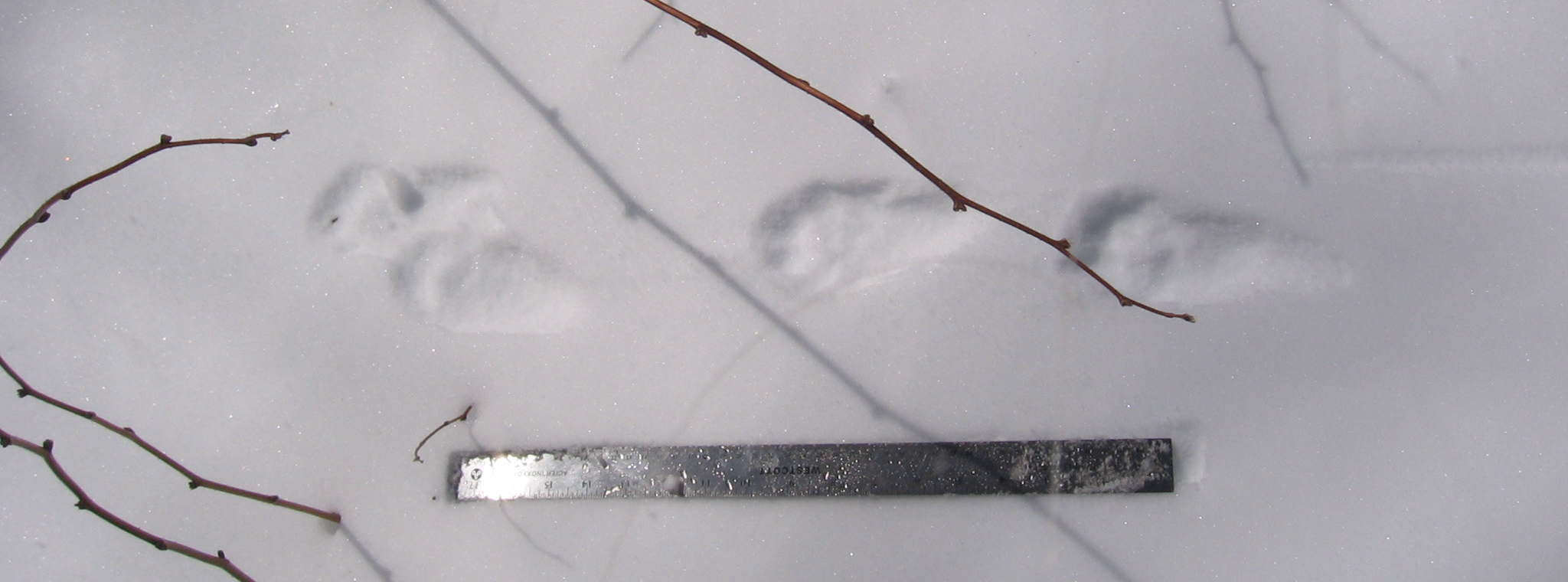
And what about these? Tracks can look very different, depending on snow conditions and gait. When the hind foot steps onto the forefoot track, it can alter the shape. Very confusing.
Running track typical of weasel family; hind feet register in the front tracks. (Ruler is 46 cm/18″)

A track is evidence but a sighting is proof. One day I looked out and there he was, poking around in the snow beside the house. My compost pile is under there so he may have been rooting for root veggies. On the other hand, the local squirrels have a network of snow tunnels there too, so he may have been hunting something more appetizing than rotten banana peels.

Like coyotes and other carnivores, fishers patrol large territories. Based on all those tracks I’d been seeing, it looked like my home was smackdab in the middle of this fiesty fellah’s new territory. (After seeing Growly in action, I’m going with ‘he’.)

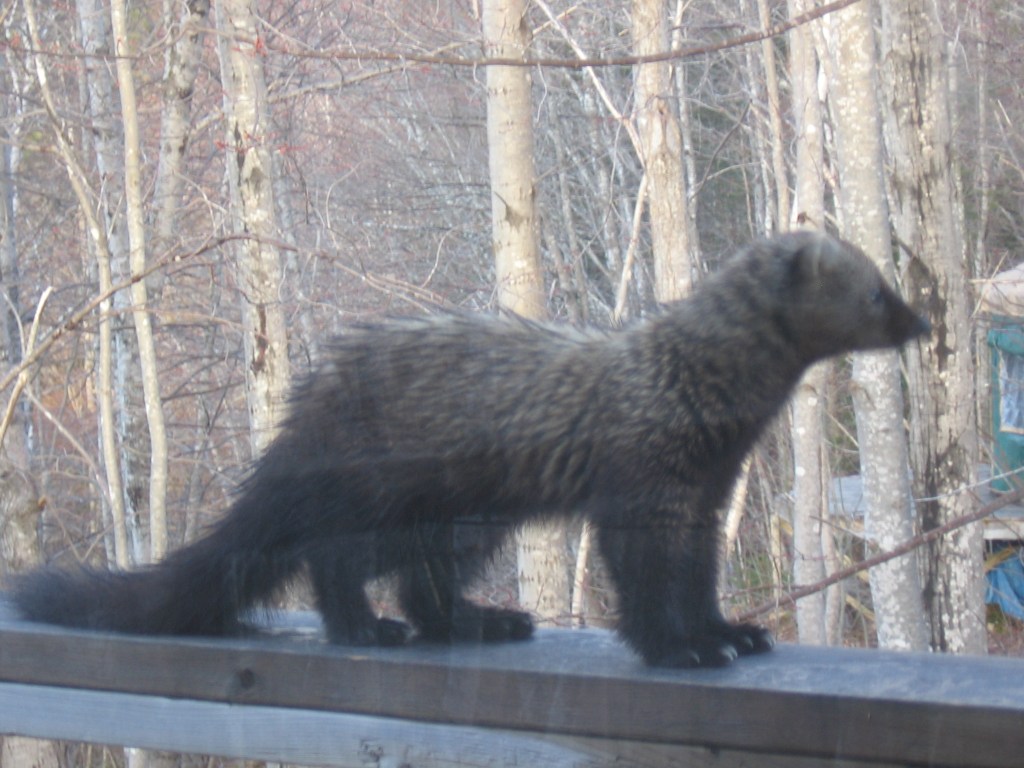
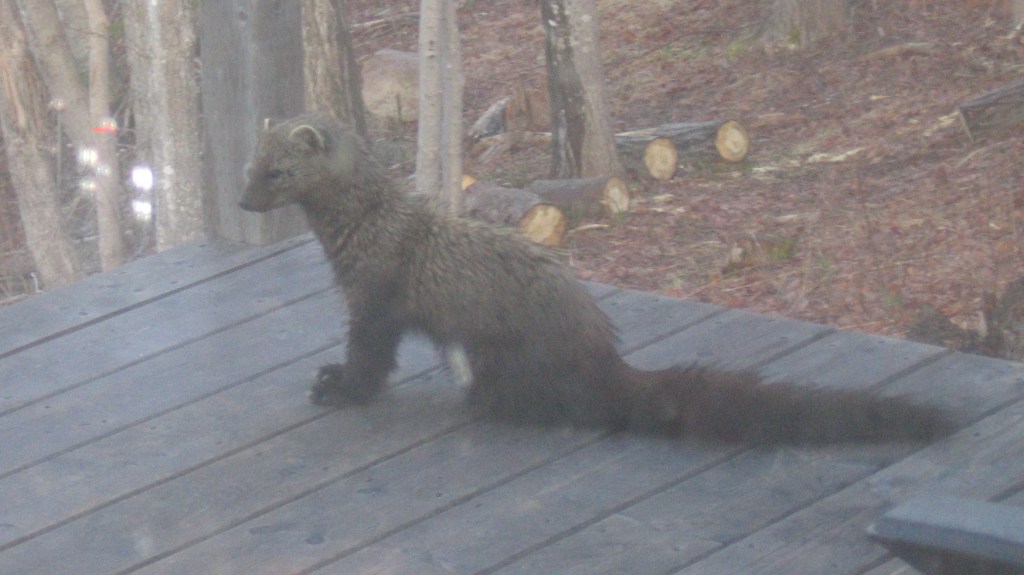
My new neighbour had no qualms about inviting himself right up onto my deck. I think these predators, like Ollie the barred owl (Hoots in the Holler) and the great horned owl (My Wild Neighbours) like my deck for the same reason humans like hunting blinds in trees – all the better for spotting prey. Plus fisher’s nose may have led him up onto the deck after squirrel’s scent, since squirrel seems to think I built the deck purely for his pleasure. One thing for sure, fisher is just as able to climb posts and trees as his wily prey. Watch out squirrel!

Fishers, known locally as fisher cats, are not unknown in this area. Some of my neighbours (the human ones I mean ;-) have seen them now and then, but they aren’t common. It does seem that there have been more frequent sightings of fishers around the island lately, so perhaps they are making a comeback. (Fishers virtually disappeared from Nova Scotia about 100 years ago due to trapping and habitat loss but were reintroduced to the eastern mainland in the 1960’s.) Or, as someone suggested, maybe we are seeing more fishers around because ongoing clearcutting is forcing them to find new territories. The current population and status of this animal seems to be yet one more mystery.

So now here we are in 2022 and it’s snowshoe time again. I haven’t seen a fisher-in-the-fur lately, but I have been seeing tracks in the woods and on the frozen pond as fisher prowls his territory. He’s not a mystery mammal anymore, or even the new kid on the block. He’s just another one of my wild neighbours, hanging out here in the Holler.

Sue McKay Miller
January 31st, 2022

p.s. Please share your own fisher sightings and observations in the comments. As always, I welcome any corrections or additional information – I’m still learning!

Just moseying across the pond.

The Secret Lives of Animals

One of my favourite winter activities is following animal tracks on snowshoe. The rest of the year we might see occasional animal signs: scat, browsed twigs, tracks in mud, scrapings and scratchings. But snow opens up the animal world like a book. Tracks tell tales: which animals are out and about, where they travel, how many, how often, how fast. When it comes to reading these signs, I am very much a novice, but just as a child learns to read ever more complex books, I learn to read the woods a bit better each year.

Over time I’ve learned to identify tracks from the usual suspects: coyote, snowshoe hare, red squirrel, ruffed grouse, deer, crow, and, of course, the unmistakable moose. But I’m often stumped as to how many animals. Do four sets of coyote tracks mean four coyotes? Or two passes by a pair? Or a lone coyote making multiple passes? This is especially tricky if the direction of travel is obscured in soft snow. Is this coyote coming or going? Half the time I don’t know if I’m coming or going.


As for coyote comings-and-goings, tracks taught me that the resident coyotes use predictable routes. One or two sets of tracks frequently crossed my drive at the same place, passed through the woods onto a trail, and followed the trail to the far side of the pond before veering back into the woods. The coyotes routinely traveled that same route, scouting their territory, marking it in the same spots.

No need to call in CSI to see who killed this ruffed grouse, aka ‘Mr. Partridge’. The culprits left their footprints all over the scene. This is clearly the work of the Coyote Gang.


My familiarity with the usual suspects helped me spot some not-so-usual tracks last winter. I was snowshoeing through old spruce forest when I spotted some tracks I’d never seen before. I had a suspect in mind (I’d glimpsed the backside of an animal a few days earlier) and my suspicions were soon confirmed. One morning I saw a fisher loping around the perimeter of the frozen pond. Later that day I heard a bizarre squabbling noise in the woods across the pond. A fisher emerged from the trees and dashed across the ice followed by a second in snarling pursuit. It was my first (but not my last) sighting of the makers of that new-to-me track.

Hmm … Who was here? These mysterious tracks were soon identified.

Otters are close kin to fishers (both are members of the weasel family Mustelidae and are a similar size). These ‘water weasels’ are by far the easiest and most fun animals to follow. I first came cross a strange groove in the snow years ago and followed it through the trees. The groove slalomed downslope among the spruce, dropping in and out of a tree well, then out onto the pond where it vanished beneath a crack in the ice. I backtracked the trail through the woods and saw that even on the flats the otter will run and slide, run and slide. The trail led through thick brush where I couldn’t follow, but it was as easy as ABC to keep track of that distinctive groove, all the way back to the river. Whenever I see an otter’s slide I feel a vicarious sense of fun.


Tracks are only part of the tale revealed in the snow. Detailed depressions, including hair imprints, show where a moose and her calf lay. One snowy winter even long-legged moose’s belly dragged through the snow. A drag mark between fox’s tracks hinted that she snagged a hare for supper. The snow can tell a tale of a hunt or a chase or a crow landing and flying away. And squirrel keeps popping his head out of snow tunnel openings like a living whack-a-mole – perhaps the very squirrel that used a snow tunnel to evade an owl? (see Hoots in the Holler) Tunnels beneath the snow provide cover and also warmth, the snow acting as an insulating blanket, for mice, voles and other wee critters.


Field guides are great, human guides are better, but the best way to learn a track is to see the animal lay it down, and, once they are safely out of the area, have a look. One winter I spotted a bobcat trotting just below my house. She’d no sooner disappeared into the trees when a second one showed up, hot on her heels. Once they’d gone about their bobcat business, I checked out the tracks. There was the round pad (coyote tracks are similar in size but more oval) but I also saw distinctive claw marks, contrary to field guide descriptions. In that case, crampon claws kept the cat from slipping on an icy slope.

This was taken along my driveway on a different winter. I do believe a bobcat was following in my footsteps – literally.

This has been an odd winter in Cape Breton (gives a whole new meaning to ‘Dry January’, eh?). But after a couple of snowfalls in February the landscape finally looks more wintery. One sunny afternoon I schlepped around the Holler and saw tracks galore on the crusty snow. I’d been feeling like it was just the squirrels and me out here, but, as always, the snow revealed that the wild ones are far more abundant and active than we realize. Amongst a plethora of coyote, hare and squirrel tracks, one mysterious trail had me absolutely stumped (below left). If you have any ideas on this – or any other – track, please leave a comment below.

This month’s blog just scratched the surface (hee hee) on the topic of tracks but I’ll leave it there for now. It snowed last night and I see fresh tracks over on the hillside. Time to strap on the snowshoes and see who’s out and about in the neighbourhood.

Sue McKay Miller
February 26, 2021

HOLD THE PRESSES! I did have a look at that fresh track yesterday afternoon and guess who? Otter had dropped by, sliding all the way from the top of the hill to the pond. Sometimes life is just too funny.