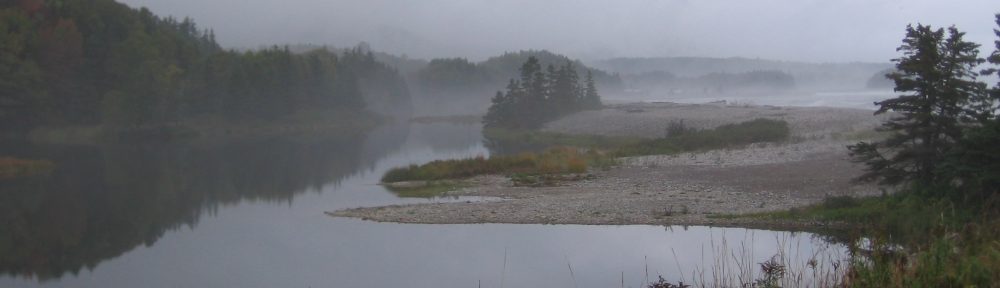
Back In 2013 I entered a ‘CBC Writes’ contest called ‘Hyperlocal’. To enter, contestants had to write a short personal essay on their neighbourhood. Since I live in the woods, I submitted an essay entitled My Dying Neighbourhood. It wasn’t about urban decay or life in a ghost town, but rather the devastating impact of the spruce bark beetle on the surrounding forest and my neighbours, the trees.
I’m revisiting this topic over a decade later because things have changed since then. A forest is a living dynamic ecosystem. It is a place of continual birth, death, transformation, and regeneration. In this blog I revisit my dying neighbourhood and show what has happened since I first penned those words and took those photos. The essay is also posted on my website under Articles and Essays, but I’ve copied it here verbatim, including the preamble, so you don’t have to hop about.
My Dying Neighbourhood
I submitted this essay to the CBC Canada Writes contest called Hyperlocal. It was awarded a gold star as ‘Editors’ Pick’ of the day. In grade 2 I was in fierce competition with Cindy Egbert to get the most gold stars for spelling, so I was rather chuffed.
My neighbourhood is a forest on Cape Breton Island, and it is dying. The trees that are my nearest neighbours are dropping dead at an ever faster rate. A walk through the woods reveals the carnage – standing tree trunks ending in exposed jagged shards. The toppled crowns lie strewn on the forest floor or lean against ailing neighbours. When I first walked this trail a dozen years ago, the tall white spruce rising high overhead created a cool shaded passage that felt like a cathedral. Now my cathedral is a graveyard and deadfall blocks the trail used by moose, coyotes, bears and me. Each freshly fractured tree stabs at my heart. And sometimes, when a tree falls in the forest, I hear. A crack like a rifle shot, a thud bouncing off the Highlands and echoing across the pond.
When I look across the pond to the hill, deep conifer green is peppered with the stark grey of the standing dead. The pace of decimation is breathtaking. My towering neighbours are under attack by a bark beetle the size of grain of rice, and they are losing.

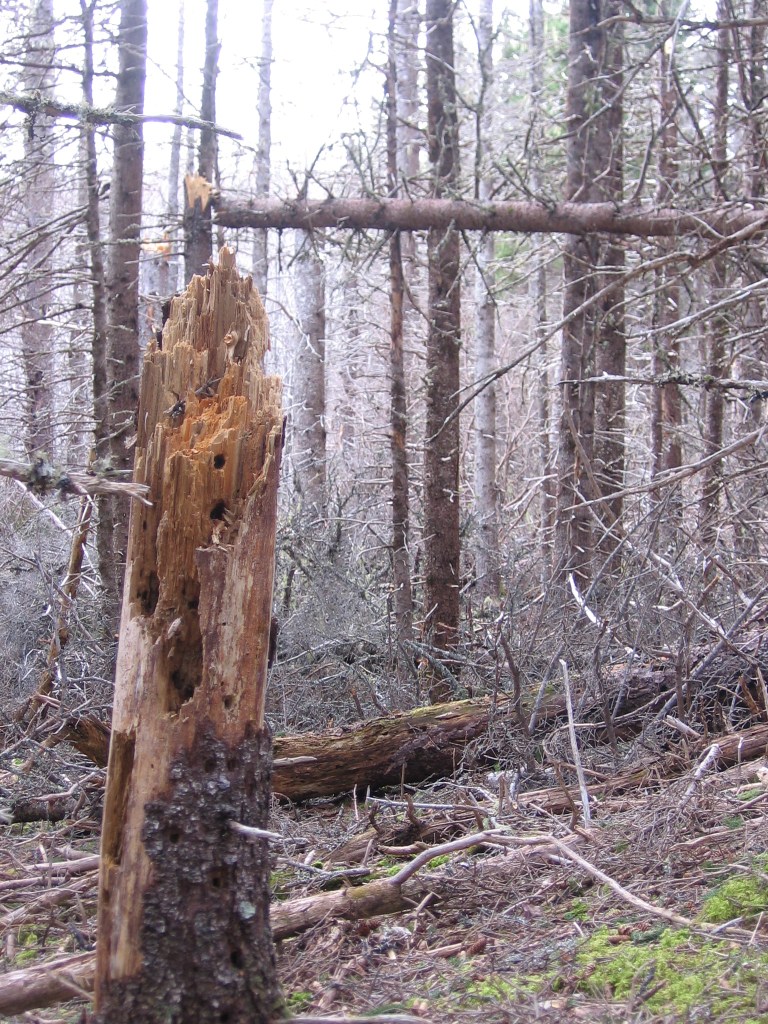
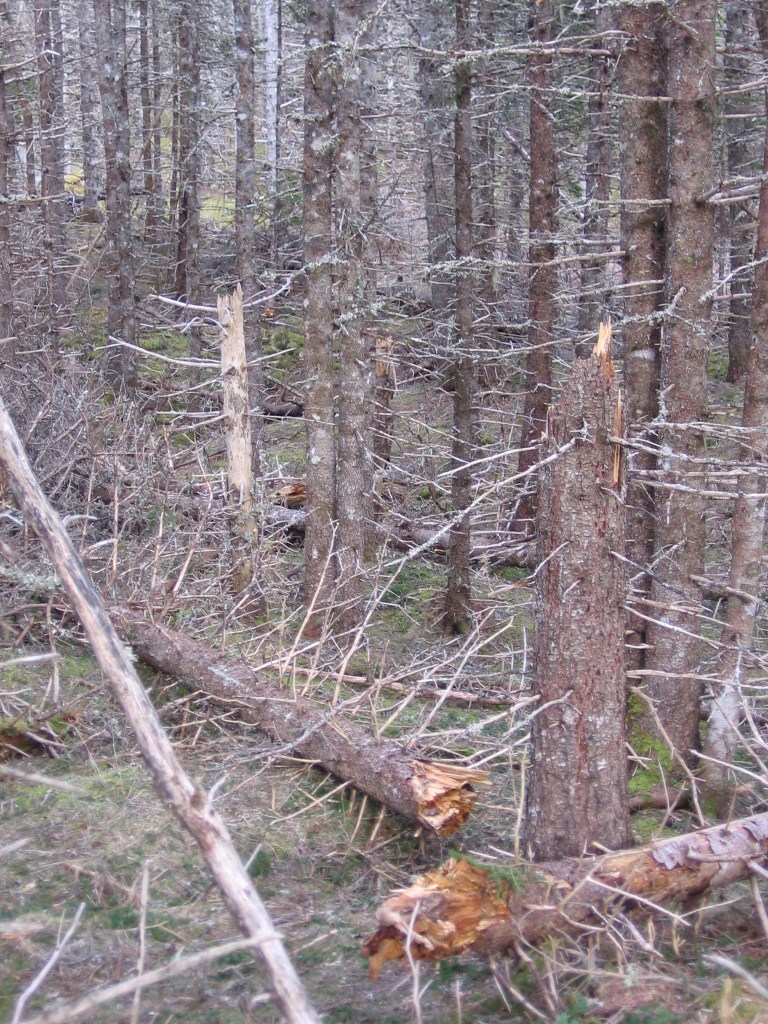
This is only the most recent change in my neighbourhood. When this land was reclaimed from the glaciers it gave rise to a mixed Acadian forest of birch and maple, hemlock and pine. Scottish settlers cleared the trees and tried to coax crops from the rocky glacial till, but some fifty years ago they abandoned the hard-scrabble farms for greener pastures. White spruce sprouted like weeds, surrounding old apple trees and concealing the stone root cellars that bear witness to a more domesticated past. Now the spruce trees are growing old, and are, like all the aged – be they tree or coyote, man or moose – more vulnerable to disease and death.
My deceased – and diseased – neighbours are being reclaimed by the forest floor that birthed them. Gravity gradually eases the trunk into the ground as insects and fungi go to work. Moss draws a soft green blanket over the log as it disintegrates into the soil, forming an undulating forest floor. Some seeds sprout on the sunny, well-drained tops of these hummocks while others thrive in the cool shady moisture below. Newly created gaps in the canopy let the sunshine peek in for the first time in decades and birch and maple saplings take root and reach for the sun. The forest succession back to a mixed Acadian forest is underway. But I, alas, will not be alive to see it. I see only this dying. By the time this forest is transformed, my own body, like the spruce, will have returned to the elements. My atoms will disperse into air, water and soil, nourishing new seedlings, inhabiting roots and bark and leaves, cycling through life and death and life again. My neighbourhood is a forest and it is dying. Long live the forest.
by Sue McKay Miller
May 2013
So there you have it. The last bit sums it up: the forest is dying; long live the forest. Because in truth, it isn’t the forest that is dying, it’s the white spruce trees that once dominated this forest that are dying. The individual plants, fungi, and animals that inhabit the forest die, but the forest itself changes and lives on.
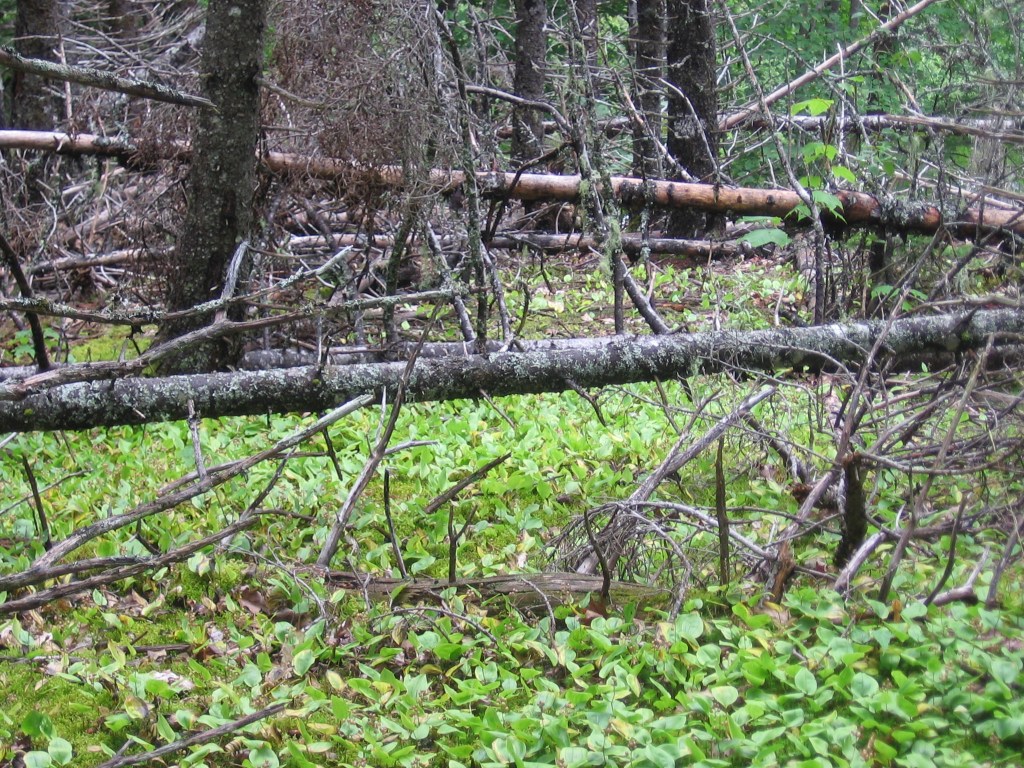

When I bought this land in 2003 I was already in my late forties. I assumed that the forest would long outlive me, that it would stay the same, changing only slowly over the course of many human lifetimes. But within five years of my arrival the spruce bark beetle began decimating white spruce trees in our neck of the woods. Milder winters (allowing more beetles to survive) and aging trees contributed to this rapid die off. Not only was the forest changing in my lifetime, it was changing month by month, year by year as spruce trees toppled like dominoes.
Bark beetles are small, the size of a grain of rice, and lay their eggs under the bark. The hatched larvae feed on the cambium, forming galleries that girdle the tree and cut off the flow of nutrients between leaves and roots, eventually killing the tree. The girdling can happen anywhere along the trunk, and trees break or even just bend at the point of infestation. Near the root, midway up, near the top. Spruce are shallow rooted and easily blow down in a fierce wind, but trees killed by the beetle have these tell-tale signs mid-trunk.
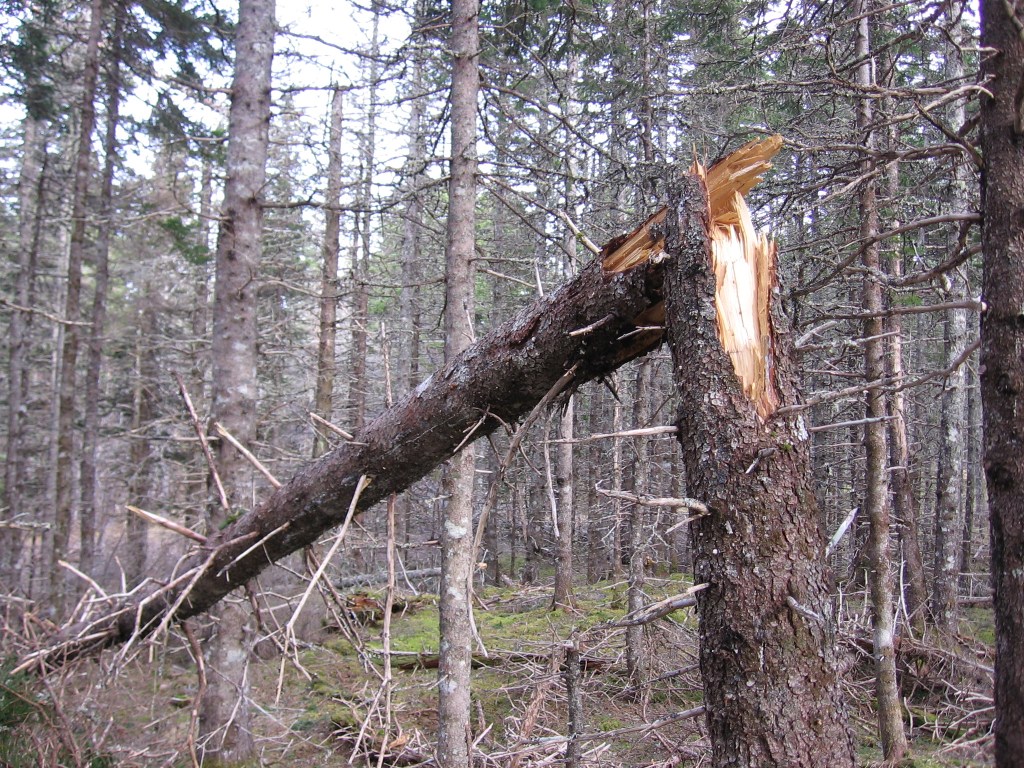
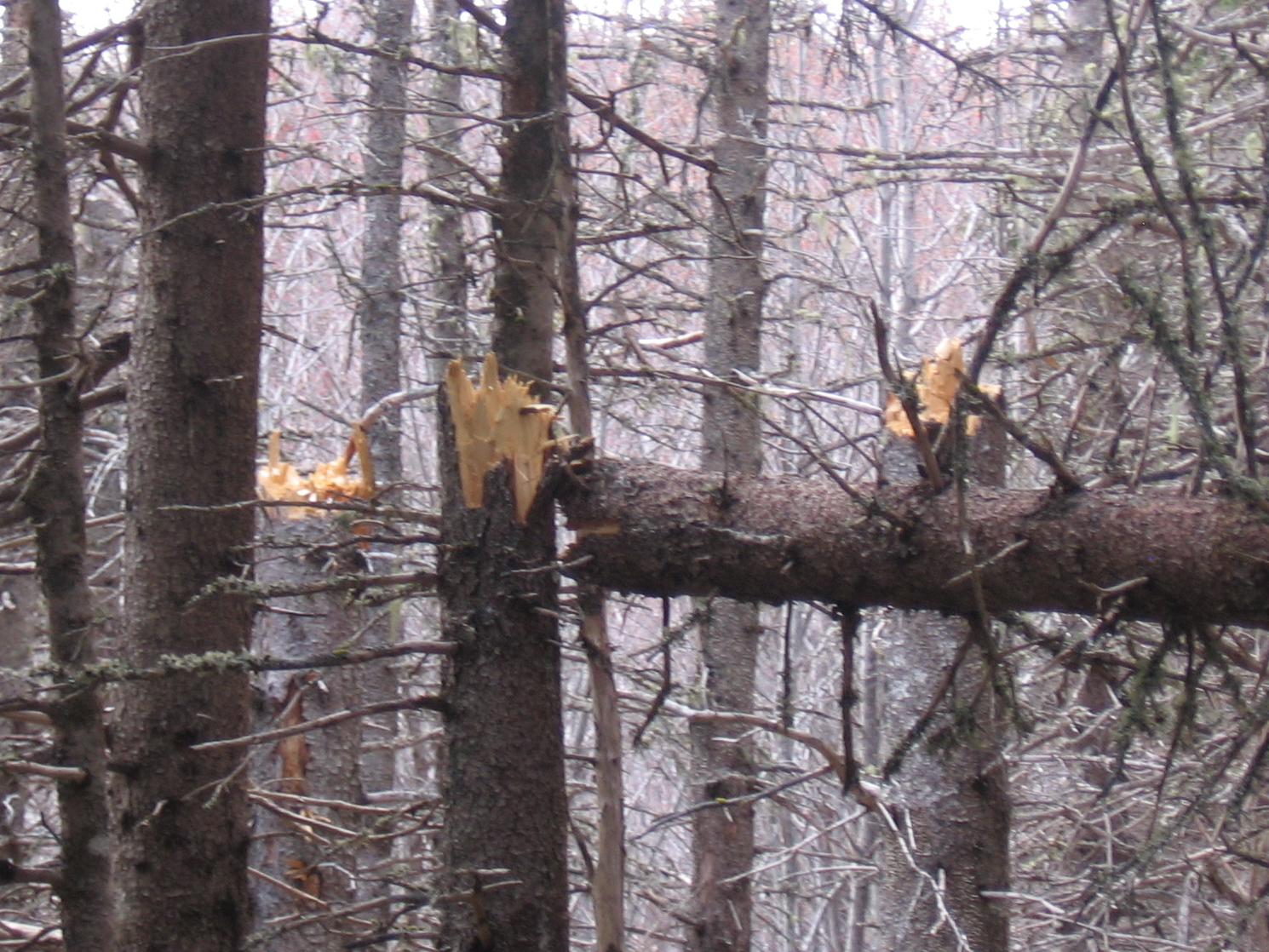
The dying spruce were falling across a path I named Tundra’s Trail after my dog. As I wrote in the essay, the trail once felt to me like a cathedral, with towering spruce shading a narrow dirt path. The path was well used, not just by Tundra and me, but by moose, bears, coyotes and other forest critters. Local coyotes routinely scent-marked a mossy mound and Tundra was always keen to check out the latest coyote news. But in 2008, shortly after my dear old dog died, I noticed the beginning of the spruce die-off. It accelerated rapidly thereafter.
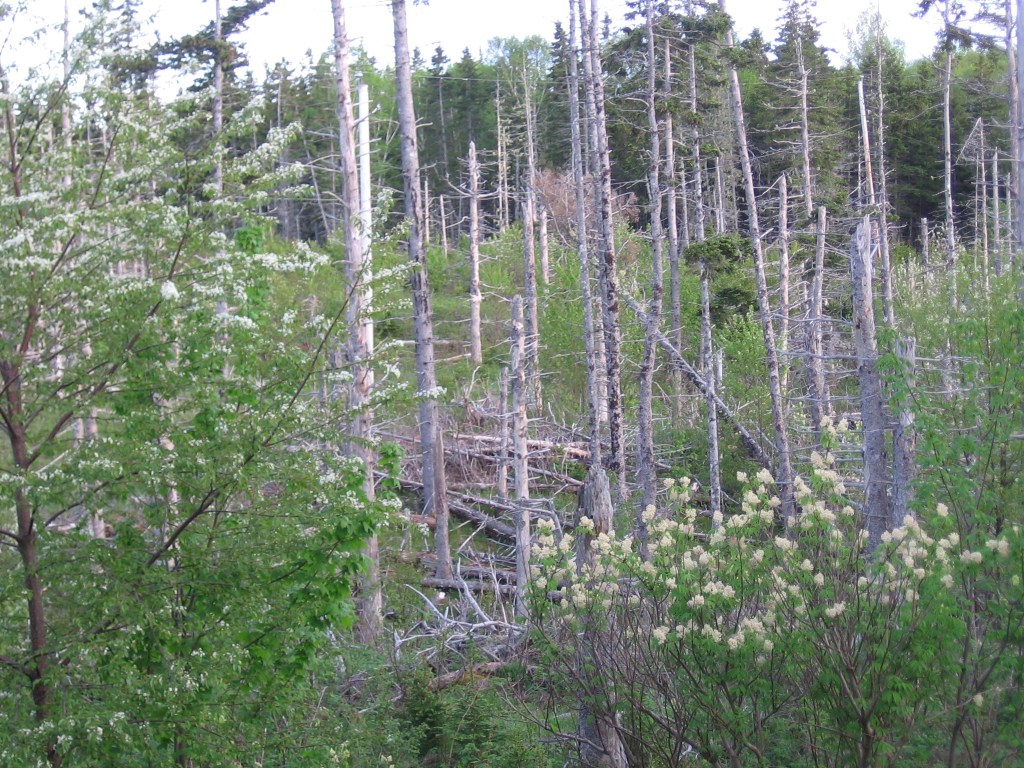
Dying and rotting trees were breaking off and blocking the narrow trail, with no easy walk around. So when a tree-cutting crew came to clear the route for my power line, I asked them to also clean up the area around the path. After they were done I could walk Tundra’s Trail again, but the once-shady path was bare and exposed, surrounded by stumps and dead trees. It was a sorry sight.


Right: Tundra’s Trail from the other direction, after the bark beetle die-off but before clearing.
But nature abhors a vacuum and plants will pop up like … er … well, weeds as soon as there’s a patch of sunlight. Pioneering plants rushed in and rose up rapidly, and one of those pioneers was the red elderberry. This fast-growing shrub grows up on disturbed land. Unlike black elderberry the raw fruit is not edible for humans, but it is enjoyed by birds, who return the favour by spreading the seeds in their droppings. The flowers begin as a tight purplish cluster that blossoms into a white cone and fills the air with a delicious scent. The flowers are enjoyed by butterflies, hummingbirds and humans alike.
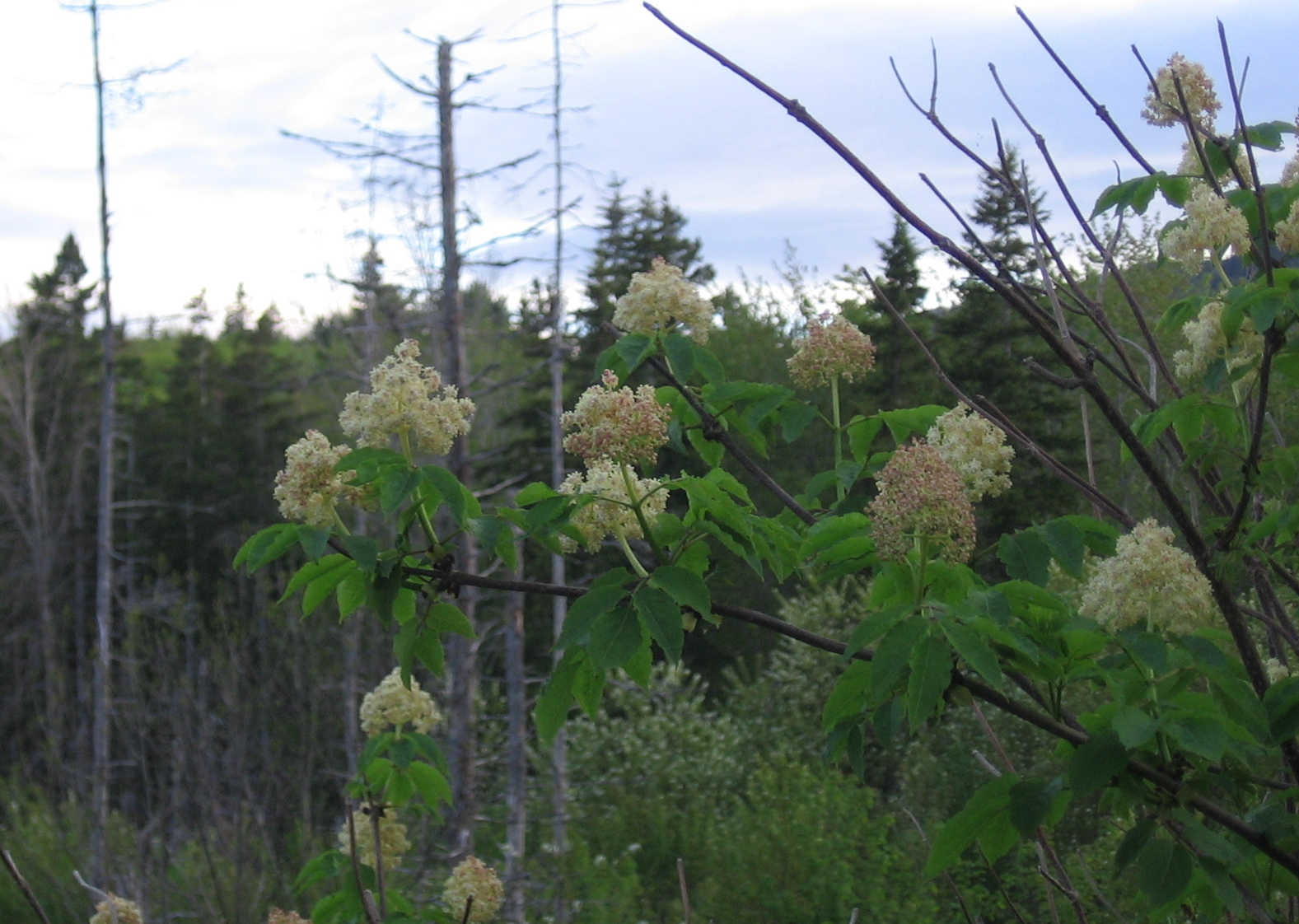
When I first saw the elderberries blossoming alongside Tundra’s Trail, I felt a rush of joy at the regenerative power of plants. A delicious scent filled the air, carrying with it a whiff of nostalgia. I was reminded of the scent of lilacs filling the spring air in Calgary, my hometown. The scent isn’t the same but both permeate the air with perfume. And although I prefer purple lilacs (or should I say lilac lilacs?), they can also be white, and those look similar to elderberry flowers. It was such a sweet gift from nature, these lovely fragrant flowering shrubs thriving in the sun, renewing the dying forest, reminding me of my childhood.


As the forest continues to evolve, other plants will grow up. Taller trees will seed the soil and sprout under the sun or in the shade. Birch and maple will thrive in the open gaps created by fallen spruce. Plants are persistent, survivors, relentless (just try to get rid of an unwanted plant – good luck!). As I wrote in Which Way is Up, a plant will do whatever it takes to reach the sun, even if that means growing down or sideways or in a crazy loop-de-loop.
Now we are past the summer solstice and the spring flowers have faded and died. But as we swing into a new season, fruits and berries are forming, bearing within them the seeds of new life. The circle continues. Have a happy summer!
Sue McKay Miller
June 27, 2024
 Sue McKay Miller